DEF 14A: Definitive proxy statements
Published on March 27, 2026
Table of Contents
☐ |
Preliminary Proxy Statement | |
☐ |
Confidential, for Use of the Commission Only (as permitted by Rule 14a-6(e)(2)) | |
☒ |
Definitive Proxy Statement | |
☐ |
Definitive Additional Materials | |
☐ |
Soliciting Material Pursuant to §240.14a-12 | |
☒ |
No fee required. | |||
☐ |
Fee paid previously with preliminary materials. | |||
☐ |
Fee computed on table in exhibit required by Item 25(b) per Exchange Act Rules 14a-6(i)(1) and 0-11 | |||
Table of Contents
Table of Contents

Notice of Annual
Meeting of Shareholders
To the Shareholders:
The Annual Meeting of the Shareholders of Southwest Airlines Co. (the “Company”) will be held on Thursday, May 7, 2026. The Annual Meeting will be a completely virtual meeting. You may attend the Annual Meeting online at the following website address: www.virtualshareholdermeeting.com/LUV2026 and by entering the 16-digit control number you received in the proxy materials. The Annual Meeting will begin at approximately 4:00 p.m., Central Daylight Time, with online login beginning at 3:45 p.m., Central Daylight Time, via a live webcast on the Internet.
The Annual Meeting is being held for the following purposes:
| (1) | to elect eleven Directors; |
| (2) | to conduct an advisory (non-binding) vote to approve named executive officer compensation; |
| (3) | to ratify the selection of Ernst & Young LLP as Southwest’s independent auditors for the fiscal year ending December 31, 2026; and |
| (4) | to transact such other business as may properly come before the meeting or any adjournment or postponement thereof. |
March 11, 2026, is the date of record for determining Shareholders entitled to receive notice of and to vote at the Annual Meeting or any adjournment or postponement thereof.
Your vote is important. As described in your electronic proxy materials notice, please vote by accessing the Internet website. If you received printed copies of the materials, you also have the option of (1) calling the toll-free number on the proxy or voting instruction card; or (2) signing, dating, and mailing the proxy or voting instruction card. We encourage you to vote via the Internet, as this is the most cost-effective method. In addition, if you vote via the Internet, you may elect to have next year’s Proxy Statement and Annual Report to Shareholders delivered to you electronically. We encourage you to enroll in electronic delivery, as it is a cost-effective, more efficient way for us to provide you with proxy materials and annual reports. Even if you plan to attend the virtual Annual Meeting, we recommend that you vote your shares in advance, so that your vote will be counted if you later decide not to attend online.
By Order of the Board of Directors,
Jeff Novota
Corporate Secretary
March 27, 2026
|
IMPORTANT NOTICE REGARDING THE AVAILABILITY OF PROXY MATERIALS FOR THE
We have elected to take advantage of the U.S. Securities and Exchange Commission rules that allow companies to furnish proxy materials to their shareholders on the Internet. These rules allow us to provide information Shareholders need while lowering the costs of delivery. Southwest’s Notice of Annual Meeting, Proxy Statement for the 2026 Annual Meeting of Shareholders, and Annual Report to Shareholders for the fiscal year ended December 31, 2025 are available at
|
Table of Contents
| A Message from our Independent Chair
|
Dear Shareholder:
I joined the Southwest Airlines Board in 2010 and have had the privilege of helping the Company navigate numerous changes and challenges, including the AirTran Airways acquisition, the launch of international service, the repeal of the Wright Amendment, the evolution of the Company’s loyalty program, the Company’s fleet modernization initiatives, the industry-wide MAX grounding, and the COVID-19 pandemic. On August 1, 2025, the Board elected me independent Chair, succeeding Rakesh Gangwal, who remains an active Director and chairs the Board’s Fleet Oversight Committee. My years on the Board, through periods of growth, challenge, and meaningful change, have prepared me well for the honor of serving as Chair in this new era of transformation at Southwest.
I want to thank Rakesh for his leadership, vision, and tireless dedication as Southwest embarked on this journey of immense change. His perspective as a visionary leader with decades of industry experience remains invaluable to the Board and to the Company.
Last year’s message to Shareholders highlighted some of the challenges as we entered 2025—an insidious operating margin squeeze, the need to move with speed and intensity, and the imperative to pursue revenue opportunities through both innovation and practices long established in the industry. The Southwest team rose to the occasion, delivering one of the most ambitious sets of changes in the Company’s history—modernizing our product, expanding revenue opportunities, evolving our commercial platform, and elevating the Customer experience.
This transformation has strengthened Southwest’s competitive position and is translating into meaningful value creation. Southwest delivered a total shareholder return of
roughly 25 percent and was named the best airline by the Wall Street Journal in 2025, and we entered 2026 forecasting significantly improved year-over-year earnings. While the results in 2025 are commendable and the Company’s momentum in 2026 is encouraging, a great deal of work remains. The Board and management remain focused on disciplined execution, relentless pursuit of opportunities, and superior financial performance. While there has been significant progress, we remain far from satisfied.
It is an exciting time at Southwest, and the future holds great opportunities for the Company. We are committed to capitalizing on those opportunities and continuing to drive value for Employees, Customers, Shareholders, and the communities we serve.
On behalf of the Board, thank you for your continued support of Southwest Airlines.
Sincerely,
|
|
| Douglas H. Brooks Chair of the Board
|
|
|


|
Southwest Airlines 2026 Proxy Statement |
Table of Contents
| A Message from our President, Chief Executive Officer & Vice Chairman
|
Dear Shareholder,
This past year was transformational for Southwest Airlines, as we executed the most ambitious set of changes in our history. That foundation provides strong momentum, and positions the Company well for both long-term success and significant earnings growth in 2026. In my 38 years with Southwest, I have never seen our People deliver more change, or with greater focus and urgency, than they did this past year.
On top of this transformation, we were named the best airline of 2025 by The Wall Street Journal. That recognition represents the extraordinary work of our People, who transformed the business while continuing to serve our Customers with unparalleled hospitality and operational excellence.
In January of this year, we reached a historic milestone with the introduction of assigned seating, including new extra legroom and preferred seating products. This was one of the most significant initiatives ever undertaken by the Company, requiring fleet-wide cabin retrofits, new technology capabilities, redesigned policies and procedures, and extensive Employee training. Our People rose to the challenge and delivered on schedule, all while keeping our operation safe, reliable, and focused on our Customers.
Our results in 2025 were supported by a comprehensive set of additional initiatives that also laid the groundwork for 2026 and beyond, including:
| • | changing our product offering with the introduction of bag fees, a new Basic fare, and updated flight credit expiration |
| • | optimizing our Rapid Rewards® program, including variable earn and burn rates |
| • | reaching an amended co-brand agreement with Chase that provides enhanced benefits and improved economics |
| • | launching free Wi-Fi for Rapid Rewards Members through our partnership with T-Mobile |
| • | expanding our online presence through new partnerships with Expedia and Priceline |
| • | announcing six new international partnerships with Icelandair, EVA Air, China Airlines, Philippine Airlines, Condor, and Turkish Airlines |
| • | launching Getaways by Southwest™, our in-house vacations product |
| • | adding redeye flying to improve aircraft utilization and network connectivity |
| • | reducing turn times across the system to support greater aircraft utilization |
Together, these changes modernized our product, diversified our revenue opportunities, increased our efficiency, and broadened our network reach, positioning us for stronger, sustained financial performance.
None of this would have been possible without our People. They delivered some of the most complex and consequential changes in the Company’s 54-year history, and I am immensely proud of them. Assigned seating marked a new era for Southwest Airlines, but our essential difference remains the same—our People and their Heart for serving each other and our Customers.
In addition to our transformational efforts, the Company returned $2.9 billion to Shareholders in 2025 while maintaining our investment-grade credit rating. This included $2.6 billion in share repurchases, representing approximately 14% of shares outstanding and reflecting our confidence in the value created by the Company’s transformational initiatives.
A year ago, in my message to Shareholders, I said we were just getting started in propelling our airline forward. While we have made tremendous progress, and the momentum is gratifying, we are not letting up. We will continue to evolve to meet the needs of our Customers, and remain resolute in pursuing opportunities that provide value for our Shareholders.
Thank you for your continued investment in and support of Southwest Airlines.
| Sincerely,
|
|
| Bob Jordan |
| President, Chief Executive Officer, & Vice Chairman of the Board |

|
| Southwest Airlines 2026 Proxy Statement |
|
Table of Contents

Table of Contents
| Page | ||
| 1 | Proxy Summary | |
| 7 | Proposal 1 — Election of Directors | |
| 20 | Corporate Governance | |
| 20 | ||
| 20 | ||
| 21 | ||
| 22 | ||
| 23 | ||
| 23 | ||
| 24 | ||
| 25 | ||
| 28 | ||
| 28 | Certain Relationships and Related Transactions, and Director Independence | |
| 30 | ||
| 30 | ||
| 31 | Voting Securities and Principal Shareholders | |
| 31 | ||
| 32 | ||
| 33 | Compensation of Executive Officers | |
| 33 | ||
| 52 | ||
| 53 | ||
| 54 | ||
| 56 | ||
| 59 | ||
| 60 | ||
| 61 | ||
| 61 | Nonqualified Deferred Compensation in Fiscal 2025 | |
| 63 | Potential Payments upon Termination or Change-in-Control | |
| i |
|
Southwest Airlines 2026 Proxy Statement |
Table of Contents
| Proxy Summary
|
This summary highlights certain information contained in this year’s Proxy Statement. This summary does not contain all the information you should consider in making your voting decisions. Accordingly, we encourage you to read the entire Proxy Statement before voting.
Annual Meeting Information

|

|

|

| |||
| Date and Time | Location | Record Date | Admission | |||
| May 7, 2026 4:00 p.m. Central Daylight Time |
Virtual Meeting www.virtualshareholdermeeting.com/LUV2026 |
The close of business on March 11, 2026 | For information about participation, refer to “Other Matters” on page 72. | |||
Ways to Vote

|

|

| ||
| By Internet | By Phone | By Mail | ||
| Use the instructions on the electronic proxy materials notice and those posted on the virtual meeting website. |
Call the telephone number on the proxy card. |
Sign, date, and return the proxy card. | ||
If you are a beneficial owner and received a voting instruction form, please follow the instructions
provided by your broker (or bank or other nominee) to vote your shares.
Voting Matters
Shareholders will be asked to vote on the following matters at the Annual Meeting:
| Proposals |
Board’s Voting Recommendation |
More Information | ||||
| Proposal 1 |
Election of Eleven Directors | FOR each Nominee |
on page 7 | |||
| Proposal 2 |
Advisory Vote to Approve Named Executive Officer Compensation | FOR | on page 69 | |||
| Proposal 3 |
Ratification of Ernst & Young LLP as our Independent Auditors for the Fiscal Year Ending December 31, 2026 | FOR | on page 71 | |||
| Southwest Airlines 2026 Proxy Statement |
|
1 |
Table of Contents

| Proxy Summary
|
Governance Highlights
The Board of Directors (the “Board”) believes that strong corporate governance is critical to promoting the best long-term interests of our Shareholders, Employees, and Customers. Thoughtful consideration is given to the composition, refreshment, and structure of the Board for it to effectively fulfill its oversight responsibilities. The Board has nominated eleven Directors to stand for election at the Annual Meeting.
Director Nominees
| Name |
Occupation | Independent | Director Since |
Other Current Public Boards |
Audit | Compensation | Nominating & Corporate Governance |
Safety & Operations |
Fleet Oversight* | |||||||||
| Lisa M. Atherton |
President & CEO of Textron, Inc. | ✓ | 2024 | 1 |
|
● |
● |
|
● | |||||||||
| Pierre R. Breber |
Former Vice President & CFO of Chevron Corporation | ✓ | 2024 | 2 | ● |
● |
|
|
| |||||||||
| Douglas H. Brooks |
Former Chairman of the Board, President, and CEO of Brinker International, Inc. | ✓ | 2010 | — | ● |
● |
|
|
● | |||||||||
| Sarah E. Feinberg |
Former Administrator of the U.S. Federal Railroad Administration | ✓ | 2024 | 1 |
|
● |
● |
|
| |||||||||
| Robert L. Fornaro |
Former CEO of Spirit Airlines and AirTran Holdings Inc. |
|
2024 | 1 |
|
|
|
● |
| |||||||||
| Rakesh Gangwal |
Co-founder of InterGlobe Aviation | ✓ | 2024 | — |
|
|
● |
|
● | |||||||||
| David J. Grissen |
Former Group President of Marriott International | ✓ | 2024 | 1 | ● |
● |
|
|
| |||||||||
| David P. Hess |
Former CEO of Arconic Corporation | ✓ | 2021 | 2 | ● |
|
|
● |
| |||||||||
| Robert E. Jordan |
President, CEO, and Vice Chairman of the Board of Southwest Airlines Co. |
|
2022 | — |
|
|
|
● |
● | |||||||||
| Christopher P. Reynolds |
Former EVP and Chief Strategy Officer of Toyota Motor North America | ✓ | 2022 | 1 |
|
● |
● |
|
| |||||||||
| Patricia A. Watson |
Former Chief Information and Technology Officer of NCR Atleos | ✓ | 2024 | 2 |
|
|
● |
● |
| |||||||||
| ● |
Committee Member |
|
|
| ● |
Committee Chair |
|
|
| * |
Ad hoc committee established in July 2025 |
| 2 |
|
Southwest Airlines 2026 Proxy Statement |
Table of Contents
| Proxy Summary
|
Board Refreshment
Our Board has evolved significantly over recent years as the Company implements strategic initiatives intended to improve the Company’s value proposition. The Board and Nominating and Corporate Governance Committee are deliberate in identifying individuals with relevant skills, backgrounds, experiences, and perspectives to join the Board as they anticipate the qualifications needed to effectively guide Southwest through our continuing transformation.
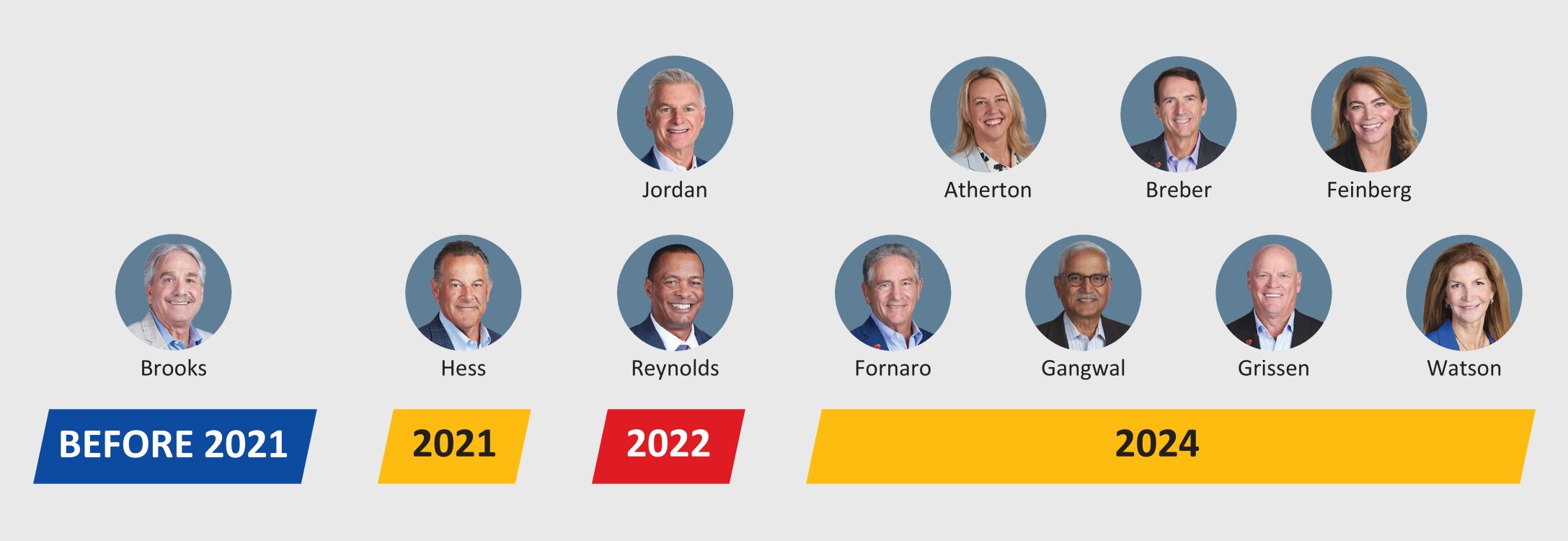
Director Nominee Composition
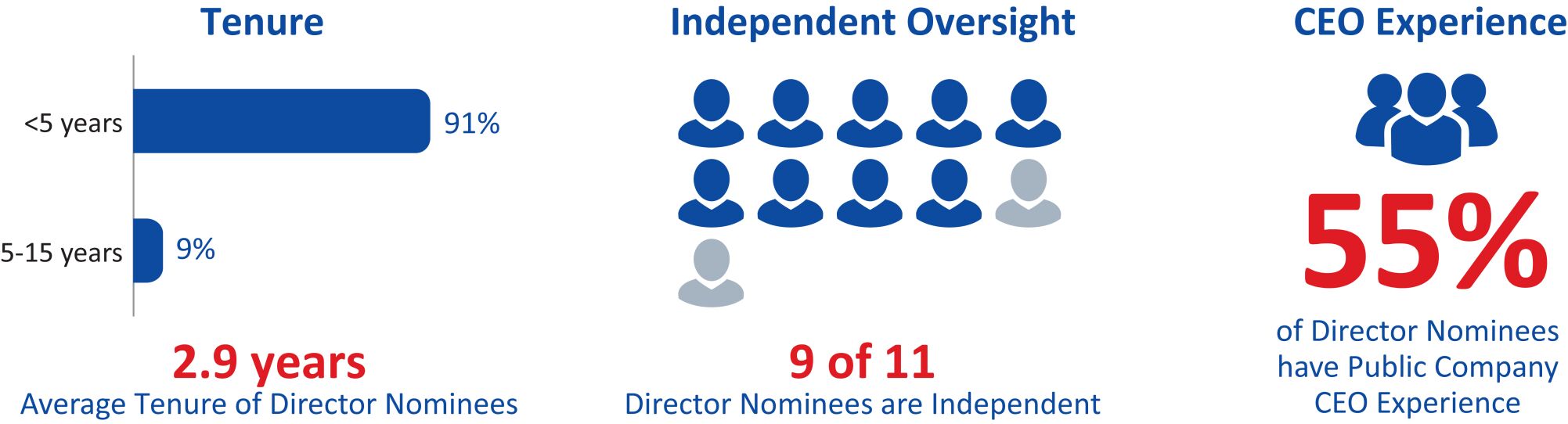
In evaluating Director candidates for membership, the Nominating and Corporate Governance Committee considers numerous factors, including, for example, diversity of experience, skills, background, and geography, with the goals of obtaining varied perspectives and promoting constructive debate.
The Board is composed of, and benefits from, individuals with distinguished leadership experience across multiple industries, including aviation/aerospace, transportation, manufacturing, energy, professional services, financial services, technology, government affairs, retail, and hospitality. Maintaining a Board of knowledgeable professionals with the backgrounds, experiences, perspectives, and skills that will best serve the Board’s and the Company’s needs is a top priority of the Board and the Nominating and Corporate Governance Committee.
| Southwest Airlines 2026 Proxy Statement |
|
3 |
Table of Contents
| Proxy Summary
|
Governance Best Practices
We are committed to strong corporate governance policies and practices that promote the interests of our Shareholders and strengthen Board and management accountability, highlights of which are listed below.
| Governance Principles |
Governance Practices | |
| Accountability to our Shareholders |
• We have only one class of Common Stock, with one vote per share.
• Our Shareholders elect Directors annually for one-year terms by a majority vote standard.
• Incumbent Directors in uncontested elections who receive less than a majority of votes must tender their resignation.
• Our Bylaws permit Shareholder proxy access.
• Shareholders constituting more than 10% of our outstanding Common Stock can request a special meeting. | |
| Board Independence |
• 9 out of 11 members of the Board are independent.
• We have an independent Chair of the Board.
• The independent members of the Board select the Chair of the Board annually.
• The independent Chair of the Board may call meetings and hold executive sessions with the independent Directors.
• All members of the Board’s Audit, Compensation, and Nominating and Corporate Governance Committees are independent. | |
| Board Policies and Practices |
• We annually review our Corporate Governance Guidelines and all committee charters.
• Our Board annually reviews its performance, as well as the performance of each of its committees.
• Our Corporate Governance Guidelines limit the number of public company boards upon which Directors may sit to protect against overboarding.
• Our Board actively engages in CEO succession planning and reviews succession plans for our other executives annually.
• Our Compensation Committee evaluates our CEO’s performance annually.
• Our Audit Committee oversees technology risks, including cybersecurity and related artificial intelligence risks. | |
| Alignment of Interests and Leading Governance Practices |
• We have robust share ownership guidelines for executive officers and Directors.
• Our Compensation Committee has adopted an Amended and Restated Clawback Policy (the “Clawback Policy”) to recoup executive officers’ erroneously awarded incentive-based compensation in the event the Company is required to restate its financial statements.
• Our Corporate Governance Guidelines provide for a limitation on severance payments.
• Our Insider Trading Policy prohibits Employees (including officers) and Directors from entering into hedging transactions with respect to the Company’s securities or pledging Southwest securities as collateral for a loan.
• Our Code of Ethics applies to all Employees (including officers) and Directors. | |
| 4 |
|
Southwest Airlines 2026 Proxy Statement |
Table of Contents
| Proxy Summary
|
Shareholder Engagement
We maintain an open dialogue with our Shareholders and value their perspectives. We proactively engage with our Shareholders year-round to gain an understanding of the issues that are important to them. Our Investor Relations team regularly meets with investors, prospective investors, and investment analysts, and these meetings can include participation from our Chief Executive Officer, Chief Financial Officer, other senior members of management, Chair of the Board, and other independent Directors.
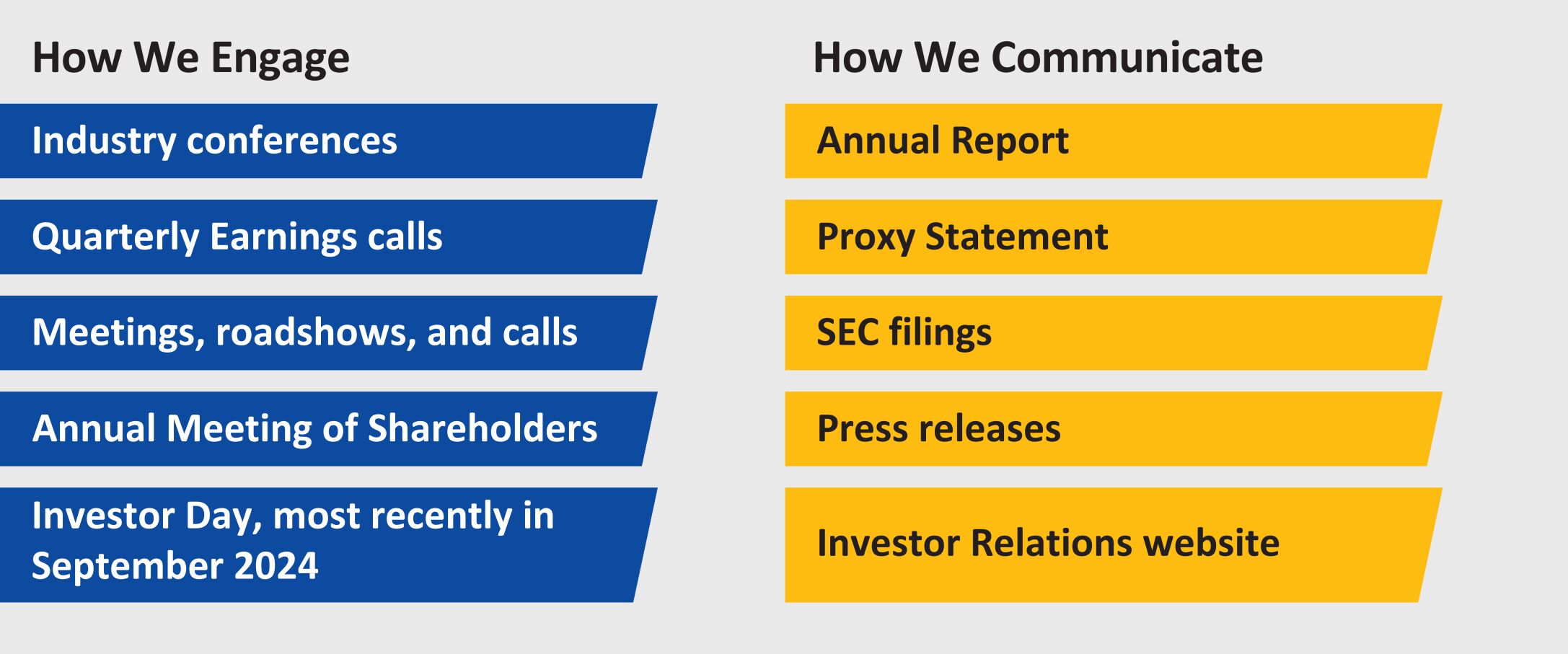
In 2025, we engaged with Shareholders representing approximately 50% of our outstanding shares through more than 200 interactions. In addition to our regular Shareholder engagement efforts, we conducted dedicated outreach efforts to listen to and understand investors’ priorities and perspectives. We had substantive conversations with interested Shareholders regarding corporate governance, Board structure and composition, executive compensation, financial performance, and a range of other topics.
Executive Compensation Highlights
Design and Philosophy
The Compensation Committee of the Board oversees the design and administration of the compensation program for the Chief Executive Officer (“CEO”) and other named executive officers (“NEOs”) identified in the Proxy Statement. The overall objective of the Company’s compensation program is to provide for fair pay opportunities, while aligning these opportunities with the Company’s business objectives and priorities, including the key strategic initiatives the Company establishes from time to time to support its business objectives and priorities.
The Compensation Committee believes in maintaining a strong and transparent pay-for-performance philosophy that is heavily weighted toward long-term incentive opportunities. As shown in the following graphics, a significant portion of executive compensation is dependent on Company performance against pre-defined metrics and Company stock price, and therefore entirely at risk.
| Southwest Airlines 2026 Proxy Statement |
|
5 |
Table of Contents
| Proxy Summary
|
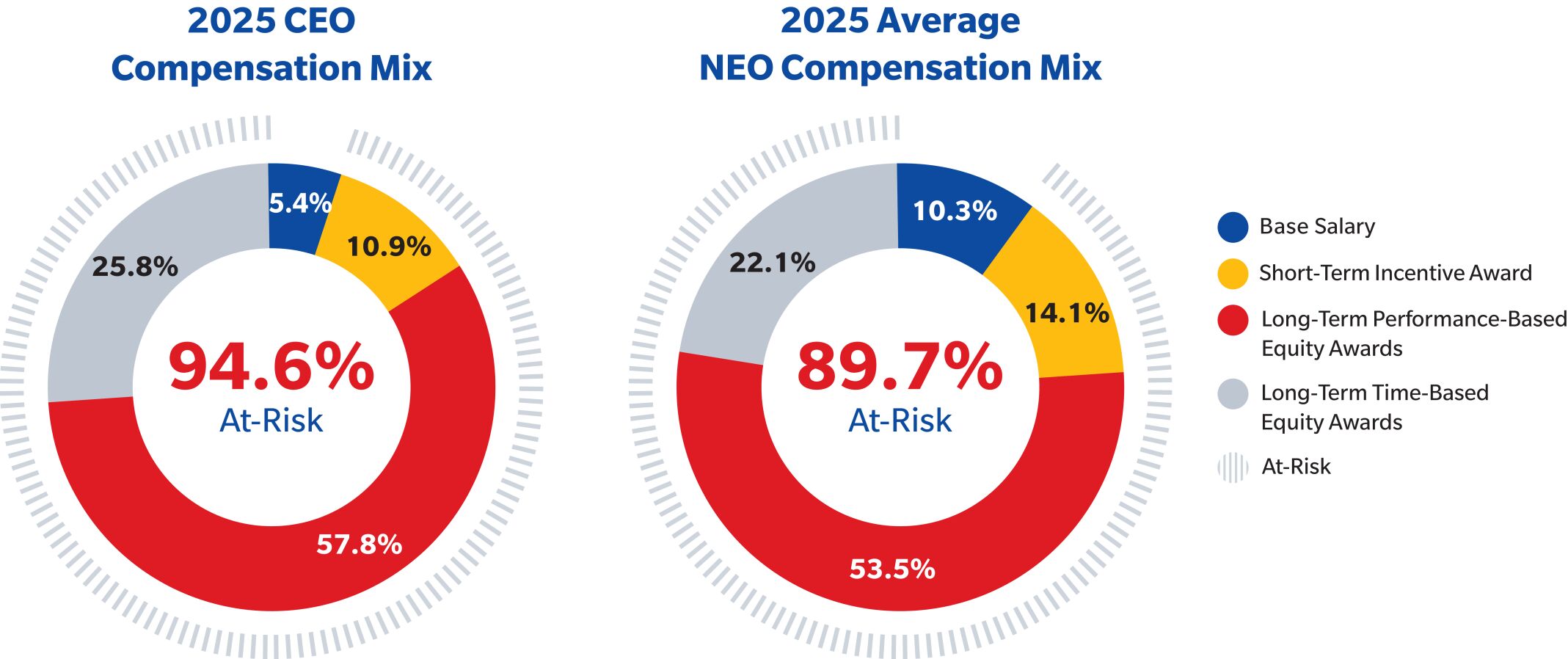
For a more detailed discussion of the Company’s compensation design and philosophy, please see the “Compensation of Executive Officers—Compensation Discussion and Analysis” section.
| Compensation Design |
Compensation Practices | |
| Link Pay to Performance |
• Performance goals tied to operational performance, profitability, and achieving our strategic objectives
• CEO base salary represents less than 10% of targeted opportunities of compensation in 2025 | |
| Promote Long-Term Focus |
• Performance-based long-term equity awards with a three-year performance period
• Time-based long-term equity awards that vest 1/3 per year over a three-year period | |
| Align Interests with Shareholders |
• Equity awards provide a significant stake in the long-term financial success of the Company that aligns with Shareholder interests
• Over 80% of targeted 2025 CEO compensation represented by equity awards
• Robust share ownership guidelines | |
| Independent Compensation Consultants |
• Our Compensation Committee directly engages an independent executive compensation consultant to advise on executive and Director compensation matters | |
| Independent Directors Approve CEO Compensation |
• Our Compensation Committee recommends the CEO’s compensation to the independent Directors of the Board for approval | |
| Shareholder Engagement |
• We solicit investor feedback on our compensation program | |
| Clawback Policy |
• Recoups executive officers’ erroneously awarded incentive-based compensation in the event the Company is required to restate its financial statements | |
| No Hedging or Pledging of our Stock |
• Executive officers and Directors are prohibited from entering into hedging transactions with respect to Southwest securities or pledging Southwest securities as collateral for a loan | |
| Change of Control |
• Our Executive Service Recognition Plan Executive Employment Agreements require a double-trigger change of control to trigger benefits | |
| No Excessive Perquisites |
• Perquisites and other personal benefits are in line with industry standards | |
| 6 |
|
Southwest Airlines 2026 Proxy Statement |
Table of Contents
| PROPOSAL 1
Election of Directors
|
At the Annual Meeting of Shareholders, eleven Directors are nominated to be elected for terms expiring at the 2027 Annual Meeting of Shareholders or until their earlier death, retirement, resignation, or removal in accordance with the provisions of the Company’s bylaws. Robert E. Jordan, Tom Doxey, and Jeff Novota have been selected as a proxy committee by the Board, and it is the intention of the proxy committee that, unless otherwise directed therein, proxies will be voted for the election of all of the nominees listed below. Although it is not contemplated that any of the nominees will be unable to serve, if such a situation arises prior to the meeting, the proxy committee will act in accordance with its best judgment. Each of the nominees has indicated his or her willingness to serve as a member of the Board, if elected.
Vote Required
Provided a quorum is present at the meeting, the affirmative vote of a majority of the votes cast by the holders of shares entitled to vote in the election of Directors is required to elect Directors. A majority of the votes cast means the number of votes cast “for” a Director must exceed the number of votes cast “against” that Director.
|
|
The Board of Directors unanimously recommends a vote FOR the election of each of the nominees for Director named below.
| |

Proxies solicited by the Board will be so voted unless Shareholders specify a different choice.
| Southwest Airlines 2026 Proxy Statement |
|
7 |
Table of Contents
| Proposal 1 — Election of Directors
|
Director Skills and Qualifications
When conducting its review of the appropriate skills and qualifications desired of Directors, the Nominating and Corporate Governance Committee considers the skills, experience, and expertise that are critical to the Board’s ability to provide effective oversight of the Company and are relevant to Southwest’s business, strategy, and operations. The Nominating and Corporate Governance Committee reviews the composition of the Board as a whole to maintain a balance of knowledge and experience. The following matrix displays the significant skills and qualifications that each Director nominee possesses.
| Skill | Definition | |
|
Public CEO: |
Substantial professional experience as a past or present CEO of a public company. | |
|
Finance & Accounting: |
Substantial professional experience in finance or accounting, including experience assessing capital structure and allocation, financing and investing activities, financial reporting, and internal controls. | |
|
Technology: |
Substantial professional experience in technology fields such as cybersecurity, product development, digital solutions, data analytics, information technology, and data management. | |
|
Government Affairs: |
Substantial professional experience in government relations, regulatory affairs, or public policy. | |
|
Human Capital: |
Substantial professional experience in human resources, compensation practices, and talent acquisition, retention, and development. | |
|
Environmental/ |
Substantial professional experience with environmental or sustainability initiatives. | |


| Skill | Definition | |
|
Logistics/ Operations: |
Substantial professional experience with supply chain management, logistics, inventory management, network design, or operations strategy. | |
|
Marketing/Brand Management: |
Substantial professional experience in retail and consumer marketing, sales, and brand management, as well as in customer and product support services. | |
|
Safety: |
Substantial professional experience in safety and operational compliance, including experience overseeing and implementing policies, processes, and procedures designed to comply with applicable government and industry regulations, standards, and trends. | |
|
Airline/Aerospace: |
Substantial professional experience as a senior executive, regulator, or consultant in the airline or aerospace industries. | |
|
Risk Management: |
Substantial professional experience overseeing and implementing processes and procedures to identify, mitigate, and manage risks facing an enterprise. | |


| Skills and Experience |
Public CEO |
Finance & Accounting |
Technology | Govt Affairs |
Human Capital |
Environmental/ Sustainability |
Logistics/ Operations |
Marketing/ Brand Management |
Safety | Airline/ Aerospace |
Risk Management | |||||||||||
| Lisa M. Atherton |
● |
|
|
● | ● |
|
● |
|
● | ● | ● | |||||||||||
| Pierre R. Breber |
|
● | ● | ● |
|
● | ● |
|
● |
|
● | |||||||||||
| Douglas H. Brooks |
● | ● |
|
|
● |
|
● | ● |
|
|
● | |||||||||||
| Sarah E. Feinberg |
|
|
● | ● | ● | ● | ● | ● | ● | ● | ● | |||||||||||
| Robert L. Fornaro |
● | ● |
|
● | ● |
|
● | ● | ● | ● | ● | |||||||||||
| Rakesh Gangwal |
● | ● | ● |
|
● |
|
● |
|
● | ● | ● | |||||||||||
| David J. Grissen |
|
● |
|
● | ● | ● | ● | ● | ● |
|
● | |||||||||||
| David P. Hess |
● | ● | ● | ● | ● | ● | ● | ● | ● | ● | ● | |||||||||||
| Robert E. Jordan |
● | ● | ● | ● | ● | ● | ● | ● | ● | ● | ● | |||||||||||
| Christopher P. Reynolds |
|
|
● | ● | ● | ● | ● |
|
● |
|
● | |||||||||||
| Patricia A. Watson |
|
|
● | ● | ● |
|
● | ● |
|
● | ● | |||||||||||
| 8 |
|
Southwest Airlines 2026 Proxy Statement |
Table of Contents
| Proposal 1 — Election of Directors
|
|
Director since: 2024
Principal Occupation President and CEO of Textron, Inc.
Board Committees • Compensation (Chair) • Fleet Oversight • Nominating and Corporate Governance
Skills and Qualifications • Airline / Aerospace • Government Affairs • Human Capital • Logistics / Operations • Public CEO • Risk Management • Safety |
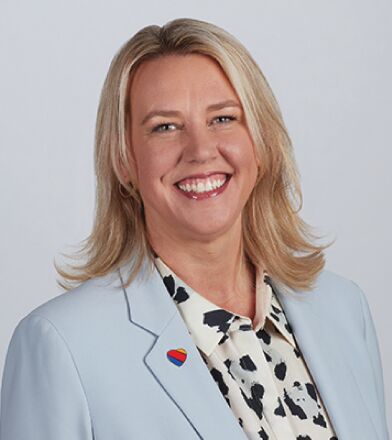
LISA M. ATHERTON Age: 51 | Independent Director | |
|
Expertise Relevant to Southwest Airlines’ Business and Strategy
• Executive leadership and operational expertise, including in the commercial and defense aviation industry as President and CEO of Textron, Inc. (“TXT”), an industrial conglomerate, and formerly as President and CEO of Bell, a subsidiary of TXT and leading global supplier of innovative products for defense and commercial helicopter customers, and as a member of the Corporate Leadership Team of TXT. In these roles, Ms. Atherton has overseen strategic direction and the overall management of business development efforts, including leading complex business segments through a rebranding and the successful integration of a major military training segment acquisition.
• Extensive aerospace and aviation experience, including in M&A and strategic planning, having overseen approximately $3.5 billion worth of aviation contracts, consisting of a mix of military, parapublic and commercial contracts, as President and CEO of Bell and approximately $1.5 billion worth of military and defense contracts as President and CEO at Textron Systems, a leading developer of crewed and uncrewed military ground vehicles, with a focus on aircraft systems. She has also presided over synergistic acquisitions to strategically expand the company’s portfolio of military-grade product and services offerings. These experiences enable Ms. Atherton to share valuable insights as Southwest executes on its strategic transformational plan.
• Valuable perspective on governmental regulation and contracting, with over 30 years of experience interacting with regulators acquired through her roles in the private sector at the Textron and Bell suite of businesses and at the Air Combat Command’s Directorate of Requirements, where she helped to shape the budget and operational requirements and needs for the Combat Air Forces. | ||
|
Business Experience
• President and CEO, Textron, Inc. (2026 – present) • President and CEO, Bell (2023 – 2025) • Chief Operating Officer (2023) • President and CEO, Textron Systems (2017 – 2023) • Executive Vice President, Military Business, Bell Helicopter (2015 – 2017) • Vice President, Global Military Business Development (2014 – 2015) • Various leadership roles (2013 – 2014) • Various leadership positions, Textron Systems (2007 – 2013) • Air Combat Command, Directorate of Requirements (1999 – 2007)
Other Public Company Board Experience • Textron, Inc. (2026 – present) | ||
| Southwest Airlines 2026 Proxy Statement |
|
9 |
Table of Contents
| Proposal 1 — Election of Directors
|
|
Director since: 2024
Principal Occupation Former Vice President and CFO of Chevron Corporation
Board Committees • Audit (Chair) • Compensation
Skills and Qualifications • Environmental / Sustainability • Finance & Accounting • Government Affairs • Logistics / Operations • Risk Management • Safety • Technology |
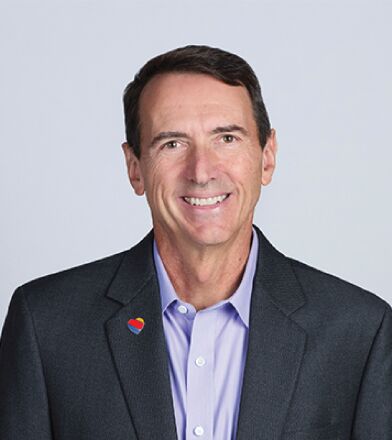
PIERRE R. BREBER Age: 61 | Independent Director | |
|
Expertise Relevant to Southwest Airlines’ Business and Strategy
• Proven track record of leading company turnaround. As the Chief Financial Officer of Chevron Corporation, a multinational energy corporation (“Chevron”), Mr. Breber led Chevron’s strategy to “win back” investors, resulting in stock prices rising after a decade of underperformance. Mr. Breber boosted investor confidence in the energy sector and maintained Chevron’s sector-leading valuation and reputation by instilling capital discipline and championing a lower carbon strategy. Mr. Breber also oversaw the growth of Chevron’s global trading and shipping operations and worldwide refining, marketing, and chemicals businesses, effectuating double digit returns on capital employed.
• Deep financial experience, leading global and multi-national businesses with annual after-tax profits greater than $1 billion for 8 years. Mr. Breber guided well-timed, value additive acquisitions at Chevron, including the completion of over $20 billion in highly accretive bolt on acquisitions with Noble Energy Inc. and PDC Energy Inc. and signing a $60 billion deal to acquire Hess Corporation and transform Chevron’s long term growth portfolio. Mr. Breber also encouraged the acquisition of Renewable Energy Group (“REG”) in 2022 when growth stocks fell, accelerating progress in renewable fuels at a price 10% below REG’s prior secondary offering.
• Commitment to balanced energy transition. Mr. Breber has been steadfast in his support of capital and carbon efficient growth in both traditional and new energy sources – understanding that perpetual dividend growth requires profitable businesses now and in the future. As investor focus on environmental prudence grew during his tenure at Chevron, Mr. Breber helped steer an approach that balanced returns to shareholders with positioning the company into new energy businesses where it had competitive advantages. | ||
|
Business Experience
• Vice President and Chief Financial Officer, Chevron Corporation (2019 – 2024) • Executive Vice President – Downstream and Chemicals (2016 – 2018) • Executive Vice President – Gas and Midstream (2014 – 2015) • Managing Director, Asia South Business Unit (2011 – 2013) • Vice President and Treasurer (2009 – 2010) • Head of Investor Relations (2000 – 2003) • Various Roles (1989 – 2000)
Other Public Company Board Experience • The Clorox Company (2024 – present) • PACCAR Inc. (2024 – present) • Air Liquide S.A. (2021)
Other Professional Memberships • The ExCo Group LLC (2025 – present) • Johnson Advisory Council, Cornell University (2021 – present) • Board of Directors, United Way Bay Area, a non-profit assisting people living in poverty (2015 – 2024) • Board of Directors, Thurgood Marshall College Fund (2021 – 2023) |
| 10 |
|
Southwest Airlines 2026 Proxy Statement |
Table of Contents
| Proposal 1 — Election of Directors
|
|
Director since: 2010
Principal Occupation Former Chairman, President, and CEO of Brinker International, Inc.
Board Committees • Audit • Compensation • Fleet Oversight
Skills and Qualifications • Finance & Accounting • Human Capital • Logistics / Operations • Marketing / Brand Management • Public CEO • Risk Management |
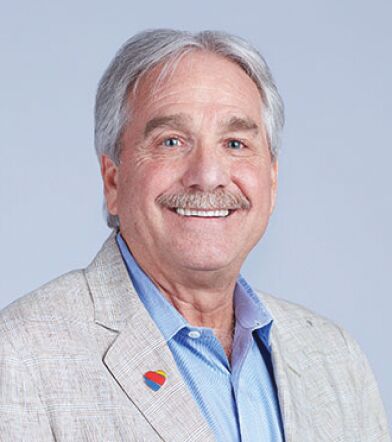
DOUGLAS H. BROOKS Age: 73 | Independent Chair of the Board | |
|
Expertise Relevant to Southwest Airlines’ Business and Strategy
• Experience leading transformational corporate strategy. During his tenure as Chairman of the Board, President and CEO of Brinker International, Inc., a multinational portfolio of restaurants, Mr. Brooks led the company’s portfolio optimization efforts through the sale of its interests in Big Bowl Asian Kitchen, Corner Bakery Café, Rockfish Seafood Grill, Romano’s Macaroni Grill, and On the Border Mexican Grill & Cantina brands to focus its efforts on its two core assets, Chili’s Grill & Bar and Maggiano’s Little Italy. Over the course of his tenure as COO and subsequently CEO, Brinker delivered shareholder returns in excess of 185%.
• Decisive leader with well-honed operational planning judgment. Mr. Brooks’ career is exemplified by a consistent pattern of business enhancement, with a focus on growing shareholder value. As CEO, Mr. Brooks led Brinker in stabilizing its balance sheet following the 2008 financial crisis by paying down debt and paring back costs and then returned significant capital to shareholders through share buyback programs and a 30% increase to the dividend.
• Accomplished public company director. In his capacity as a director of AutoZone, Inc., the leading retailer and a leading distributor of automotive replacement parts and accessories in the U.S., Mr. Brooks oversaw both business transformations and crucial strategic transitions, including share repurchase programs, international expansion and the successful execution of a CEO succession plan. Over the course of his tenure as director, AutoZone delivered a total shareholder return of over 450%, and, between 2017 and 2022, its revenues increased by over 50%, from $10.8 billion to $16.25 billion. As a director of Clubcorp Holdings, Mr. Brooks oversaw the company’s strategic review that led to the company being taken private by Apollo in a $1.1 billion transaction. | ||
|
Business Experience
• Chairman, President, and CEO, Brinker International, Inc. (2004 – 2013) • President (2004 – 2013) • Chief Operating Officer (1999 – 2003) • Executive Vice President (1998 – 1999) • President, Chili’s Grill & Bar (1994 – 1998) • Senior Vice President—Chili’s Operations (1992 – 1994) • Senior Vice President—Central Region Operations (1987 – 1992)
Other Public Company Board Experience • AutoZone, Inc. (2013 – 2022) • Clubcorp Holdings, Inc. (2013 – 2017) • Brinker International, Inc. (1994 – 2013)
Other Professional Memberships • Professional Advisory Board, St. Jude Children’s Research Hospital (1999 – present) • Board of Regents, University of Houston System (2018 – 2023) • Board of Directors, Limbs for Life (1999 – 2021) |
| Southwest Airlines 2026 Proxy Statement |
|
11 |
Table of Contents
| Proposal 1 — Election of Directors
|
|
Director since: 2024
Principal Occupation Former CEO and President of the New York City Transit Authority; Former Administrator of the U.S. Federal Railroad Administration
Board Committees • Compensation • Nominating and Corporate Governance
Skills and Qualifications • Airline / Aerospace • Environmental / Sustainability • Government Affairs • Human Capital • Logistics / Operations • Marketing / Brand Management • Risk Management • Safety • Technology |
SARAH E. FEINBERG Age: 48 | Independent Director | |
|
Expertise Relevant to Southwest Airlines’ Business and Strategy
• Proven commitment to safety and efficient, scalable operations in highly regulated industries. Ms. Feinberg brings a wealth of experience as a transportation executive and operator, and as a former federal safety regulator, which supports Southwest’s commitment to ensuring the Company’s safe and efficient operations. As Administrator at the U.S. Federal Railroad Administration, the safety regulator for the U.S. passenger and freight rail system, Ms. Feinberg focused on enhancing the safety of the rail network after a series of accidents. During her tenure, Ms. Feinberg aggressively enforced safety regulations and oversaw billions of dollars in investments to improve the safety of the rail system.
• Extensive transportation operations experience. As CEO and President of the New York City Transit Authority, the largest transit system in North America, Feinberg led a 50,000 employee workforce during the COVID-19 pandemic and New York City’s recovery from the pandemic.
• Extensive experience in regulatory and government affairs. Ms. Feinberg served as Senior Advisor to the White House Chief of Staff from November 2008 through July 2010 and Special Assistant to President Barack Obama, who later nominated Ms. Feinberg to fill the role of Administrator of the Federal Railroad Administration.
• Strong knowledge of the transportation industry. As Chief of Staff at the U.S. Department of Transportation during the Obama administration, Ms. Feinberg oversaw and advised on a broad range of initiatives across the aviation and broader transportation sector. Ms. Feinberg most recently founded Feinberg Strategies, LLC, a strategic business consulting practice focused on the technology and transportation sectors. She also brings corporate governance experience, having served on the boards of multiple transportation service providers. | ||
|
Business Experience
• Founder, Feinberg Strategies, LLC (2017 – present) • Interim President and Chief Executive Officer, New York City Transit Authority, a public transportation operator in New York City (2020 – 2021) • Chair of the Transit Committee and Board Member, Metropolitan Transportation Authority, a public transportation operator in New York City (2019 – 2020) • Administrator, U.S. Federal Railroad Administration (2015 – 2017) • Chief of Staff to the U.S. Secretary of Transportation, U.S. Department of Transportation (2013 – 2015) • Director of Policy and Crisis Communications, Meta Platforms, Inc. (2011 – 2013) • Global Communications Director, Bloomberg L.P. (2010 – 2011) • Special Assistant to the President and Senior Advisor to the White House Chief of Staff (2009 – 2010)
Other Public Company Board Experience • Marblegate Capital Corporation, a vertically integrated, full-service fleet operator and specialty finance lender (2025 – present)
Other Professional Memberships • Board of Directors, Mainstay Maritime, a marine transportation service provider (2023 – present) • Board of Directors, Regional Plan Association, a not-for-profit regional planning organization (2024 – present) • Board of Trustees, NHP Foundation, a not-for-profit real estate organization (2020 – present) • Board of Directors, National Railroad Passenger Corporation (d/b/a Amtrak) (2015 – 2017) |

| 12 |
|
Southwest Airlines 2026 Proxy Statement |
Table of Contents
| Proposal 1 — Election of Directors
|
|
Director since: 2024
Principal Occupation Former CEO of Spirit Airlines and of AirTran Holdings Inc.
Board Committees • Safety and Operations
Skills and Qualifications • Airline / Aerospace • Finance & Accounting • Government Affairs • Human Capital • Logistics / Operations • Marketing/ Brand Management • Public CEO • Risk Management • Safety |
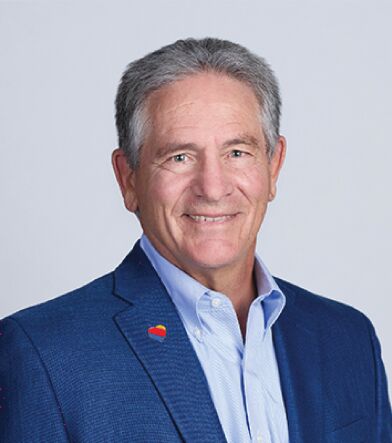
ROBERT L. FORNARO Age: 73 | Director | |
|
Expertise Relevant to Southwest Airlines’ Business and Strategy
• Airline industry veteran with deep C-suite operational and managerial experience. Under Mr. Fornaro’s leadership as CEO, Spirit Airlines’ on-time performance increased from last place nationwide prior to his appointment in January 2016 to near the top of the industry at 81.1% in 2018. Over the course of his three-year tenure, Spirit’s share price increased 45%; second highest among major airlines. At AirTran, Mr. Fornaro served as President and CFO on a turnaround leadership team that led the transformation of the company into one of the most successful airlines in the nation. Then as CEO of AirTran, Mr. Fornaro successfully negotiated its sale to Southwest at a 69% premium. Before AirTran, Mr. Fornaro operated an aviation consulting practice and served in senior marketing and planning positions at US Airways and Northwest Airlines.
• Proven track record in airline M&A and integration follow-through. Mr. Fornaro oversaw the successful acquisition of AirTran by Southwest as AirTran’s CEO and worked with Southwest as a consultant in the following years to ensure the seamless integration of the two companies. As a director at WestJet Airlines, he helped guide the airline through the challenging COVID-19 pandemic period and the repositioning of the airline’s route network and oversaw WestJet’s successful acquisition of Sunwing Airlines and Sunwing Vacations.
• Expertise in navigating complex regulatory landscapes. As CEO of AirTran, Mr. Fornaro led successful lobbying efforts and negotiations with federal agencies that won the airline more landing rights at federally restricted airports in New York and Washington. His experience with the complex regulatory landscape governing the airline industry was supported by his experience as Chair of Spirit’s Safety, Security and Operations Committee, and as a member of the safety committees at WestJet and Avianca. | ||
|
Business Experience
• Principal, ParkView Partners LLC (2011 – 2015, 2019 – present) • Advisor, Southwest Airlines Co. (2011 – 2014, 2020 – 2024) • CEO, Spirit Airlines (2016 – 2018) • President (2016 – 2017) • President & CEO, AirTran Holdings Inc. (2007 – 2011) • Chairman (2008 – 2011) • President & COO, AirTran Airways Inc. (2001 – 2007) • President & CFO (1999 – 2000) • SVP – Planning, US Airways (1992 – 1998) • SVP – Planning and Alliances, Northwest Airways (1988 – 1992)
Other Public Company Board Experience • WestJet Airlines (2020 – present) • Avianca Group International Limited, a leading airline in Central America and South America (2021 – 2026) • Spirit Airlines, Inc. (2014 – 2019) • AirTran Holdings Inc. (2001 – 2011)
Other Professional Memberships • Board of Directors, ABRA Group Limited, an air transport holding company (2026 – present) |
| Southwest Airlines 2026 Proxy Statement |
|
13 |
Table of Contents
| Proposal 1 — Election of Directors
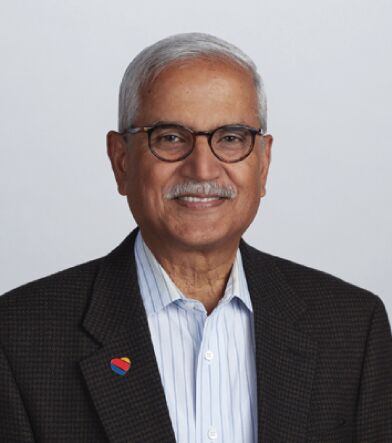
|
|
Director since: 2024
Principal Occupation Co-Founder of InterGlobe Aviation Limited
Board Committees • Fleet Oversight (Chair) • Nominating and Corporate Governance
Skills and Qualifications • Airline / Aerospace • Finance & Accounting • Human Capital • Logistics / Operations • Public CEO • Risk Management • Safety • Technology |
RAKESH GANGWAL Age: 72 | Independent Director | |
|
Expertise Relevant to Southwest Airlines’ Business and Strategy
• Visionary leader and proven operator in the airline industry. As co-founder of IndiGo, India’s largest airline, Mr. Gangwal positioned the airline for consistent profitability in the competitive Indian market. Today, IndiGo is one of the world’s largest airlines by market cap. Earlier, he served as COO and then as President & CEO at U.S. Airways after holding executive roles at Air France and United Airlines.
• Effective boardroom voice. Mr. Gangwal has extensive experience serving on the boards of public companies in the retail, travel, and technology industries and is known for his candor and changing the status quo in the companies in which he has been involved.
• Extensive M&A and strategic planning experience as executive and director. As Chairman, President, and CEO, he led Worldspan Technologies, Inc., a travel technology provider, through its $1.4 billion strategic sale to Travelport. In the boardroom, Mr. Gangwal oversaw the negotiation and completion of OfficeMax’s combination with Office Depot and the sale of PetSmart to a consortium of buyers led by BC Partners for $8.7 billion. | ||
|
Business Experience
• Co-Founder, InterGlobe Aviation Limited, the parent company of low-cost carrier IndiGo • Chairman, President and CEO, Worldspan Technologies, Inc. (2003 – 2007) • President and CEO, US Airways Group, Inc. (1998 – 2001) • President and COO (1996 – 1998) • Executive Vice President, Air France (1994 – 1996) • Series of advancing roles up to SVP of Planning at United Airlines (1984 – 1994)
Other Public Company Board Experience • InterGlobe Aviation Limited (2015 –2022) • Office Depot, Inc. (2013 – 2017) • CarMax, Inc. (2011 – 2017) • PetSmart, Inc. (2005 – 2015) • OfficeMax Incorporated (1998 – 2013) • US Airways (1996 – 2001) |
| 14 |
|
Southwest Airlines 2026 Proxy Statement |
Table of Contents
| Proposal 1 — Election of Directors
|
|
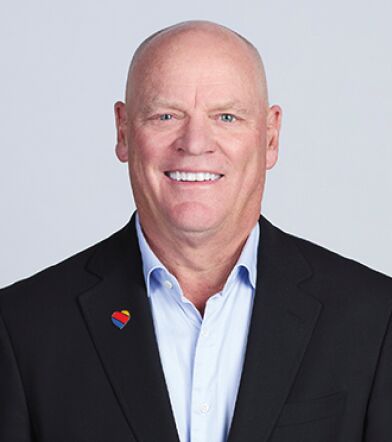
Director since: 2024
Principal Occupation Former Group President of Marriott International
Board Committees • Audit • Compensation
Skills and Qualifications • Environmental / Sustainability • Finance & Accounting • Government Affairs • Human Capital • Logistics / Operations • Marketing / Brand Management • Risk Management • Safety |
DAVID J. GRISSEN Age: 68 | Independent Director | |
|
Expertise Relevant to Southwest Airlines’ Business and Strategy
• Expertise in successful brand management. As former Group President of Marriott International, Inc., a global operator, franchisor, and licensor of hotel, residential, and timeshare properties (“Marriott”), Mr. Grissen is a seasoned hospitality executive with extensive experience leading a global franchise and growing a storied brand. Mr. Grissen led all functions for Marriott’s brands in the Americas and for the Ritz-Carlton and EDITION brands globally, including strategy, revenue management, sales and marketing, operations, food and beverage, technology, development and human resources.
• Strong finance experience. Mr. Grissen served in several senior finance positions during his 36-year career at Marriott, culminating in the Senior Vice President of Finance & Business Development. Mr. Grissen oversaw major activities including the due diligence of the Ritz-Carlton and Renaissance acquisitions. As Group President of Marriott, he provided P&L leadership for the Americas with about 80% of the company’s fee income.
• Proven track record of spearheading company growth, leading the expansion of Marriott’s Americas organization from 2,928 hotels to 5,640 properties, with another 1,800 hotels in the pipeline during his tenure. Mr. Grissen managed hotels representing approximately two-thirds of Marriott’s fee revenue and a workforce of 160,000 people, developing new leaders and driving performance at Marriott hotels across the region. | ||
|
Business Experience
• Group President, Americas, Marriott International, Inc. (2013 – 2021) • President, Americas (2010 – 2013) • Executive Vice President of the Eastern Region (2004 – 2010) • Various Roles (1986 – 2004)
Other Public Company Board Experience • Chatham Lodging Trust (2021 – present) • Regis Corporation (2013-2024), Chairman (2021-2024) • Good Times Restaurants Inc. (2005 – 2010)
Other Professional Memberships • Board of Directors, WaterWalk International and Consolidated Holdings, Inc., a hospitality brand (2022 – present) • Board of Directors, Greenwood Racing, Inc., a casino, betting, and racing company (2021 – 2023) |
| Southwest Airlines 2026 Proxy Statement |
|
15 |
Table of Contents
| Proposal 1 — Election of Directors
|
|
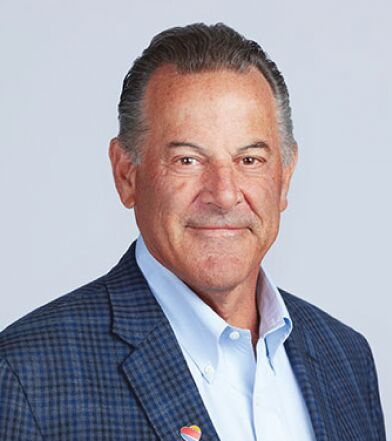
Director since: 2021
Principal Occupation Former CEO of Arconic Corporation
Board Committees • Audit • Safety and Operations (Chair)
Skills and Qualifications • Airline / Aerospace • Environmental / Sustainability • Finance & Accounting • Government Affairs • Human Capital • Logistics / Operations • Marketing / Brand Management • Public CEO • Risk Management • Safety • Technology |
DAVID P. HESS Age: 70 | Independent Director | |
|
Expertise Relevant to Southwest Airlines’ Business and Strategy
• Seasoned executive with over four decades of aerospace background. Under Mr. Hess’ leadership, Hamilton Sundstrand, a manufacturer of aerospace and industrial products, became the largest systems supplier of Boeing’s 787 aircraft. As President of Pratt & Whitney, an aerospace manufacturer, Mr. Hess expanded the company’s reach and influence, including through achieving sole-source position on key aircraft models and acquiring a majority share in International Aero Engines, an important partner.
• Effective leader of strategic transformations. At Arconic (now Howmet Aerospace, Inc.), a metals manufacturing business that serves the aerospace market, among others, Mr. Hess stepped in as interim CEO while the company, recently having split off from Alcoa, underwent a significant business transformation and leadership transition. In this role, he led the company through the initial stages of a business and management transition that eventually culminated in its further separation into Howmet Aerospace, specializing in engineered products and forgings, and Arconic, specializing in building materials and construction systems.
• Extensive boardroom experience at aerospace, defense, and industrial materials companies. Mr. Hess has served as a board member of companies like Woodward, Inc., a global leader in the design, manufacture, and service of energy conversion and control solutions for aerospace and industrial equipment; Allegheny Technologies, a manufacturer of industrial metals; and Arconic, where, as CEO, he oversaw the company’s transition after a major split-off transaction and helped set the stage for further transformational transactions. Mr. Hess leverages his boardroom experience in the aerospace industry to provide insights on Southwest’s strategy and operations. | ||
|
Business Experience
• CEO, Arconic Corporation (2017 – 2018) • Executive Vice President and Chief Customer Officer for Aerospace, United Technologies Corporation (2015 – 2017) • President, Pratt & Whitney, a subsidiary of United Technologies Corporation (2009 – 2014) • President, Hamilton Sundstrand (2004 – 2009)
Other Public Company Board Experience • Woodward, Inc. (2021 – present) • Allegheny Technologies Incorporated (2019 – present) • Arconic Corporation (2017 – 2019)
Other Professional Memberships • Board of Directors, Hartford HealthCare (2011 – 2017), Chairman (2017 – 2020) • Board of Governors Executive Committee, Aerospace Industries Association (Chairman 2012) | ||
| 16 |
|
Southwest Airlines 2026 Proxy Statement |
Table of Contents
| Proposal 1 — Election of Directors
|
|
Director since: 2022
Principal Occupation CEO, President, and Vice Chairman of the Board of Southwest Airlines Co.
Board Committees • Fleet Oversight • Safety and Operations
Skills and Qualifications • Airline / Aerospace • Environmental / Sustainability • Finance & Accounting • Government Affairs • Human Capital • Logistics / Operations • Marketing / Brand Management • Public CEO • Risk Management • Safety • Technology |
ROBERT E. JORDAN Age: 65 | Chief Executive Officer, President, and Vice Chairman of the Board | |
|
Expertise Relevant to Southwest Airlines’ Business and Strategy
• Extensive operating experience in the airline industry. Mr. Jordan has served in 15 different positions at Southwest. As Executive Vice President Corporate Services, Mr. Jordan oversaw various functions, including technology, enterprise management, corporate strategy, and innovation. As Executive Vice President & Chief Commercial Officer, Mr. Jordan led key revenue-generating departments such as marketing and network planning. As Executive Vice President Strategy & Technology, Mr. Jordan aligned technological advancements with strategic business goals. Mr. Jordan’s tenure at the Company includes leadership roles across multiple departments, giving him a comprehensive understanding of the airline’s entire ecosystem.
• Proven track record leading transformational and modernization initiatives. Mr. Jordan has driven innovation and modernization at Southwest by spearheading the development and upgrade of Southwest’s e-commerce platform, revamping the Rapid Rewards® loyalty program, and implementing a new reservations system. Mr. Jordan created Southwest’s first commercial organization, bringing together the Company’s marketing, network planning, and revenue management functions. He also established Southwest’s first strategic planning function and process and oversaw the development and implementation of Southwest’s boarding process, as well as significant ancillary products, including Early Bird Check-In®, the Business Select® fare product category, and Upgraded Boarding. Mr. Jordan led Southwest’s acquisition and integration of AirTran Airways, a strategic move that expanded Southwest’s network in key markets like Washington D.C., provided access to near-international leisure markets, and increased domestic market share by 20% within a year. Mr. Jordan is leading the implementation of the Company’s transformational initiatives, designed to meet evolving Customer preferences with more choices and greater comfort and deliver increased revenue opportunities.
• Strong financial acumen. Mr. Jordan served as the Chair of the Audit Committee at The Container Store from 2013 to 2023, providing financial oversight and risk management over sustained periods of year-over-year revenue growth under varied economic conditions. At Southwest, as Executive Vice President & Chief Commercial Officer, Mr. Jordan led teams covering marketing, revenue management, network planning, customer support and services, customer relations, and the customer experience. | ||
|
Business Experience
• CEO, Southwest Airlines Co. (2022 – present) • President (2023 – present) • Executive Vice President & Incoming CEO (2021 – 2022) • Executive Vice President Corporate Services (2017 – 2022) • Executive Vice President and Chief Commercial Officer (2011 – 2017) • Executive Vice President Strategy & Planning (2008 – 2011) • Executive Vice President Strategy & Technology (2006 – 2008) • Various positions (1988 – 2011) • Programmer and financial analyst, Hewlett-Packard (1987 – 1988)
Other Public Company Board Experience • The Container Store Group, Inc. (2013 – 2023), Chairperson (2021 – 2023)
Other Professional Memberships • Board of Directors, Airlines for America • Governors Council, Airlink, Inc. |

| Southwest Airlines 2026 Proxy Statement |
|
17 |
Table of Contents
| Proposal 1 — Election of Directors
|
|
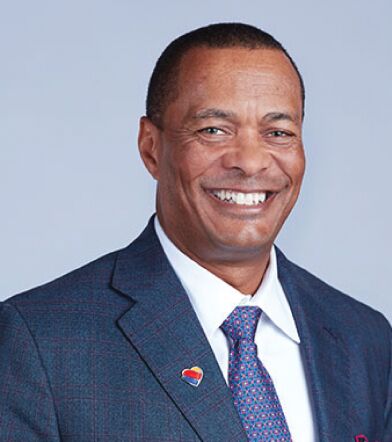
Director since: 2022
Principal Occupation Former Executive Vice President and Chief Strategy Officer, Toyota Motor North America; Former Deputy Chief Officer, Toyota Motor Corporation
Board Committees • Compensation • Nominating and Corporate Governance (Chair)
Skills and Qualifications • Compliance • Environmental / Sustainability • Government Affairs • Human Capital • Legal Affairs • Logistics / Operations • Multinational public company executive • Risk Management • Safety • Technology |
CHRISTOPHER P. REYNOLDS Age: 63 | Independent Director | |
|
Expertise Relevant to Southwest Airlines’ Business and Strategy
• Experience overseeing business development, strategy, compliance, and risk management functions. At Toyota Motor North America (“TMNA”), the operating subsidiary of global automotive manufacturer Toyota Motor Corporation (“TMC”), in Canada, Mexico and the United States, Mr. Reynolds successfully navigated significant challenges, including the Great Recession, a major recall crisis, natural disasters in Japan, and the COVID-19 pandemic. He oversaw crucial North American functions, including strategy, business development, human resources, information technology, legal, diversity and inclusion, sustainability, regulatory affairs, and research and development. Mr. Reynolds also has extensive crisis management experience, having played a key role in Toyota’s 2010 unintended acceleration recall crisis, preparing the CEO for U.S. Congressional testimony, and contributing to subsequent organizational restructurings. As Deputy Chief Officer for TMC, Mr. Reynolds established and grew Toyota’s global compliance and risk management programs across its seven global regions, handling and resolving a myriad of cross-border issues with potential reputational impacts to the company’s brand.
• Deep operational and safety experience in the transportation industry. Mr. Reynolds’ leadership guided the delivery of quality cars to the market while ensuring safety, efficiency, innovation, and strategic investments across TMNA, which produces and sells approximately 1.8 million vehicles annually. He led teams that established Toyota’s new vehicle and component platforms in North America, including the 2019 opening of Toyota’s second assembly plant in Mexico, the 2020 opening of Toyota’s joint venture plant with Mazda in Alabama, and the establishment of Toyota’s first battery plant in North Carolina. He also spearheaded strategic partnerships to accomplish Toyota’s carbon neutrality and mobility goals, including investments in EV charging infrastructure, hydrogen fuel cell technologies and VTOL commuter aviation. Mr. Reynolds spearheaded a strategic partnership to reduce TMNA’s carbon footprint and advance sustainable transportation solutions through the development of the innovative “Tri-gen” hydrogen-based energy production system.
• Commitment to sound governance and excellence in human capital management. Mr. Reynolds’ leadership in the human resources function at TMNA provided him with significant insight into how an employee-driven, value-based company delivers excellent results, which enables him to contribute to the Board’s oversight of Southwest’s Culture that relies on active employee involvement. As Deputy Chief Officer at TMC, he identified and developed high potential talent for leadership roles across Toyota’s global regions. Mr. Reynolds engages in the North Texas community as Vice-Chair of the board of AT&T Performing Arts Center in Dallas and board member of the Communities Foundation of Texas. | ||
|
Business Experience
• Senior Advisor, Toyota Motor North America (2025) • Executive Vice President and Chief Strategy Officer, Strategy & Innovation, Toyota Motor North America (2024 – 2025) • Executive Vice President, Chief Administrative Officer (2015 – 2024) • Head of North American Manufacturing (2018 – 2020) • Deputy Chief Officer, Toyota Motor Corporation (2015 – 2025) • Chief Legal Officer (2012 – 2015) • Group Vice President, Toyota Motor Sales, USA, Inc. (2007 – 2014) • Group Managing Partner, Morgan Lewis & Bockius LLP • Director and Former Chair, Alliance for Automotive Innovation • Assistant U.S. Attorney, Criminal Division, U.S. Department of Justice
Other Public Company Board Experience • Toyota Motor Corporation (2025 – present) |
| 18 |
|
Southwest Airlines 2026 Proxy Statement |
Table of Contents
| Proposal 1 — Election of Directors
|
|
Director since: 2024
Principal Occupation Former Chief Information & Technology Officer of NCR Atleos Corporation
Board Committees • Nominating and Corporate Governance • Safety and Operations
Skills and Qualifications • Airline / Aerospace • Government Affairs • Human Capital • Logistics / Operations • Marketing/ Brand Management • Risk Management • Technology |
PATRICIA A. WATSON Age: 60 | Independent Director | |
|
Expertise Relevant to Southwest Airlines’ Business and Strategy
• Experience implementing new technology initiatives, including generative AI solutions, with a track record of developing modernization plans and overseeing IT transformations at large, complex financial services and transportation/logistics companies. Ms. Watson served as Chief Information Officer at NCR Corporation, a commerce technology solutions company, as NCR Corporation completed a spin-off transaction into two independent, publicly traded companies. Ms. Watson then served as EVP and Chief Information and Technology Officer at NCR Atleos Corporation, a financial services company, focused on manufacturing, technology and servicing/logistics for the world’s largest independent ATM network and over 600,000 ATM’s for financial institutions. Ms Watson had responsibility for defining the technology strategy for all aspects of technology from cybersecurity, data and analytics, infrastructure operations, corporate systems, and product software engineering.
• Strong cybersecurity and risk management knowledge. Ms. Watson brings a wealth of knowledge in technology-related risk management and cybersecurity oversight to our Board, as companies experience heightened legislative and regulatory focus on cybersecurity and Southwest continues to invest in technology infrastructure and cybersecurity.
• Accomplished logistics and aircraft background. Prior to her corporate career, Ms. Watson served in the U.S. Air Force where she served in various roles, including as a contracting and acquisition officer, delivering aircraft technology systems, Flight Commander, and as a director of operations. | ||
|
Business Experience
• Executive Vice President and Chief Information & Technology Officer, NCR Atleos Corporation (2023 – 2024) • Chief Information Officer, NCR Corporation (2022 – 2023) • President of Cloud Collaboration and Enterprise Collaboration, Intrado Corporation, a telecommunications company (2020 – 2022) • Global Chief Information Officer, Total System Services, Inc. (2015 – 2019) • Chief Information Officer, The Brink’s Company (2013 – 2015) • Various technology executive positions, Bank of America Corporation (1998 – 2013) • Captain, United States Air Force (1989 – 1998)
Other Public Company Board Experience • Global Payments Inc. (2025 – present) • Rockwell Automation, Inc. (2017 – present) • Texas Capital Bank, Inc. (2016 – 2020)
Other Professional Memberships • Board of Directors, USAA Federal Savings Bank (2020 – 2023) |

| Southwest Airlines 2026 Proxy Statement |
|
19 |
Table of Contents
| Corporate Governance
|
General
The business of the Company is managed under the direction of the Board. Pursuant to the requirements of the New York Stock Exchange (“NYSE”), a majority of the members of the Board must be independent, as defined by NYSE rules. The Board meets on a regularly scheduled basis to review significant developments affecting the Company, to act on matters requiring approval by the Board, and to otherwise fulfill its responsibilities. The Board has adopted Corporate Governance Guidelines, based on the recommendation of its Nominating and Corporate Governance Committee, to further its goal of providing effective governance of the Company’s business for the long-term benefit of the Company’s Shareholders, Employees, and Customers. These guidelines set forth policies concerning overall governance practices for the Company and are reviewed by the Nominating and Corporate Governance Committee and approved by the Board at least annually.
The Company’s Corporate Governance Guidelines, along with its Code of Ethics and the Charters for its Audit, Compensation, Nominating and Corporate Governance, Safety and Operations, and Fleet Oversight Committees, are available on the Company’s website, www.southwestairlinesinvestorrelations.com/corporate-governance/board-committees. Shareholders may also obtain copies of these documents upon written request to Southwest Airlines Co., Investor Relations, HDQ-6IR, P.O. Box 36611, Dallas, Texas 75235.
Board Membership and Qualifications
General Qualification Requirements
The Company’s Nominating and Corporate Governance Committee is responsible for recommending to the Board the criteria for Board membership, as set forth in the Company’s Corporate Governance Guidelines.
| Corporate Governance Guidelines Requirements for Board Members |
• Possess the highest personal and professional ethics, integrity, and values, as well as practical wisdom and mature judgment
• Be committed to the best long-term interests of the Company’s Shareholders, Employees, and Customers
• Be willing to devote sufficient time to fulfill their responsibilities
• Be willing to serve on the Board for an extended period of time
| |
| Board Considerations for Nominations or Appointments |
• Skills including public company CEO experience, finance, accounting, technology, government affairs, human capital, environmental/sustainability, logistics/operations, marketing/brand management, safety, risk management, airline/aerospace, and other professional experience or knowledge relevant to the success of the Company in the current business environment
• Independence
• Past attendance at Board and committee meetings and participation in and contributions to such meetings
• Diverse skills, experience, backgrounds, and perspectives, with the goals of obtaining well-rounded membership and promoting constructive debate to fulfill the Board’s and the Company’s needs
• Evaluation of each individual in the context of the Board as a whole, with the objective of recommending to Shareholders a group that collectively can best serve the long-term interests of the Company’s Shareholders, Employees, and Customers
|
| 20 |
|
Southwest Airlines 2026 Proxy Statement |
Table of Contents
| Corporate Governance
|
The Corporate Governance Guidelines prohibit non-Employee Directors from serving on more than five public company boards and prohibit Employee Directors from serving on more than two public company boards. The Corporate Governance Guidelines also require that the nature and time involved in a Director’s service on other boards be considered in connection with the evaluation of the suitability of that Director. In addition, in accordance with the Corporate Governance Guidelines, Directors should advise the Chair of the Board and the Chair of the Nominating and Corporate Governance Committee in advance of accepting an invitation to serve on the board of directors, the audit committee, or the compensation committee of another publicly traded company.
Composition and Refreshment Considerations
The Board believes Board composition and refreshment are important elements of the effective fulfillment of the Board’s oversight responsibilities. As the Company navigated numerous challenges and changes in recent years, and in response to Shareholder feedback, the Board and the Nominating and Corporate Governance Committee have increasingly focused on Board refreshment, appointing one new Director in 2021, two new Directors in 2022, four new Directors in 2023, nine new Directors in 2024, and reducing the Board size to eleven members in 2026. The Nominating and Corporate Governance Committee has also put forth a concerted and ongoing effort to identify and build a pipeline of possible candidates to address the evolving needs of the Board and the Company. As part of this effort, and with input from the full Board, the Nominating and Corporate Governance Committee regularly reviews its candidate search process and recruitment criteria.
Director Orientation and Continuing Education
The Company conducts an orientation and onboarding process for new Directors. In addition, Directors may participate in professional development or continuing education programs, courses, seminars, and other similar events. The Company reimburses Directors for the costs associated with these programs, courses, and seminars, including reasonable travel expenses, membership fees, and registration fees.
Board Leadership Structure
| The independent Directors of the Board select the Chair of the Board annually and review whether the role of Chair of the Board should be combined with the office of CEO and whether the role should be held by an independent Director. The Board appointed Douglas H. Brooks as independent Chair of the Board, effective August 1, 2025, succeeding Rakesh Gangwal, who previously served as the Company’s independent Chair of the Board since November 1, 2024, before stepping down due to additional time commitments unrelated to the Company.
The Board believes the current structure with an independent Chair of the Board is in the best interests of the Company and its Shareholders, particularly in light of Shareholder feedback, because, among other factors, the structure allows Mr. Brooks to focus on matters of Board oversight and corporate governance with an independent perspective and Mr. Jordan to focus on leading the business’s strategic operations, including the implementation of the Company’s transformational initiatives. Together, Mr. Brooks and Mr. Jordan can effectively coordinate in (i) properly and timely identifying matters that should be brought to the Board’s attention, (ii) prioritizing Board agenda items, and (iii) identifying the individuals in the best position to present agenda items. |
DOUGLAS H. BROOKS Independent Chair of the Board
| |
|
ROBERT E. JORDAN President & CEO |

| Southwest Airlines 2026 Proxy Statement |
|
21 |
Table of Contents
| Corporate Governance
|
Pursuant to the Company’s Corporate Governance Guidelines, Mr. Brooks, as the independent Chair of the Board, has duties including, but not limited to:
| • | Providing leadership to the Board in its oversight of management; |
| • | Presiding at meetings of the Board, including executive sessions, and the Annual Meeting of Shareholders; |
| • | Setting agendas for, and scheduling meetings of, the Board; |
| • | Serving as a liaison, along with Board committee chairs, among the CEO and the independent Directors and communicating feedback to the CEO following executive sessions; |
| • | Coordinating the activities of non-management and independent Directors, as applicable; |
| • | Consulting with management on the quality, quantity, appropriateness, and timeliness of information provided to the Board; |
| • | Assisting the committees with oversight of the annual evaluations of the Board, the committees, and the CEO; |
| • | Consulting with the Nominating and Corporate Governance Committee with respect to recommendations for the assignment of Board members to the Board’s committees and of the Chairs of those committees; and |
| • | Retaining outside professionals on behalf of the Board. |
Annual Board Self-Evaluations
In accordance with the Corporate Governance Guidelines and committee charters, the Board and each of its standing committees engage in self-evaluations at least annually. The Board believes this annual evaluation process supports the effectiveness and continuous improvement of the Board as a whole and of each of its committees.
| Evaluation
|
The Nominating and Corporate Governance Committee is responsible for overseeing the annual evaluations of the performance of the Board and the Board’s committees. The Chair of the Nominating and Corporate Governance Committee reviews the format and substance of the annual self-evaluation questionnaire to help ensure feedback remains pertinent and appropriate.
Each Board member completes the annual self-evaluation questionnaire, which addresses such areas as:
• Board composition, culture, and structure
• Key responsibilities and oversight
• Board processes and meetings
• Committee structure, performance, and coordination
• Individual committee effectiveness
• Evaluation process and follow-through
The self-evaluation questionnaire also requests written feedback in key areas, including governance enhancements and committee focus.
Additionally, in 2025, the Nominating and Corporate Governance Committee engaged Heidrick & Struggles, Inc. (“Heidrick”) to conduct a board assessment and peer benchmarking, which included interviews with each Director. | |
| Review of Results and Recommendations
|
The responses of the Board members are compiled on an anonymous basis and reviewed by the Nominating and Corporate Governance Committee. The Chairs of each committee also review the anonymous responses for their respective committee self-evaluations.
The Nominating and Corporate Governance Committee reports its conclusions and makes appropriate recommendations to the Board following such evaluations, including areas in which the Board or individual committees of the Board can better contribute to the governance and long-term success of the Company.
The Board and each committee Chair, as applicable, identifies follow-up matters from the evaluation and implements changes as appropriate in response to the results.
The Nominating and Corporate Governance Committee may use the results of its evaluation in determining the criteria for Directors to be considered for appointment to fill any vacancies on the Board or on its committees and for inclusion in the slate of Directors to be recommended by the Board at the Annual Meeting of Shareholders. | |


| 22 |
|
Southwest Airlines 2026 Proxy Statement |
Table of Contents
| Corporate Governance
|
Attendance and Executive Sessions
The Board held seven meetings during 2025 and acted six times by unanimous written consent. During 2025, each of the Company’s current Directors attended at least 75 percent of the total number of Board and applicable committee meetings. It is the Board’s policy that every Director and nominee for Director should make every effort to attend the Company’s Annual Meeting of Shareholders. All of the Company’s current Directors attended the 2025 Annual Meeting of Shareholders.
Pursuant to the Company’s Corporate Governance Guidelines, the non-management members of the Board are required to meet in regularly scheduled executive sessions without the presence of management. To the extent that, at any time, the non-management members of the Board include Directors who are not independent, the independent Directors will also meet at least annually in an executive session that includes only independent Directors. The independent Chair of the Board, Douglas H. Brooks, presides over these executive sessions.
Communications with Non-Management Directors
Shareholders and any other interested parties may communicate directly with the independent Chair of the Board or any or all of the non-management or independent Directors as a group or any other members of the Board by writing to such Director(s), c/o Southwest Airlines Co., Attn: Independent Chair of the Board, P.O. Box 36611, Dallas, Texas 75235.
| Southwest Airlines 2026 Proxy Statement |
|
23 |
Table of Contents
| Corporate Governance
|
Risk Oversight
The Board is responsible for overseeing management’s assessments of major risks facing the Company and for reviewing options to mitigate such risks.
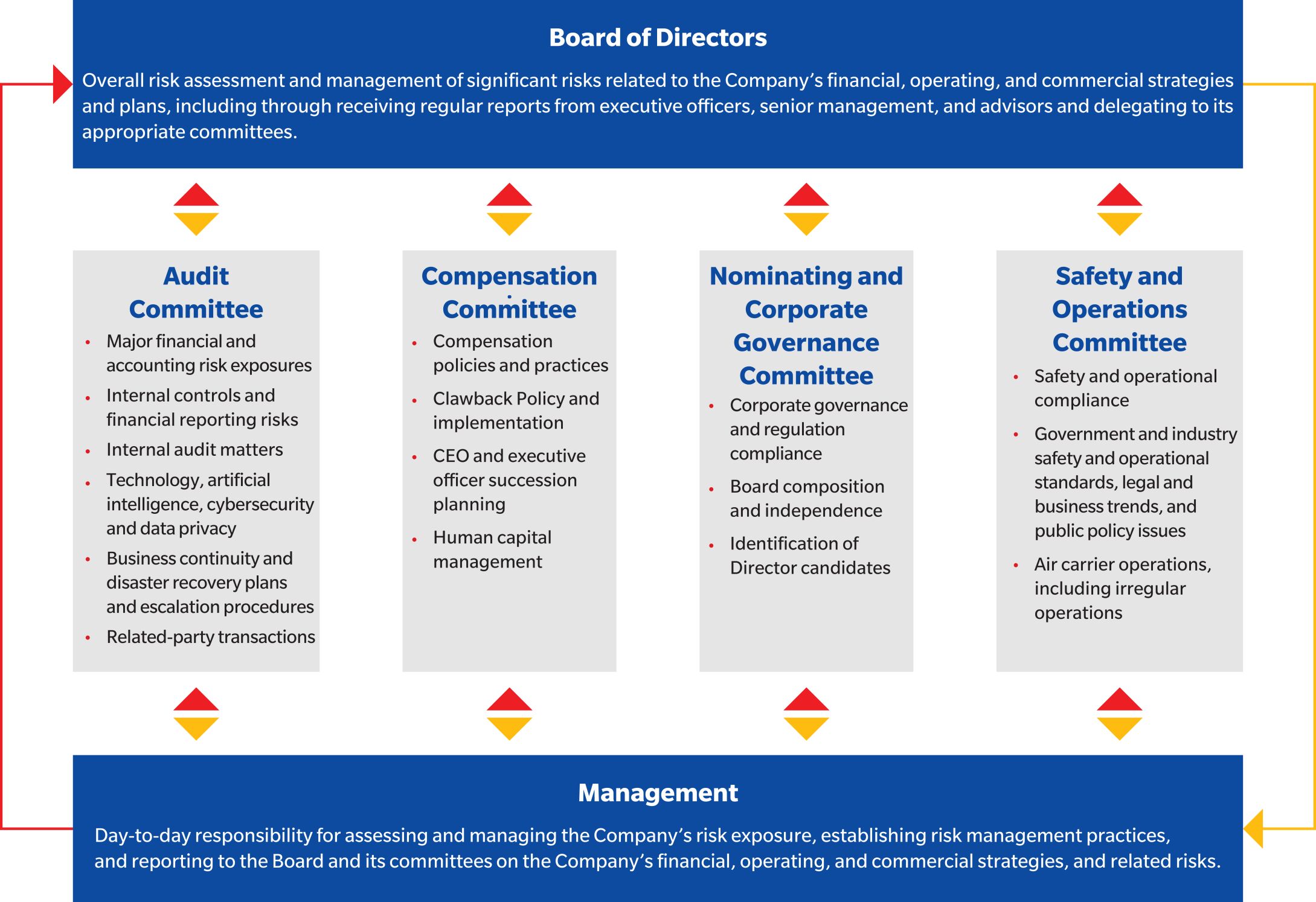
| 24 |
|
Southwest Airlines 2026 Proxy Statement |
Table of Contents
| Corporate Governance
|
Committees of the Board
The Board has established the following standing committees to assist it with fulfilling its responsibilities: (i) Audit, (ii) Compensation, (iii) Nominating and Corporate Governance, and (iv) Safety and Operations. In July 2025, the Board also established an ad hoc Fleet Oversight Committee. The following table provides information on the Board’s current committee memberships.
| *Name |
|
Audit Committee** |
Compensation Committee+ |
Nominating and Corporate Governance Committee# |
Safety and Operations Committee |
Fleet Oversight Committee | ||||||
| Lisa M. Atherton |
|
● | ● | ● | ||||||||
| Pierre R. Breber |
● | ● | ||||||||||
| Douglas H. Brooks |
● | ● | ● | |||||||||
| Sarah E. Feinberg |
● | ● | ||||||||||
| Robert L. Fornaro |
● | |||||||||||
| Rakesh Gangwal |
● | ● | ||||||||||
| David J. Grissen |
● | ● | ||||||||||
| David P. Hess |
● | ● | ||||||||||
| Robert E. Jordan |
● | ● | ||||||||||
| Christopher P. Reynolds |
● | ● | ||||||||||
| Patricia A. Watson |
● | ● | ||||||||||
| * | The former Finance Committee, which was dissolved in February 2026, met 9 times and acted by written consent once in 2025. |
| ** | The Audit Committee has been established in accordance with Section 3(a)(58)(A) of the Securities Exchange Act of 1934, as amended (the “Exchange Act”), and the Board has determined that each of the members of the Audit Committee is (and each Director who previously served on the Audit Committee during 2025 was) independent under all applicable rules of the Securities and Exchange Commission (the “SEC”) and the NYSE governing Audit Committee membership. |
| + | The Board has determined that each of the members of the Compensation Committee is (and each Director who previously served on the Compensation Committee during 2025 was) (i) independent under the NYSE’s rules governing Compensation Committee membership; and (ii) a “non-employee director” under Rule 16b-3 of the Exchange Act. |
| # | The Board has determined that each of the members of the Nominating and Corporate Governance Committee is (and each Director who previously served on the Nominating and Corporate Governance Committee during 2025 was) independent under the NYSE’s rules. |
| ● |
Chair |
| ● |
Member |
The primary functions of each of the Board’s standing committees and the ad hoc Fleet Oversight Committee are discussed below. A more detailed list of each Committee’s functions can be found in their respective charters on the Company’s website, www.southwestairlinesinvestorrelations.com/corporate-governance/board-committees.
| Southwest Airlines 2026 Proxy Statement |
|
25 |
Table of Contents
| Corporate Governance
|

Audit Committee
| Current Members: Pierre R. Breber (Chair)* Douglas H. Brooks* David J. Grissen* David P. Hess*
Meetings in 2025: 7
Actions by Written Consent in 2025: none
* Satisfies the criteria adopted by the SEC to serve as an “audit committee financial expert” |
Primary Functions: • Oversee the integrity of the Company’s financial statements and related disclosure controls and procedures and internal control over financial reporting
• Monitor compliance with legal and regulatory requirements
• Appoint, compensate, and oversee the independent auditor, including assessment of qualifications and independence
• Supervise the performance of the internal audit function and the independent auditor
• Review and oversee the Company’s framework for financial risk assessment and management, as well as material financial policies and actions
• Oversee cybersecurity, technology, and artificial intelligence-related risks and management’s efforts to monitor and mitigate those risks
• Review and approve related-person transactions |
Compensation Committee
| Current Members: Lisa M. Atherton (Chair) Pierre R. Breber Douglas H. Brooks Sarah E. Feinberg David J. Grissen Christopher P. Reynolds
Meetings in 2025: 7
Actions by Written Consent in 2025: none |
Primary Functions: • Evaluate potential candidates for senior executive positions and develop succession plans, including for the CEO
• Provide oversight of human capital management, including culture, recruiting, and retention
• Set and review corporate goals and objectives relevant to CEO compensation; evaluate CEO performance and recommend compensation levels to the independent directors
• Review and approve salaries, incentive opportunities, and equity-based compensation for executive officers who are subject to Section 16(b) of the Exchange Act
• Approve and make recommendations regarding equity-based compensation arrangements and plans and compensation recovery policies, including clawback policy
• Review results of advisory say-on-pay and say-on-frequency votes and adjust policies as appropriate
• Review and recommend compensation for non-employee directors
• Appoint and oversee the work of compensation consultant(s) |
| 26 |
|
Southwest Airlines 2026 Proxy Statement |
Table of Contents
| Corporate Governance
|
Nominating and Corporate Governance Committee
| Current Members: Christopher P. Reynolds (Chair) Lisa M. Atherton Sarah E. Feinberg Rakesh Gangwal Patricia A. Watson
Meetings in 2025: 4
Actions by Written Consent in 2025: none |
Primary Functions: • Develop, review, and recommend Corporate Governance Guidelines, including director qualification criteria
• Identify, evaluate, and recommend candidates for Board membership; oversee director nomination process; recommend a slate of nominees for the Annual Meeting of Shareholders
• Assess director independence, financial literacy, and expertise in accordance with NYSE and SEC requirements
• Review and recommend changes to Board leadership structure and committee composition
• Oversee performance evaluations of the Board, its committees, and management; report conclusions to the Board
• Maintain a pipeline of director candidates and engage external search firms when appropriate |
Safety and Operations Committee
| Current Members: David P. Hess (Chair) Robert L. Fornaro Robert E. Jordan Patricia A. Watson
Meetings in 2025: 4
Actions by Written Consent in 2025: none |
Primary Functions: • Monitor the Company’s safety culture and operational compliance, considering applicable government and industry standards, trends, and public policy issues
• Assess safety and operational compliance obligations, associated risks, and performance relative to those standards
• Review policies, programs, and procedures related to safety and operational compliance, including reporting systems
• Meet regularly with management to evaluate the adequacy and effectiveness of safety and operational compliance practices and review strategies and objectives for operational performance
• Oversee air carrier operations and related risks |
Fleet Oversight Committee*
| Current Members: Rakesh Gangwal (Chair) Lisa M. Atherton Douglas H. Brooks Robert E. Jordan
Meetings in 2025: 1
Actions by Written Consent in 2025: none
* Ad Hoc committee created in July 2025 |
Primary Functions: • Evaluate the Company’s aircraft fleet acquisition strategy, including the manufacturer of the aircraft, engines, and components
• Assess significant relationships with suppliers and manufacturers and other third-party service providers related to the Company’s aircraft fleet
• Review and make recommendations regarding aircraft related transactions, including major aircraft, engine, and aircraft component procurement contracts |
| Southwest Airlines 2026 Proxy Statement |
|
27 |
Table of Contents
| Corporate Governance
|
Director Identification
The Nominating and Corporate Governance Committee identifies potential candidates for first-time nomination as a Board member using a variety of sources, such as recommendations from current Board members, management, and contacts in communities served by the Company. On occasion, the Nominating and Corporate Governance Committee also retains third-party executive search firms to identify candidates. In July 2025, the Nominating and Corporate Governance Committee engaged Heidrick to assist the committee with (i) assessing the Board’s size, composition, and effectiveness and (ii) identifying a pipeline of potential candidates for future Board membership.
The Nominating and Corporate Governance Committee will also consider nominees submitted by Shareholders based on the criteria set forth in the Company’s Corporate Governance Guidelines; provided that such nominations are submitted in accordance with the requirements of the Company’s bylaws. See additional information under “Other Matters—Submission of Shareholder Proposals and Director Nominations.”
The Nominating and Corporate Governance Committee considers all aspects of each possible candidate’s qualifications and skills in the context of the needs of the Company at the relevant point in time with a view to creating a Board with varied backgrounds and perspectives, including diversity with respect to skills, experiences, and geography.
Pursuant to the Cooperation Agreement by and among the Company and Elliott Investment Management L.P., a Delaware limited partnership, Elliott Associates, L.P., a Delaware limited partnership, Elliott International, L.P., a Cayman Islands limited partnership, and The Liverpool Limited Partnership, a Bermuda limited partnership (collectively, the “Elliott Parties”), dated as of October 23, 2024 (as amended, the “Cooperation Agreement”), the Board appointed C. David Cush, Sarah E. Feinberg, David J. Grissen, Gregg A. Saretsky, and Patricia A. Watson to the Board, each effective as of November 1, 2024 and with an initial term expiring at the 2025 Annual Meeting. The Company also agreed to include these Directors, together with the other persons recommended by the Board, in the Company’s slate of nominees for election as a Director at the 2025 Annual Meeting.
Certain Relationships and Related Transactions, and Director Independence
Review, Approval, or Ratification of Transactions with Related Persons; Director Independence Determinations. The Company does not have a formal written policy with respect to the review, approval, or ratification of transactions with related persons, but has established procedures to identify these transactions, if any, and bring them to the attention of the Board and the Audit Committee for consideration. These procedures include formal written questionnaires to Directors and executive officers and written procedures followed by the Company’s Internal Audit Department to identify related person transactions.
The Company requires all of its Directors and executive officers to complete an annual questionnaire that requires them to identify and describe any transactions that they or their respective related parties may have with the Company, whether or not material. Separately, the Company’s Internal Audit Department analyzes accounts payable records to search for payments involving (i) the Company’s Directors and executive officers, (ii) known relatives of the Company’s Directors and executive officers, (iii) companies and organizations with which the Directors and executive officers are associated, and (iv) security holders known to the Company to be the beneficial owner of more than five percent of the Company’s common stock. The questionnaire for non-Employee Directors is also designed to elicit information that should be considered to determine that the Company satisfies the NYSE’s requirement that a majority of its Board members be independent within the meaning of the NYSE’s rules. Relevant information regarding Directors is then provided to the Nominating and Corporate Governance Committee, which is responsible for evaluating the qualifications of Board nominees, including independence, and for making recommendations to the Board regarding (i) nominations for Board membership and (ii) individual qualifications for committee membership, taking into account various additional regulatory requirements, including independence requirements, that specifically apply to the different Board committees. In making its recommendations to the Board, the Nominating and Corporate Governance Committee considers the following regulatory guidance: (i) Item 404(a) of Regulation S-K of the Securities Act of 1933, as amended (Transactions with Related Persons); (ii) Accounting Standards Codification Topic 850 (Related Party Disclosures); (iii) Public Company Accounting Oversight Board Auditing Standard No. 18 (Related Parties); and (iv) the NYSE’s governance standards related to independence determinations. Based on the foregoing, the Board has determined that the following Board members are independent under applicable NYSE standards: Lisa M. Atherton, Pierre R. Breber, Douglas H. Brooks, Sarah E. Feinberg, Rakesh Gangwal, David J. Grissen, David P. Hess, Christopher P. Reynolds, and Patricia A. Watson.
| 28 |
|
Southwest Airlines 2026 Proxy Statement |
Table of Contents
| Corporate Governance
|
In determining her independence, the Board considered Ms. Atherton’s service as President & CEO of TXT and previously as President & CEO of Bell, a TXT subsidiary. In particular, the Board considered the Company’s ordinary course commercial transactions over the past three years with certain TXT subsidiaries, including Textron Ground Support Equipment and Able Aerospace Services. None of the cumulative business transactions in any of the prior three years involved an amount that exceeded 2% of the other company’s consolidated gross revenues. The Board determined that such transactions are not material to either TXT or to the Company and that Ms. Atherton does not have a direct or indirect material interest in the Company’s transactions with the TXT subsidiaries. The Board has concluded that these transactions and arrangements will not impair Ms. Atherton’s exercise of independent judgment in carrying out her responsibilities as Director. Therefore, the Board has determined that Lisa M. Atherton has no material relationship with the Company (either directly or as a partner, shareholder, or officer of an organization that has a relationship with the Company) and is independent under applicable NYSE standards.
Transactions with Related Persons since January 1, 2025. Pursuant to the requirements of the NYSE, the Audit Committee reviews all related party transactions and prohibits such a transaction if the Audit Committee determines it to be inconsistent with the interests of the Company and its Shareholders. The following are reportable transactions with related persons for 2025, which were approved by the Audit Committee.
Ms. Watson’s husband, Paul Watson, is employed as a pilot by the Company, and during 2025, Mr. Watson’s compensation was $463,144.
Mr. Fornaro’s son-in-law, Eric Hall, is a Director level Employee of the Company. For 2025, Mr. Hall’s total compensation was $352,891, which included base salary for 2025, bonus related to his employment in 2025, and grant date fair value of equity compensation awards granted to Mr. Hall in 2025 for financial statement purposes. Mr. Hall also participated in benefit plans generally available to the Company’s Employees. Mr. Fornaro disclaims any interest in Mr. Hall’s compensation.
The Cooperation Agreement. On October 23, 2024, the Company entered into the Cooperation Agreement with the Elliott Parties, and on February 19, 2025, the Company and the Elliott Parties amended the Cooperation Agreement. The Elliott Parties are the beneficial owners of more than 5% of the Company’s common stock.
Pursuant to the Cooperation Agreement, as amended, the Company agreed to, among other things, appoint Mses. Feinberg and Watson and Messrs. Cush, Grissen, and Saretsky to the Board, effective November 1, 2024, and include each in the Company’s slate of nominees for election as a Director at the 2025 Annual Meeting. The Cooperation Agreement included certain voting commitments, customary standstill restrictions, and mutual non-disparagement provisions that remained in place until February 14, 2026; provided, however, that certain standstill restrictions ended on March 12, 2026, the day after the record date for the 2026 Annual Meeting of Shareholders.
Ongoing Reporting Obligations with Respect to Related Person Transactions. In order to provide an ongoing mechanism for monitoring related person transactions and Board member independence, each Board member and executive officer of the Company is required to sign an acknowledgement that he or she will promptly inform the Company of any new information that should be considered by the Board subsequent to the Director’s or executive officer’s completion of his or her annual questionnaire.
Compensation Committee Interlocks and Insider Participation. No member of the Compensation Committee has ever been an executive officer or Employee of the Company. None of the Company’s executive officers currently serves, or has served during the last completed fiscal year, on the compensation committee or board of directors of any other entity that has one or more executive officers serving as a member of the Board or Compensation Committee.
| Southwest Airlines 2026 Proxy Statement |
|
29 |
Table of Contents
Corporate Governance |
30 |
|
Southwest Airlines 2026 Proxy Statement |
Name and Address of Beneficial Owner |
Amount and Nature of Beneficial Ownership |
Percent of Class (1) | ||||||||
The Vanguard Group |
65,421,331 | (2) |
13.3 | |||||||
100 Vanguard Blvd. Malvern, PA 19355 |
||||||||||
PRIMECAP Management Company |
49,444,947 | (3) |
10.0 | |||||||
177 E. Colorado Blvd., 11 th FloorPasadena, CA 91105 |
||||||||||
Elliott Investment Management L.P. |
45,875,000 | (4) |
9.3 | |||||||
360 S. Rosemary Ave. 18th Floor West Palm Beach, FL 33401 |
||||||||||
State Street Corporation State Street Global Advisors Trust Company |
40,639,399 | (5) |
8.3 | |||||||
1 Congress Street, Suite 1 Boston, MA 02114 (6) |
||||||||||
Franklin Resources, Inc. |
40,200,530 | (7) |
8.2 | |||||||
One Franklin Parkway San Mateo, CA 94403-1906 |
||||||||||
BlackRock, Inc. |
32,943,061 | (8) |
6.7 | |||||||
50 Hudson Yards New York, NY 10001 |
||||||||||
| (1) | Percentages are calculated based on the number of outstanding shares of the Company’s common stock as of February 28, 2026, which was 492,327,968. |
| (2) | Information is based on an Amendment to Schedule 13G filed with the SEC on February 13, 2024, by The Vanguard Group. The Vanguard Group reported no sole voting power with respect to shares beneficially owned, sole dispositive power with respect to 63,655,770 shares, shared voting power with respect to 528,654 shares, and shared dispositive power with respect to 1,765,561 shares. |
| (3) | Information is based on an Amendment to Schedule 13G filed with the SEC on February 12, 2024, by PRIMECAP Management Company. PRIMECAP Management Company reported sole voting power with respect to 48,122,326 shares, sole dispositive power with respect to 49,444,947 shares, and no shared voting or dispositive power. |
| (4) | Information is based on an Amendment to Schedule 13D filed with the SEC on February 23, 2026, by Elliott Investment Management L.P. (“EIM”), a Delaware limited partnership, the investment manager of Elliott Associates, L.P., a Delaware limited partnership, and Elliott International, L.P., a Cayman Islands limited partnership. Elliott Investment Management GP LLC, a Delaware limited liability company (“EIM GP”), is the sole general partner of EIM. Paul E. Singer is the sole managing member of EIM GP. EIM reported sole voting power with respect to 45,875,000 shares, no shared voting power, sole dispositive power with respect to 45,875,000 shares, and no shared dispositive power. |
| (5) | Information is based on an Amendment to Schedule 13G filed with the SEC on January 30, 2024, by State Street Corporation, a parent holding company, and State Street Global Advisors Trust Company. Each of these Shareholders reported no sole voting or dispositive power over shares beneficially owned. State Street Corporation reported shared voting power with respect to 10,881,794 shares and shared dispositive power with respect to 40,618,066 shares; and State Street Global Advisors Trust Company reported shared voting power with respect to 5,685,942 shares and shared dispositive power with respect to |
Southwest Airlines 2026 Proxy Statement |
|
31 |
Voting Securities and Principal Shareholders |
| 34,913,960 shares. Based on the Schedule 13G filing, State Street Global Advisors Trust Company beneficially owned 5.86 percent of the Company’s outstanding shares of common stock. |
| (6) | This address is listed in the Amendment to Schedule 13G filed with the SEC on January 30, 2024, as the address of both State Street Corporation and State Street Global Advisors Trust Company. |
| (7) | Information is based on an Amendment to Schedule 13G filed with the SEC on January 29, 2026, by Franklin Resources, Inc., Charles B. Johnson, Rupert H. Johnson, Jr., and Putnam Investment Management, LLC. (1) Franklin Resources, Inc. reported sole voting power with respect to 40,199,858 shares, no shared voting power, sole dispositive power with respect to 40,199,846 shares, and shared dispositive power with respect to 684 shares, and (2) Putnam Investment Management LLC, a direct or indirect subsidiary of Franklin Resources, Inc., reported sole voting power with respect to 30,928,472 shares, no shared voting power, sole dispositive power with respect to 30,928,763 shares, and no shared dispositive power. |
| (8) | Information is based on an Amendment to Schedule 13G filed with the SEC on January 31, 2024, by BlackRock, Inc. BlackRock, Inc., a parent holding company or control person, reported sole voting power with respect to 31,518,717 shares, sole dispositive power with respect to 32,943,061 shares, and no shared voting or dispositive power. |
Name of Beneficial Owner |
Amount and Nature of Beneficial Ownership (1) |
Percent of Class | ||||||||
Lisa M. Atherton (2) |
11,658 | * | ||||||||
Pierre R. Breber (3) |
53,429 | * | ||||||||
Douglas H. Brooks |
81,306 | * | ||||||||
Sarah E. Feinberg (4) |
14,497 | * | ||||||||
Robert L. Fornaro |
9,429 | * | ||||||||
Rakesh Gangwal |
3,611,729 | * | ||||||||
David J. Grissen |
9,429 | * | ||||||||
David P. Hess |
28,574 | * | ||||||||
Robert E. Jordan (5) |
399,148 | * | ||||||||
Christopher P. Reynolds |
24,332 | * | ||||||||
Patricia A. Watson (6) |
17,940 | * | ||||||||
Tom Doxey (7) |
29,350 | * | ||||||||
Andrew M. Watterson (8) |
134,491 | * | ||||||||
Justin Jones |
19,994 | * | ||||||||
Anthony Roach (9) |
21,502 | * | ||||||||
Tammy Romo (10) |
53,034 | * | ||||||||
Current Executive Officers and Directors as a Group (16 persons) |
4,484,496 | * | ||||||||
| * | Less than 1% based on the number of outstanding shares of the Company as of February 28, 2026, which was 492,327,968. |
| (1) | Unless otherwise indicated, beneficial owners have sole rather than shared voting and investment power with respect to their shares, other than rights shared with spouses pursuant to joint tenancy or marital property laws. |
| (2) | Includes 118 shares held by Ms. Atherton’s husband. |
| (3) | Includes 44,000 shares held by a family trust for which Mr. Breber serves as trustee. |
| (4) | Includes 268 shares held by Ms. Feinberg’s domestic partner. |
| (5) | Includes 112,803 shares held for Mr. Jordan’s account under the Company’s Retirement Savings Plan, with respect to which he has the right to direct the voting. |
| (6) | Includes 1,279 shares held by Ms. Watson’s husband. |
| (7) | Includes 29,350 time-based restricted stock units that vest within 60 days of February 28, 2026. |
| (8) | Includes 17,947 shares held for Mr. Watterson’s account under the Company’s Retirement Savings Plan, with respect to which he has the right to direct the voting. |
| (9) | Includes 79 shares held for Mr. Roach’s account under the Company’s Retirement Savings Plan, with respect to which he has the right to direct the voting, and 5,537 time-based restricted stock units that vest within 60 days of February 28, 2026. |
| (10) | Includes 3,952 shares held for Ms. Romo’s account under the Company’s Retirement Savings Plan, with respect to which she has the right to direct the voting. |
32 |
|
Southwest Airlines 2026 Proxy Statement |
Table of Contents
| Compensation of Executive Officers |
Compensation Discussion and Analysis
Table of Contents
The Company is required to provide detailed compensation information in this Proxy Statement regarding its Chief Executive Officer; its Chief Financial Officer; each of its three other most highly compensated executive officers who were serving as such at the end of fiscal 2025; and up to two former executive officers who would have been among the three next most highly compensated officers had they been serving as an executive officer on December 31, 2025. For 2025, these executive officers, who will be referred to in this Proxy Statement as the “named executive officers” or “NEOs,” were:
| Name |
Position | |
| Robert E. Jordan |
President & Chief Executive Officer | |
| Tom Doxey |
Executive Vice President & Chief Financial Officer | |
| Andrew M. Watterson |
Chief Operating Officer | |
| Justin Jones |
Executive Vice President Operations | |
| Anthony Roach |
Executive Vice President Chief Customer & Brand Officer | |
| Tammy Romo |
Former Executive Vice President & Chief Financial Officer | |
For purposes of this Compensation Discussion and Analysis, the Compensation Committee will be referred to as the “Committee.”
| Southwest Airlines 2026 Proxy Statement |
|
33 |
Table of Contents
| Compensation of Executive Officers
|
Executive Summary
Set forth below is a summary of the Committee’s overall compensation objectives, philosophy, and decisions for 2025.
Compensation Objectives and Philosophy
The overall objective of the Company’s compensation programs is to provide for fair pay opportunities, while aligning these opportunities with the Company’s business objectives and priorities, including the key strategic initiatives the Company establishes from time to time to support its business objectives and priorities.
| Pay-for-Performance
Place a substantial portion |
Attract and Retain Top Talent
Balance market |
Align with Strategic Initiatives
Align compensation programs |
Pay-for-Performance. In designing the Company’s executive compensation programs, the Committee believes in maintaining a strong and transparent pay-for-performance philosophy that emphasizes variable pay and is heavily weighted toward long-term incentive opportunities. The Committee’s pay-for-performance philosophy rewards executives for absolute and relative financial, operational, and strategic performance. Annually, the Committee establishes challenging performance goals under both the Company’s short-term and long-term incentive compensation plans to drive the Company’s business objectives and priorities and to support long-term value creation.
Retention; Internal Equity. The Committee balances its pay-for-performance philosophy with its view that pay should be adequate for retention purposes and should account for internal equity. To address retention, the Committee has historically sought to balance market competitive considerations and internal equity. The Committee believes that, to be competitive, executive compensation should be within a reasonable range of median compensation based on available and relevant market data both within and outside of the airline industry. While the Committee references the median of market data as a point of reference when assessing the appropriateness of the Company’s executive compensation, actual and target pay for each executive may vary from the median based on each individual’s relative role, responsibilities, performance, and contributions as well as tenure.
Say-on-Pay Voting Results. At its 2025 Annual Meeting of Shareholders, votes in favor of approving the Company’s named executive officer compensation constituted approximately 94 percent of the shares voted either for or against the proposal. The Committee interpreted these say-on-pay voting results as an endorsement of (i) the Committee’s overall compensation philosophy and structure, (ii) the Company’s executive pay levels generally, and (iii) the Committee’s justifications for its individual executive compensation decisions. The Committee will continue to consider the results of the advisory say-on-pay vote, as well as feedback from the Company’s Shareholders, when making future compensation decisions. Additional detail regarding Shareholder engagement is provided under “Proxy Summary – Shareholder Engagement.”
| 34 |
|
Southwest Airlines 2026 Proxy Statement |
Table of Contents
| Compensation of Executive Officers
|
Elements of Compensation
| Type | Component | Objective | ||||
| Fixed Compensation |
Base Salary | • Provide a reasonable base level of monthly income relative to responsibilities, skills, experience, tenure, performance, and the market for the executive’s skills | ||||
| Variable Compensation | Short-Term Incentive (“STI”) Compensation | |||||
| STI Cash Compensation | • Incentivize short-term absolute and relative financial and operational performance, as well as achievement of the Company’s major initiatives using pre-established performance criteria
• Create accountability and focus Employees on specific goals in the current year
• Enable the Company to attract and retain qualified executive talent | |||||
| Long-Term Incentive (“LTI”) Compensation | ||||||
| Time-Based LTI | ||||||
| Annual Time-Based Restricted Stock Units (“RSUs”) | • Align interests with Shareholders, facilitate executive officer share ownership, and encourage retention | |||||
| Performance-Based LTI | ||||||
| Annual Performance-Based RSUs | • Incentivize and reward achievement of the Company’s long-term financial objectives
• Align interests with Shareholders, facilitate executive officer share ownership, and encourage retention | |||||
| Special Southwest Even Better Awards | • Incentivize execution of the Company’s transformational initiatives and improvements to the Company’s financial performance in alignment with Shareholder interests | |||||
| Benefits and Perquisites | Health, Welfare, and Retirement Benefit Plans; Perquisites; and Other Benefits |
• Encourage retention, support long-term employment, and allow the Company to compete for executive talent
• Demonstrate the Company’s commitment to the health and financial wellness of its Employees | ||||
In addition to the elements of compensation described above, Mr. Doxey received a sign-on cash award, subject to certain repayment provisions, and a sign-on equity award in the form of time-based RSUs in connection with his appointment as Executive Vice President & Chief Financial Officer. None of the other NEOs received these sign-on awards.
Key Executive Compensation Changes in 2025
Key changes to the Company’s executive compensation program that took effect in 2025 include:
| STI Compensation
• The Committee chose Operating Margin, excluding special items, as the financial performance metric on the Management Incentive Scorecard (“Scorecard”), a change from previously using EBITDA, excluding special items. This change reflects the Committee’s focus on core business performance in terms of both revenue growth and cost management in alignment with Shareholder interest in value creation.
• The Committee increased the weighting of the financial metric on the Scorecard to further incentivize improvement in financial performance. |
LTI Compensation
• The Committee granted special Southwest Even Better Awards in 2025 to incentivize management to execute on its transformational initiatives and expedite improvements to the Company’s financial performance in alignment with Shareholder interests. The Southwest Even Better Awards are performance-based RSUs with a three-year cliff vesting period dependent on the Company’s financial performance over multiple years. |
Leadership Changes
• Anthony Roach was promoted to Executive Vice President Chief Customer & Brand Officer, effective March 1, 2025.
• Tom Doxey was appointed Executive Vice President & Chief Financial Officer, effective March 10, 2025.
• Tammy Romo resigned from her positions as Chief Financial Officer and Executive Vice President of the Company, effective March 10, 2025, and April 1, 2025, respectively. |
| Southwest Airlines 2026 Proxy Statement |
|
35 |
Table of Contents
| Compensation of Executive Officers
|
2025 Compensation Mix (At Target)
2025 Base Pay and Short-Term Incentive Compensation
Consistent with its historic practices, the Committee established a target short-term incentive opportunity (the “STI Target Opportunity”) for each of the named executive officers as a percentage of the named executive officer’s base pay, effective first quarter 2025. Additional detail regarding base salary and short-term incentive compensation is included below under “Determination of 2025 Executive Compensation; Analysis of Compensation Elements.” The named executive officer base salaries, STI Target Opportunities, and actual STI award payments for 2025 are shown in the table below.

| Name |
Base Salary(1) |
2025 STI Target Opportunity |
2025 STI Target Opportunity |
Company Scorecard Performance |
Actual STI Award Payout | ||||||||||||||||||||
| Bob Jordan |
$ | 850,000 | 200 | % | $ | 1,700,000 | 119.48 | % | $ | 2,031,160 | |||||||||||||||
| Tom Doxey(2) |
$ | 575,000 | 135 | % | $ | 776,250 | 119.48 | % | $ | 790,250 | (3) | ||||||||||||||
| Andrew Watterson |
$ | 680,000 | 150 | % | $ | 1,020,000 | 119.48 | % | $ | 1,218,696 | |||||||||||||||
| Justin Jones |
$ | 545,000 | 135 | % | $ | 735,750 | 119.48 | % | $ | 879,074 | |||||||||||||||
| Anthony Roach |
$ | 500,000 | 135 | % | $ | 675,000 | 119.48 | % | $ | 748,550 | (4) | ||||||||||||||
| Tammy Romo |
$ | 610,000 | 135 | % | $ | 823,500 | 119.48 | % | $ | 983,918 | |||||||||||||||
| (1) | Base salary as of December 31, 2025. |
| (2) | Mr. Doxey also received a sign-on cash award in 2025 of $500,000, subject to certain repayment provisions, approved by the Committee in connection with Mr. Doxey’s appointment as Executive Vice President & Chief Financial Officer. |
| (3) | Mr. Doxey joined the Company in 2025, and his STI award payout was prorated accordingly. |
| (4) | Mr. Roach’s STI award payout was prorated based on his previous STI Target Opportunity of 75% and his new STI Target Opportunity of 135%, in connection with his promotion to executive officer in March 2025. |
| 36 |
|
Southwest Airlines 2026 Proxy Statement |
Table of Contents
| Compensation of Executive Officers
|
2025 Long-Term Incentive Compensation
Annual RSUs and Performance Based RSUs. For 2025, all named executive officer annual long-term incentive opportunities were awarded in the form of equity awards, with 50 percent of each NEO’s long-term incentive opportunity granted in the form of performance-based RSUs and 50 percent in the form of time-vesting RSUs. The time-based RSUs vest ratably over three years. The performance-based RSUs will vest, if at all, depending on the Company’s financial performance over multiple years.
Southwest Even Better Awards. Reflecting the Committee’s desire to incentivize management to execute on its transformational initiatives and expedite improvements to the Company’s financial performance in alignment with Shareholder interests, the Committee granted additional long-term incentive equity awards to certain senior Employees in March 2025 and to Mr. Jordan in October 2025. The Southwest Even Better Awards will vest, if at all, depending on the Company’s financial performance over multiple years.
The Committee awarded long-term incentive opportunities in 2025 (shown at target) to the named executive officers as follows:
| Name |
2025 Annual LTI Opportunity as Percentage of Base Salary |
2025 Time-Based LTI |
2025 Performance-Based |
Special Southwest Even Better Awards | ||||||||||||||||
| Robert E. Jordan |
950 | % | $ | 4,037,523 | $ | 4,037,523 | $ | 5,000,025 | ||||||||||||
| Tom Doxey |
450 | % | $ | 1,356,172 | $ | 1,356,172 | $ | 3,173,000 | ||||||||||||
| Andrew M. Watterson |
500 | % | $ | 1,700,008 | $ | 1,700,008 | $ | 3,173,000 | ||||||||||||
| Justin Jones |
400 | % | $ | 1,090,028 | $ | 1,090,028 | $ | 1,903,800 | ||||||||||||
| Anthony Roach* |
350 | % | $ | 875,023 | $ | 875,023 | $ | 1,903,800 | ||||||||||||
| Tammy Romo |
450 | % | $ | 1,372,526 | $ | 1,372,526 | — | |||||||||||||
| * | Mr. Roach’s long-term incentive opportunity in 2025 increased from 150% to 350% effective March 1, 2025 in connection with his promotion to Executive Vice President Chief Customer & Brand Officer. |
Sign-On Equity Award. In order to attract and retain a highly qualified executive officer, the Committee approved a long-term sign-on equity award for Mr. Doxey in the form of time-vesting RSUs with a grant date fair value of approximately $1.5 million in March 2025 upon his appointment as Executive Vice President & Chief Financial Officer.
Additional detail regarding these equity grants is included below under “Determination of 2025 Executive Compensation; Analysis of Compensation Elements – Long-Term Incentive Compensation.”
Prior-Period Awards
In 2022 and 2023, the Committee granted long-term performance-based cash and equity awards and time-based cash awards to certain of the named executive officers. The tables below summarize the prior-period awards that vested in 2025. Mr. Doxey did not receive any of the prior-period awards listed below because he was hired in 2025.
| Name |
2022 Restricted Cash Awards |
2023 Restricted Cash Awards |
2023 Performance- Based RSUs |
2023 Based Cash | ||||||||||||||||
| Robert E. Jordan |
● | ● | ● | ● | ||||||||||||||||
| Andrew M. Watterson |
● | ● | ● | ● | ||||||||||||||||
| Justin Jones |
● | ● | ● | ● | ||||||||||||||||
| Anthony Roach |
● | |||||||||||||||||||
| Tammy Romo |
● | ● | ● | ● | ||||||||||||||||
| Southwest Airlines 2026 Proxy Statement |
|
37 |
Table of Contents
| Compensation of Executive Officers
|
| Prior-Period Awards |
Metric | Payout | ||||
|
|
Performance-Based Awards
2023 Performance-Based RSUs
2023 Performance-Based Cash Incentive Awards |
ROIC (after-tax) Less Excess Cash Performance period: January 1, 2023 to December 31, 2025 |
0% | |||
| Time-Based Awards
2022 Restricted Cash Awards
2023 Restricted Cash Awards |
Service-based and time-based |
Vests 1/3 annually on April 15th |
Additional detail regarding these prior-period long-term incentive grants is included below under “Determination of 2025 Executive Compensation; Analysis of Compensation Elements – Prior-Period Awards.”
Role of Independent Compensation Consultant; Benchmarking; Market Data
Use of Consultants
The Committee is directly responsible for the appointment, compensation, and oversight of the work of any compensation consultant, independent legal counsel, or other advisor retained by the Committee. During 2024, the Committee engaged Pay Governance LLC (“Pay Governance”), an independent executive compensation advisory firm, as the Committee’s independent consultant. The Committee was reconstituted in November 2024, and in January 2025, the Committee engaged Meridian Compensation Partners, LLC (“Meridian”), an independent executive compensation advisory firm, as its new independent consultant. With respect to executive compensation opportunities awarded for 2025, the Committee based its decisions in part on market data provided by its consultant during 2024 and 2025, as well as recommendations from the consultant with respect to the form and amount of executive compensation.
The Committee uses information provided by its independent consultant (i) for the purpose of informing, as opposed to determining, the Committee’s decisions; and (ii) to assist it in balancing between compensation that is appropriately linked to performance and compensation that is fair and adequate for retention purposes. Although the Committee generally considers any recommendations received from its consultant, the Committee’s decisions are ultimately based on its own assessment of the information provided to it in the context of the totality of the Company’s circumstances at any given point in time.
The Committee has considered the independence of its consultant in light of SEC rules and the NYSE listing standards. The Committee received a letter from Meridian addressing independence, covering the following factors: (i) other services provided to the Company by the independent consultant, if any; (ii) fees paid by the Company as a percentage of the consultant’s total revenue; (iii) policies and procedures maintained by the consultant that are designed to prevent a conflict of interest; (iv) any business or personal relationships between the individual consultants involved in the engagement and members of the Committee; (v) any business or personal relationships between the Company’s executive officers and the independent consultant or the individual consultants involved in the engagement; and (vi) any Company stock owned by the individual consultants involved in the engagement. Questions intended to elicit information regarding business or personal relationships between the independent consultant and the individual consultants involved in the engagement and the Company’s Board members and executive officers were also included in the Company’s annual Director and Executive Officer Questionnaires. The Committee has assessed the independence of Meridian pursuant to SEC and NYSE rules and determined that no conflict of interest exists, or has existed, that would prevent Meridian from independently representing the Committee.
Benchmarking and Market Data
The Committee receives information and input from its consultant regarding, among other matters, market data and competitive compensation trends and practices. The independent consultant historically conducts its review of market data and trend analysis in the summer of each year to allow the Committee to make final compensation decisions at the beginning of the following year. Although the Committee engaged Meridian as its independent compensation consultant in January 2025, it relied on market data provided by Pay Governance in July 2024 to determine executive compensation at the beginning of 2025. This data included reviews of the named executive officers’ base salaries, annual bonus/short-term incentive compensation opportunities, total cash compensation opportunities (base salary plus annual bonus/short-term incentive compensation),
| 38 |
|
Southwest Airlines 2026 Proxy Statement |
Table of Contents
| Compensation of Executive Officers
|
long-term incentive compensation opportunities (equity), and total direct compensation opportunities (total cash compensation plus long-term incentive compensation) relative to similar positions reported in the databases below.
| General Industry – Comparable |
Willis Towers Watson 2023 General Industry Executive Compensation Database(1) From this database, the compensation consultant identified 33 comparable companies that were considered to be a representative sample of a select group of companies focused on transportation, brand, hospitality, and consumer-oriented businesses. | |
| General Industry – |
Willis Towers Watson 2023 General Industry Executive Compensation Database (600 companies) | |
| Airline Data |
American Airlines Group Inc.; Delta Air Lines, Inc.; United Airlines Holdings, Inc.; Alaska Air Group, Inc.; and JetBlue Airways Corporation(2) | |
| (1) | Where appropriate, the data was adjusted by the independent consultant to take into account differences in company size. |
| (2) | The independent consultant considered these five airlines to be the most relevant (e.g., from a competitive hiring standpoint). The airline data was based on 2023 compensation data reported in these airlines’ 2024 proxy statements and was not aged. The independent consultant provided the Committee with data representing the average for the largest three airlines (American Airlines Group Inc.; Delta Air Lines, Inc.; and United Airlines Holdings, Inc.), a smaller carrier average (Alaska Air Group, Inc. and JetBlue Airways Corporation), and the midpoint between the largest three airline average and the smaller carrier average. |
When monitoring the data regarding the Company’s peer groups, the Committee reviewed information on comparable companies in transportation, brand, hospitality, and consumer-oriented businesses (General Industry – Comparable Companies), a group historically viewed by the independent consultant and the Committee as representative of organizations that have been particularly relevant for monitoring the adequacy of the Company’s executive pay levels and enabling the Committee to identify potential retention risks. Other airlines are constituents of this group, and for 2025, the independent consultant called out practices of select airlines for additional context on key positions and pay practices. In addition, to provide broader market context, the independent consultant provided the Committee with general industry data (General Industry – Total Sample).
The Committee does not directly tie named executive officer compensation to specific market data, but instead views market data as an input, as opposed to a determinant of appropriate pay. Available market data is not necessarily comprehensive, and, in particular with respect to airlines, the amount of available data is limited and will typically reflect positions with combinations of responsibilities that do not correspond directly to the roles that are included in available market data. In addition, because of the limited amount of airline industry data, the Committee also referenced the broader compensation data provided by general industry surveys, which can also serve as indicators of the named executive officers’ potential value to other organizations who might seek to hire them.
Internal Equity; Role of Management
Because approximately 84 percent of the Company’s Employees are contract employees (as of December 31, 2025), subject to collective bargaining agreements that govern their compensation structure, these negotiated agreements factor significantly into Company-wide compensation decisions, including executive compensation decisions. In approaching executive compensation decisions, the Committee seeks to balance market-appropriate levels of total direct compensation opportunities with internal equity. The Committee evaluates internal equity by assessing the roles, responsibilities, and levels of accountability of the named executive officers relative to (i) each other; (ii) other officers; and (iii) other Employees, including contract Employees. The Committee also has historically taken into account a named executive officer’s experience and tenure with the Company generally and in his or her current role. For purposes of this Compensation Discussion and Analysis, references to “internal equity” should be interpreted in this context.
In connection with compensation decisions for 2025, at the Committee’s request:
| • | Mr. Jordan and the Company’s People Department leaders provided regular input regarding overall compensation designs and recommendations presented to the Committee; |
| Southwest Airlines 2026 Proxy Statement |
|
39 |
Table of Contents
| Compensation of Executive Officers
|
| • | Mr. Jordan reviewed with the Committee the relative performance of each of the Company’s other executive officers and provided input with respect to (i) their relative roles, scope of responsibilities, and performance; (ii) their compensation generally; and (iii) their compensation relative to each other; and |
| • | The Company’s People Department leaders worked with the Committee Chair and the Committee’s independent consultant to provide market data and recommendations with respect to Mr. Jordan’s compensation. |
The input from Mr. Jordan and the Company’s People Department leaders not only aids the Committee with its compensation determinations but also serves a valuable purpose in connection with the Company’s succession planning. Although the Committee was not obligated to accept any of Mr. Jordan’s recommendations, the Committee gave considerable weight to such recommendations because of Mr. Jordan’s ability to directly observe, on a day-to-day basis, each executive officer’s contributions and performance. In addition, Mr. Jordan engaged with Shareholders throughout the year and was able to relay Shareholders’ opinions he believed should be considered by the Committee.
Determination of 2025 Executive Compensation; Analysis of Compensation Elements
Set forth below is a discussion of (i) each of the elements of the Company’s compensation program for the Company’s named executive officers; (ii) the purposes and objectives associated with each element; (iii) the manner in which each element fits within the Company’s overall compensation objectives and decisions with respect to other elements; (iv) the Committee’s determinations regarding the amounts paid to each of the named executive officers for 2025; and (v) where applicable, the involvement of the Committee’s independent consultant and members of management in compensation decisions.
Base Pay
The Committee’s objective with respect to base pay is to provide a reasonable base level of monthly income relative to an executive’s job responsibilities, skills, experience, tenure with the Company, tenure in his or her current position with the Company, performance, and the market for the executive’s skills (both within and outside of the airline industry). Messrs. Jordan, Watterson, and Jones received base salary increases in March 2025 that the Committee believes were supported by market data available at the time and internal equity considerations. Additionally, Mr. Roach’s base salary increase reflects his promotion to Executive Vice President Chief Customer & Brand Officer, effective March 1, 2025. The Committee chose not to increase Ms. Romo’s base salary in light of her announced retirement.
| Name |
March 1, 2024 | March 1, 2025 | % Change | ||||||||||||
| Bob Jordan |
$ | 825,000 | $ | 850,000 | 3% | ||||||||||
| Tom Doxey* |
— | $ | 575,000 | n/a | |||||||||||
| Andrew Watterson |
$ | 660,000 | $ | 680,000 | 3% | ||||||||||
| Justin Jones |
$ | 500,000 | $ | 545,000 | 9% | ||||||||||
| Tony Roach |
$ | 450,000 | $ | 500,000 | 11% | ||||||||||
| Tammy Romo |
$ | 610,000 | $ | 610,000 | 0% | ||||||||||
| * | Mr. Doxey was hired and appointed Executive Vice President & Chief Financial Officer in 2025. |
Short-Term Incentive Compensation
Objectives of Short-Term Incentive Compensation
The short-term incentive opportunities for the named executive officers are intended to (i) reflect the additional time, responsibility, and accountability associated with these positions; (ii) help create total compensation opportunities that are within a reasonable range of median in the marketplace; and (iii) further incentivize management to contribute to the Company’s overall performance. Pursuant to the Company’s Senior Executive Short Term Incentive Plan (the “STI Plan”), the Committee annually establishes performance metrics and targets in connection with the named executive officers’ STI Target Opportunity using the Scorecard. The Committee believes in the efficacy and relevance of the Scorecard structure, despite the significant
| 40 |
|
Southwest Airlines 2026 Proxy Statement |
Table of Contents
| Compensation of Executive Officers
|
variance in the types of challenges faced by the airline industry. The Committee believes the Scorecard’s multi-dimensional structure accomplishes the following objectives, among others:
| Objectives of the Scorecard Structure | ||
• broadens incentive drivers beyond financials to critical industry and operational metrics |
• maintains clear, consistent framework Employees understand and focuses Employees on specific goals | |
• discourages short-term financial results at the expense of longer-term business priorities |
• correlates with how the Company manages and measures performance | |
• balances quantitative and qualitative measures |
• empowers the Committee to set an appropriate mix of absolute and relative goals aligned with Shareholder interests | |
Approach to 2025 Short-Term Incentive Compensation
The Committee believes short-term incentive compensation opportunities are prevalent in the markets in which the Company competes to attract and retain Employees. Therefore, short-term incentive opportunities are offered for Leadership and most professional level positions. The Committee views such incentives as particularly important at the officer level to drive accountability and performance and to remain competitive for qualified executive talent. In 2025, the Committee continued its transparent and structured approach in setting the named executive officers’ STI Target Opportunities under the STI Plan.
The Committee established STI Target Opportunities for each of the named executive officers in the first quarter of 2025. The STI Target Opportunities were equal to a percentage of each of the named executive officer’s respective base pay amounts, with differences in percentages generally reflecting differences in levels of responsibility. The Committee did not approve any year-over-year increases in the named executive officers’ STI Target Opportunities for 2025, except for Mr. Roach, to remain consistent with the STI Target Opportunities established for 2024 in an attempt to maintain internal and external equity to the extent feasible and thereby mitigate retention risks. Mr. Roach’s STI Target Opportunity was increased to reflect his promotion to Executive Vice President Chief Customer & Brand Officer, effective March 1, 2025.
| Short-Term Incentive Opportunity as a Percentage of Base Pay | ||||||||||
| 2024 | 2025 | |||||||||
| Robert E. Jordan |
200 | % | 200 | % | ||||||
| Tom Doxey* |
— | 135 | % | |||||||
| Andrew M. Watterson |
150 | % | 150 | % | ||||||
| Justin Jones |
135 | % | 135 | % | ||||||
| Anthony Roach |
75 | % | 135 | % | ||||||
| Tammy Romo |
135 | % | 135 | % | ||||||
| * | Mr. Doxey was hired and appointed Executive Vice President & Chief Financial Officer in 2025. |
The STI Plan provides for the payment of cash bonuses based on performance measures and targets pre-established by the Committee on the Scorecard. To more closely align pay outcomes with Company performance and Shareholder interests, 100 percent of each named executive officer’s 2025 STI Target Opportunity was based on the Company’s performance on the Scorecard.
Sign-On Cash Award. In an effort to attract and retain key executive talent, the Committee approved a $500,000 sign-on cash award for Mr. Doxey in connection with his appointment as Executive Vice President & Chief Financial Officer. The cash award was subject to 100% repayment if Mr. Doxey resigned or was terminated with cause within twelve months of March 10, 2025, and is subject to 50% repayment if Mr. Doxey resigns or is terminated with cause within 24 months of March 10, 2025.
Short-Term Incentive Compensation Opportunities and Related Payouts
In designing the Scorecard for 2025, the Committee sought to incentivize absolute and relative financial, customer, and operational performance, as well as achievement of the Company’s major initiatives. The Scorecard included specific weighted metrics corresponding with the Company’s business objectives, priorities, and initiatives and relevance to the Company’s Shareholders, Employees, and Customers for 2025. In particular, the Committee chose to use Operating Margin, excluding special items, as the financial metric in the Scorecard and increased the financial metric weighting from 50 percent to 60 percent of the total Scorecard. These changes reflect the Committee’s desire to incentivize increased focus on financial performance, both in terms of revenue opportunities and cost reduction, and to further align management’s and Shareholders’ interests. The
| Southwest Airlines 2026 Proxy Statement |
|
41 |
Table of Contents
| Compensation of Executive Officers
|
Committee maintained a maximum incentive payout on the Scorecard of 200 percent based on available market data and the Committee’s desire to incentivize and reward extraordinary performance. Further, the Company’s maximum performance target metrics were set at a level that considered this maximum payout level. The 2025 quantitative performance metrics and related targets were set and approved by the Committee based on the Company’s financial and operational results and expectations in February 2025. The Committee determined that the Company performed at 119.48 percent of target for 2025, compared with Company performance at 97.9 percent of target for 2024.
The specific 2025 Scorecard metrics, targets, and weightings, as well as the results and payout percentages for 2025, are set forth in the table below.
| 2025 Scorecard |
||||||||||||||||||||||||||||
| Category and Metric |
Metric Weight |
10% Threshold |
50% Award |
100% Target |
150% Award |
200% Max |
2025 Final |
% of Target(1) |
||||||||||||||||||||
| Financial success Operating Margin(2)(3) |
60.0 | % | 1.6% | 2.5% | 3.5% | 4.3% | 5.2% | 1.9% | 24% | |||||||||||||||||||
| Qualifier: 6th Rank Maintained |
67%(3) | |||||||||||||||||||||||||||
| Customer/Operational performance(4)(5)(6) Wall Street Journal Rankings |
20.0 | % | 7th place | 5th place | 3rd place | 2nd place | 1st place | 1st place | 200% | |||||||||||||||||||
| Major initiatives Execution of Southwest Even Better |
15.0 | % | Subjective (0%-200%) | 200% | 200% | |||||||||||||||||||||||
| Minimum of 10 hours of volunteerism per leader |
2.5 | % | 90% | 94% | 97% | 99% | 100% | 100% | 200% | |||||||||||||||||||
| Gallons of jet fuel saved versus 2019 |
1.25 | % | |
2024 fuel savings |
|
|
45 million gallons |
|
|
50 million gallons |
|
|
67.5 million gallons |
|
85 million gallons |
85 million gallons |
200% | |||||||||||
| Single use plastics reduction versus 2022 |
1.25 | % | |
0% reduction |
|
|
25% reduction |
|
|
50% reduction |
|
|
65% reduction |
|
Select plastic- free cup |
64% | 146% | |||||||||||
| Total (Percent of Target) |
119.48% | |||||||||||||||||||||||||||
| (1) | Payout percentage based on reported rounded actuals. |
| (2) | Excluding special items. |
| (3) | The financial performance metric shall have a floor depending upon the Company’s 2025 NonGAAP operating income margin performance versus U.S. airline competitors. If the Company maintains its 2024 relative operating income margin position versus the Peer Group (Delta, American, United, Alaska/Hawaiian, JetBlue, Frontier, Spirit, and Allegiant), the financial performance floor will be 50 percent. If the Company improves a position, the floor will be 75 percent. If the Company improves two positions, the floor will be 100 percent. Furthermore, in the event Southwest’s NonGAAP operating income margin on a comparable basis is closer to the next highest ranked competitor than lower ranked competitor, the floor will be linearly interpolated between the floor of the lower payout and the floor of the higher payout. In the case where the Company maintains its 2024 relative operating income margin ranking versus the Peer Group and is closer to the competitor ranked higher than the competitor ranked lower, the Financial Performance floor will be interpolated between a 25% payout (the competitor below Southwest) and 75% payout (the competitor above Southwest). In 2024, the Company ranked 6th in relative operating income margin performance versus the Peer Group. The Company maintained 6th place in 2025, triggering the qualifier. Further, the Company’s operating income margin was closer to the competitor ranked above than the competitor ranked below. Therefore, the financial success floor was interpolated to 67 percent. |
| (4) | Based on Wall Street Journal ranking of U.S. airlines (Southwest, Alaska, Allegiant, American, Delta, Frontier, JetBlue, Spirit, and United) using seven equally weighted objective industry operational performance metrics. Data sourced from masFlight and the U.S. Department of Transportation (DOT), leveraging the current definitions and the methodology used by these entities. In the event of any changes to the current data and/or methodology utilized by these data sources during the reporting period that the Committee deems significant, the Committee shall have discretion to adjust the calculation in its sole discretion. In the event of any merger or change in operating as independent entities during the reporting period that the Committee deems significant, the Committee shall have the discretion to adjust the calculation in its sole discretion. For any metric, if data from masFlight and DOT sources is partially or completely unavailable for reporting in a given month of the reporting period utilized to calculate the annualized average score ranking for 2025, that month’s results will not be included in the annualized average ranking score and overall ranking. |
| (5) | If the Company’s ranking falls between two payout thresholds, the payout will be calculated linearly between those thresholds. If the Company’s annualized average ranked score is better than the midpoint between the annualized average ranked scores of the competitors immediately above and below the Company, the exact payout will be calculated linearly between the midpoint and the nearest competitor’s ranked score above the Company. |
| 42 |
|
Southwest Airlines 2026 Proxy Statement |
Table of Contents
| Compensation of Executive Officers
|
| (6) | See table below for Customer/Operational performance definitions: |
| Metric |
Definition | |
| On-time arrivals |
On-time calculation is determined by the number of marketing carrier(*) domestic and international flights arriving at the gate less than 15 minutes after the scheduled arrival time as a percentage of the total number of scheduled domestic and international flights as measured from January 1, 2025, to December 31, 2025. | |
| Completion factor |
Completion factor is defined by the total number of cancelled flights subtracted from the total number of scheduled marketing carrier domestic and international flights and divided by the total number of scheduled domestic and international flights as measured from January 1, 2025, to December 31, 2025. | |
| Extreme Delays |
Extreme delays are defined by the total number of marketing carrier domestic and international flights with delays greater than 45 minutes as a percentage of the total number of scheduled domestic and international flights as measured from January 1, 2025, to December 31, 2025. | |
| 2-hour tarmac delays |
Two-hour tarmac delays are defined by the total number of operating carrier domestic flights delayed on tarmac for more than 2 hours as a percentage of the total number of scheduled domestic flights as measured from November 1, 2024, to October 31, 2025. | |
| Mishandled baggage |
The mishandled baggage rate is defined by the total number of mishandled bags per 100 enplaned bags (checked bags enplaned including wheelchairs and scooters in cargo) for scheduled domestic flights as measured from November 1, 2024, to October 31, 2025. | |
| Involuntary bumping |
Involuntary bumping is defined by the total number of passengers bumped involuntarily per 10,000 passengers by marketing carrier on domestic flights as measured from October 1, 2024, to September 30, 2025. | |
| JD Power Rankings |
Derived from extensive surveys of passengers and are used to provide insights not which airlines deliver the best overall customer experience. JD Power Airline Customer Satisfaction Rankings are measured from October 1, 2024, to September 30, 2025. | |
| (*) | Department of Transportation (DOT) marketing carriers defined as all U.S. airlines with at least 0.5 percent of total domestic scheduled-service passenger revenues, as determined by the DOT’s Bureau of Transportation Statistics. |
Major Initiative Factors – Southwest Even Better Execution
Fifteen percent of the Scorecard requires the Committee’s subjective determination in evaluating the Company’s execution of strategic initiatives. The major initiatives category of the Scorecard was approved based on the initiatives presented at the Company’s September 2024 Investor Day. To determine the percentage of target for the major initiatives metric, the Committee evaluated, among other things:
| Execution Highlights | ||
| Loyalty program optimization |
Introduced new benefits for Rapid Rewards® Cardmembers and Tier Members | |
| Extra legroom & seat assignment |
Retrofitted 400+ aircraft; launched the sale for travel beginning January 27, 2026 | |
| Cost reduction initiative |
Achieved $370 million cost reduction | |
| Share repurchase |
Completed $2.5 billion share repurchase by July 2025 | |
| Marketing & distribution evolution |
Expanded distribution with online travel agencies including Priceline | |
| Revenue & network maturation |
Announced intention to commence new service at five locations in 2026 | |
| Fleet strategy |
Pursued opportunistic transactions to monetize the value of our fleet | |
| 24-hour operations |
Sustained aircraft utilization above 2019 levels while improving the quality of the operation | |
| Airline partnerships |
Announced partnerships with six airlines | |
| Turn |
Implemented reduced turn times beginning August 2024 schedules | |
| Service modernization |
Realized call volume decreases ahead of plan | |
| Capital discipline |
Preserved investment-grade balance sheet | |
| Getaways by Southwest |
Launched Getaways in August 2025 | |
| Southwest Airlines 2026 Proxy Statement |
|
43 |
Table of Contents
| Compensation of Executive Officers
|
In March 2025, the Company announced additional transformational initiatives that the Committee considered in its evaluation, including:
| Execution Highlights | ||
| Bag fees |
Introduced bag fees on May 28, 2025 | |
| Basic economy |
Implemented new product May 2025, laying basis for future product differentiation | |
| Flight credit expiration |
Implemented policy change for tickets booked or change on / after May 28, 2025 | |
| Additional cost initiative |
Accelerated and achieved an additional cost savings by year-end | |
| Chase co-brand amendment |
Provided additional benefits through travel perks, earning categories, and signup bonus | |
| Streamlining of corporate overhead |
Saved ~$230M in 2025 through workforce reduction | |
| Discontinuation of fuel hedging |
Continued to opportunistically unwind existing positions based on market conditions | |
With respect to the subjective determinations associated with the major initiatives, the Committee determined that in 2025, the Company performed above target-level expectations at the 200% level.
Aligning the Scorecard with Performance in 2025
In addition to the execution of the strategic initiatives listed above, the Committee believes the Company’s achievement of the following results demonstrates alignment of the Scorecard results with Shareholder, Customer, and Employee interests:
| Financial Performance | ||
• Record full-year operating revenues of $28.1 billion in 2025 |
• Full-year adjusted EBIT of $574 million in 2025 | |
• Returned $2.9 billion to Shareholders in the form of dividends and share repurchases • Full-year net income of $441 million in 2025 |
• Preserved the strength of its balance sheet, ending 2025 with liquidity of $4.7 billion, including $3.2 billion in cash and cash equivalents and a fully available revolving credit line of $1.5 billion | |
| Awards and Recognition | ||
• Wall Street Journal’s Best U.S. Airline for 2025 |
• J.D. Power Best Airline for Economy Class Customer Satisfaction | |
• Newsweek Best Loyalty Programs 2025, Airlines |
• USA Today’s Readers’ Choice Awards for Best Airline | |
• Newsweek Best Customer Service 2025, Transportation & Travel |
• USA Today’s Readers’ Choice Awards for Best Cabin Crew | |
• USA Today’s Readers’ Choice Awards for Best Inflight Entertainment |
||
Long-Term Incentive Compensation
During 2025, the Committee granted long-term incentive awards in the form of time-based RSUs and performance-based RSUs. The Committee continues to believe long-term incentive compensation should constitute a significant percentage of total compensation. The Committee believes the continued use of time-based RSUs and performance-based RSUs enabled the Committee to maintain consistency with its historical emphasis on long-term incentive opportunities, including a significant percentage granted as performance-based opportunities.
Objectives of Equity Compensation
Equity awards are used by the Company to (i) further align the interests of the Company’s senior leadership with the interests of Shareholders, (ii) serve as a performance-based method to address the competitiveness of the Company’s compensation, and (iii) serve as a long-term retention vehicle by incentivizing and rewarding achievement of the Company’s long-term objectives.
Approach to 2025 Equity Compensation
The Committee has a long-held and consistent view that equity should constitute a strong component of overall compensation and a significant percentage of base pay. The Committee applies its judgment in determining the size of equity awards, which involves (i) informing itself of practices and levels of equity pay in the market for a given position and (ii) thereby also informing itself of potential retention risks. Based on this information, for 2025, the Committee established the size of the equity awards as a percentage of base pay, having taken into account market data, internal and external equity, total direct
| 44 |
|
Southwest Airlines 2026 Proxy Statement |
Table of Contents
| Compensation of Executive Officers
|
compensation for each individual, and an individual’s specific responsibilities. The Committee awarded long-term incentive opportunities, excluding special awards, in 2024 and 2025 as a percentage of base pay (“LTI Target Opportunities”) to the named executive officers as follows:
| Long-Term Incentive Opportunity as a Percentage of Base Pay | |||||||||||||||
| 2024 | 2025 | % Change | |||||||||||||
| Robert E. Jordan |
850 | % | 950 | % | 12% | ||||||||||
| Tom Doxey* |
— | 450 | % | n/a | |||||||||||
| Andrew M. Watterson |
500 | % | 500 | % | 0% | ||||||||||
| Justin Jones |
350 | % | 400 | % | 14% | ||||||||||
| Anthony Roach |
150 | % | 350 | % | 133% | ||||||||||
| Tammy Romo |
450 | % | 450 | % | 0% | ||||||||||
| * | Mr. Doxey was hired and appointed Executive Vice President & Chief Financial Officer in 2025. |
The Committee approved a 12 percent increase in Mr. Jordan’s 2025 LTI Target Opportunity to enhance market competitiveness of his total direct compensation and to align a more significant portion of his compensation with long-term Shareholder outcomes and the Company’s stock price. The Committee approved a 14 percent increase in Mr. Jones’s 2025 LTI Target Opportunity for internal equity considerations to better align his LTI target with that of his executive officer peers. Mr. Roach’s LTI Target Opportunity increased from 150% to 350% effective March 1, 2025, in connection with his promotion to Executive Vice President Chief Customer & Brand Officer. The Committee approved this increase in Mr. Roach’s 2025 LTI Target Opportunity for internal equity considerations to better align his LTI target with that of his executive officer peers.
Long-Term Incentive Compensation Opportunities and Related Payouts
Utilizing the established LTI Target Opportunities, the Committee granted equity awards in the form of service-based, time-vesting RSUs and performance-based RSUs that are each settleable in shares of common stock. Consistent with prior years, annual equity grants, excluding any special awards, for the named executive officers consisted of 50 percent time-based RSUs and 50 percent performance-based RSUs. This allocation reflects the Committee’s desire to maintain performance-based compensation as a significant percentage of total compensation. The Committee believes this structure aligns the named executive officers’ long-term incentive compensation with Shareholder interests without unnecessarily reducing the retention value of these awards. The allocation between annual time-based RSUs and performance-based RSUs for the named executive officers is shown below with equity awards reflected at target grant date fair value.
| Name |
2025 Time-Based LTI |
2025 Performance- (Performance- | ||||||||
| Robert E. Jordan |
$ | 4,037,523 | $ | 4,037,523 | ||||||
| Tom Doxey |
$ | 1,356,172 | $ | 1,356,172 | ||||||
| Andrew M. Watterson |
$ | 1,700,008 | $ | 1,700,008 | ||||||
| Justin Jones |
$ | 1,090,028 | $ | 1,090,028 | ||||||
| Anthony Roach |
$ | 875,023 | $ | 875,023 | ||||||
| Tammy Romo |
$ | 1,372,526 | $ | 1,372,526 | ||||||
Time-based RSUs. The time-based RSUs granted to the named executive officers in 2025 are settleable in shares of common stock and are scheduled to vest with respect to one-third of the shares covered thereby annually, which vesting began on February 21, 2026. Other than in connection with death, disability, or a “qualified retirement,” vesting is subject to the individual’s continued service as an Employee, Board member, or advisor through the vesting date. In the event of an individual’s death or disability, any of the individual’s time-based RSUs that have not yet vested will fully vest as of the date of termination. If an individual’s service has terminated no earlier than 12 months after the date of grant, in the event of a “qualified retirement,” any outstanding unvested time-based RSUs will remain outstanding as if the individual’s service has not terminated and will continue to vest in accordance with the schedule set forth in the notice of the grant. An individual’s termination of service will be considered a “qualified retirement” if (a) the individual has completed at least 10 years of continuous service, (b) the individual’s age plus completed years of continuous service equal at least 65 at the time of the individual’s termination of service, and (c) the individual has not been terminated for cause.
| Southwest Airlines 2026 Proxy Statement |
|
45 |
Table of Contents
| Compensation of Executive Officers
|
Performance-Based RSUs. Performance-based RSUs are also settleable in shares of common stock. Performance-based RSUs granted in 2025 will vest, if at all, on February 21, 2028. Other than in connection with death, disability, or a “qualified retirement,” vesting is subject to the individual’s continued service as an Employee, Board member, or advisor through the vesting date. In the event of an individual’s death or disability, any of the individual’s performance-based RSUs that have not yet vested will remain outstanding as if the individual’s service has not terminated and will continue to vest in accordance with the schedule set forth in the notice of the grant. If the individual’s service has terminated no earlier than 12 months after the date of grant, in the event of a qualified retirement, such individual’s performance-based RSUs will remain outstanding as if the individual’s service has not terminated and will otherwise be settleable in accordance with the notice of grant and applicable terms and conditions; however, the number of shares received upon settlement will be prorated based on the individual’s number of days of service between the date of grant and the end of the performance period.
The Committee chose ROIC (after-tax) less Excess Cash as the long-term performance metric to further align incentive compensation with the Company’s focus on its effectiveness in generating returns to its Shareholders. Consistent with the approach taken in establishing performance-based STI compensation opportunities for 2025, the quantitative performance metrics and related targets for the 2025 performance-based RSU grants were set and approved by the Committee in first quarter 2025. The Committee maintained the maximum performance level at 200 percent to incentivize extraordinary performance.
As shown in the table below, the number of shares that will be received by each of the named executive officers, as of the vesting date, if any, will be determined based on the Company’s achievement of the ROIC (after-tax) less Excess Cash targets over a three-year performance period, subject to a Peer Group Qualifier.
| Performance Period |
Vesting Date | ROIC (after-tax) less Excess Cash in Performance Period(1)(2) |
Number of Performance-Based RSUs Vesting and Settleable in Common Stock as of the Vesting Date (3)(4) | |||
| January 1, 2025 through December 31, 2027 |
February 21, 2028 | 8.0% or greater | Grant Amount x 10% | |||
| 10.0% | Grant Amount x 100% | |||||
| 11.0% | Grant Amount x 150% | |||||
| 12.0% | Grant Amount x 200% | |||||
| (1) | Definitions. |
| “ROIC (after-tax) less Excess Cash” means After-tax Adjusted Operating Income divided by Adjusted Average Invested Capital excluding Excess Cash. |
| “After-tax Adjusted Operating Income” means Operating income (calculated in accordance with Accounting Principles Generally Accepted in the United States (GAAP)) as adjusted to reflect the impact to Operating income from (a) fuel contracts (net), (b) special items, as disclosed from time to time in the Company’s earnings releases and filings with the SEC, (c) aircraft leases (net), and (d) fuel hedge premium expense, with each such adjustment tax affected, as appropriate. For any individual year in which the After-tax Adjusted Operating Income is a loss, it will be set at zero. |
| “Adjusted Average Invested Capital” for an individual year in the three-year performance period means an average of the five most recent quarter end balances of debt, net present value of aircraft leases, and equity adjusted for hedge accounting. |
| “Excess Cash” means the average annual cash and cash equivalents and short-term investments balances in excess of $4.0 billion, which is subtracted from the Adjusted Average Invested Capital in each period’s ROIC calculation. |
| “Relative ROIC” means the Company’s return on invested capital relative to the Peer Group, as determined by the Committee using its reasonable efforts to assess return on invested capital on a comparable basis across the Peer Group. |
| “Peer Group” means Alaksa Airlines/Hawaiian Airlines, Allegiant Air, American Airlines, Delta Airlines, Frontier Airlines, JetBlue, Spirit Airlines, and United Airlines. |
| (2) | Primary Targets. ROIC (after-tax) less Excess Cash for the entire performance period will be the average of the ROIC (after-tax) less Excess Cash of the three individual years in the performance period. For purposes of the calculation, the assumed federal tax rate is 23.5 percent. In addition, in the event of a change in the corporate tax rate that the Committee deems to significantly impact the Company’s ROIC (after-tax) less Excess Cash results, the Committee shall have the authority to adjust the ROIC (after-tax) less Excess Cash calculation in its sole discretion. |
| (3) | Interpolation. The percentage of performance-based RSUs that will vest, if any, will be linearly interpolated between the ROIC (after-tax) less Excess Cash targets set forth above only after the minimum performance level has been achieved. |
| (4) | Peer Group Qualifier. In the event the Company’s ROIC (after-tax) less Excess Cash for the performance period is greater than zero and its Relative ROIC exceeds the median (i.e., 50th percentile) of the specified Peer Group, the minimum number of performance-based RSUs that will vest and the minimum number of shares of common stock to be issued as of the vesting date will be equal to the grant amount times 50 percent. In the event the Company’s Relative ROIC ranks highest in the Peer Group, the minimum number of performance-based RSUs that will vest and the minimum number of shares of common stock to be issued as of the vesting date will be equal to the grant amount times 100 percent. In the event the Peer Group Qualifier applies, and the Company’s Relative ROIC does not rank highest among the Peer Group, the number of performance-based RSUs that will vest pursuant to this award and the number of shares of the Company’s common stock to be issued, if any, as of the vesting date will be linearly interpolated based upon the Company’s ROIC (after-tax) less Excess Cash relative to the median ROIC of the Peer Group and the ROIC of the Peer Group leader. |
| 46 |
|
Southwest Airlines 2026 Proxy Statement |
Table of Contents
| Compensation of Executive Officers
|
Southwest Even Better Awards. Desiring to incentivize management to continue to execute on its transformational initiatives and to expedite improvements to the Company’s financial performance in alignment with Shareholder interests, the Committee granted special long-term incentive equity awards to certain senior Employees in March 2025 and to Mr. Jordan in October 2025. The Southwest Even Better Awards are structured as performance-based RSUs with three-year cliff vesting provisions and are designed to be “all-or-nothing” awards based on achieving the financial targets shown in the table below. The Committee provided the Board discretion to increase the maximum payout up to 200 percent to reward extraordinary performance and acceleration of initiatives delivery. To further enhance retention, vesting of the Southwest Even Better awards is subject to the individual’s continued service as an Employee at the director-level or higher, which does not include persons providing advisory or consulting services, through the vesting date.
| Performance Period |
Vesting Date(1) | Adjusted EBIT in Performance Period(2) |
Number of Performance-Based RSUs Vesting and Settleable in Common Stock as of the Vesting Date | |||
| January 1, 2026 through December 31, 2026 and January 1, 2027 through December 31, 2027 |
March 21, 2028 | $3.8 billion or greater for both 2026 and 2027 |
Grant Amount x 150% with Board discretion | |||
| $3.8 billion or greater for 2027 |
Grant Amount x 100% with Board discretion | |||||
| $3.8 billion NOT achieved for 2027 |
Grant Amount x 0% | |||||
| (1) | Mr. Jordan’s Southwest Even Better awards vest on October 21, 2028. All other Employees’ Southwest Even Better awards vest on March 21, 2028. |
| (2) | “Adjusted EBIT”means earnings before interest and taxes, as adjusted to exclude the impact of special items, as disclosed from time to time in the Company’s earnings releases and filings with the SEC. |
The Committee awarded Southwest Even Better awards in the amounts and to the named executive officers shown in the table below. The Committee considered but did not grant Southwest Even Better awards to Mr. Jordan in March 2025. Following additional consultation with its independent consultant, the Committee recommended, and the independent directors of the Board approved, the grant of Southwest Even Better awards in October 2025 to Mr. Jordan in light of his contributions to the Company’s transformational initiatives to date, to further incentivize the expeditious completion of ongoing initiatives, and to enhance the market competitiveness of his total direct compensation, particularly as compared to airline industry market data. The Committee chose to extend Mr. Jordan’s vesting date beyond that of other award recipients to October 21, 2028 to align with the three-year performance period of the Southwest Even Better awards and to encourage retention.
| Name |
Southwest Even Better Awards (at target) | |
| Robert E. Jordan |
$5,000,025 | |
| Tom Doxey |
$3,173,000 | |
| Andrew M. Watterson |
$3,173,000 | |
| Justin Jones |
$1,903,800 | |
| Anthony Roach |
$1,903,800 | |
Sign-On Equity Award. In connection with Mr. Doxey’s appointment as Executive Vice President & Chief Financial Officer, the Committee approved a special sign-on equity award for Mr. Doxey in the form of time-based RSUs with a grant date fair value of $1.5 million in March 2025. The RSUs are settleable in shares of common stock and are scheduled to vest with respect to one-third of the shares covered thereby annually, beginning on March 21, 2026. In determining the size and nature of the sign-on equity award, the Committee considered market data for chief financial officers within and outside the airline industry. The sign-on equity award was designed to attract high caliber executive talent, align Mr. Doxey’s interests with Shareholder interests, and encourage retention.
Payout of Prior-Period Awards
2023 Performance-Based RSU Awards. During 2023, the Committee granted performance-based RSUs to the named executive officers, other than Mr. Doxey, that were dependent on the Company’s achievement of ROIC (after-tax) Less Excess Cash for the performance period from January 1, 2023 to December 31, 2025, and the Company’s return on invested capital for
| Southwest Airlines 2026 Proxy Statement |
|
47 |
Table of Contents
| Compensation of Executive Officers
|
the same performance period, but relative to its peers. The following table shows the cumulative goals and payout opportunities, expressed as a percentage of target. Reflecting the Company’s commitment to pay-for-performance, the 2023 performance-based RSUs were scheduled to vest in February 2026 but paid out at zero percent of target as the Company’s ROIC (after tax) Less Excess Cash for the performance period was below absolute and relative threshold performance levels. The Company reported these award opportunities when granted in the Summary Compensation Table in its 2024 proxy statement. Please see the Company’s 2024 proxy statement for additional details and definitions.
| 10% Threshold |
100% Target |
200% Award |
% of Target | |||||
| ROIC (after-tax) Less Excess Cash for the period January 1, 2023 to December 31, 2025 |
8.0% | 10.0% | 14.0% | 0% | ||||
Cash Incentive Awards and 2022 & 2023 Restricted Cash Awards. In connection with the Company’s participation in the U.S. Treasury Department’s COVID-related payroll support programs, the Company committed to restricting executive compensation until April 1, 2023. Taking into account the retention risk for critical positions during this period, while maintaining a view from the perspective of the Company’s Shareholders, the Committee incorporated performance-based cash incentive awards and restricted cash awards as elements of long-term incentive compensation. Performance-based long-term cash incentive awards were incorporated in 2021, 2022, and 2023, and restricted cash awards were incorporated in 2022 and 2023.
During 2023, the Company awarded performance-based cash incentive awards to Messrs. Jordan, Watterson, and Jones and Ms. Romo, that were dependent on the Company’s adjusted ROIC (after-tax) Less Excess Cash for the performance period from January 1, 2023 to December 31, 2025, and the Company’s return on invested capital for the same performance period, but relative to its peers. Reflecting the Company’s commitment to pay-for-performance, the 2023 performance-based cash awards paid out at zero percent of the target opportunity as the Company’s ROIC (after tax) Less Excess Cash for the performance period was below absolute and relative threshold performance levels.
The Committee also awarded restricted cash awards to Messrs. Jordan, Watterson, and Jones and Ms. Romo in 2022 and to Messrs. Jordan, Watterson, and Jones and Ms. Romo in 2023. These long-term restricted cash opportunities are service-based and time-vesting over multiple years. The amounts paid to the named executive officers upon the April 15, 2025, vesting of portions of the 2022 and 2023 restricted cash awards are included in the “All Other Compensation” column in the Summary Compensation Table for 2025.
Career Investment Awards. As an additional vehicle for retaining talent, rewarding critical contributions to the Company, and addressing external market considerations, the Committee incorporated service-based and time-vesting Career Investment cash awards in January 2024 for certain senior Employees, including Mr. Watterson, Mr. Jones, and Mr. Roach. Subject to death or disability, the award recipient must remain as an Employee of the Company on the applicable vesting date to receive payment, which does not include persons performing advisory or consulting services. Fifty percent of these awards vested on March 5, 2026, and the remaining 50 percent of the awards vest on March 5, 2028. The amounts paid to named executive officers upon the vesting of the portions of the career investment cash awards, if any, will be included in the Summary Compensation Table for the applicable years vested.
Retirement, Health, and Other Benefits
401(k) and Profit Sharing
The Committee does not specifically consider the value of its tax-qualified retirement plans when establishing other compensation elements and amounts for the named executive officers because of the broad-based nature of these benefits. Southwest offers a tax-qualified 401(k) and profit sharing plan (the “Retirement Savings Plan”) to all eligible Employees, including the named executive officers. The Retirement Savings Plan is intended to be competitive in the market and includes five-year graded vesting provisions aimed at fostering Employee loyalty and retention. The Retirement Savings Plan provides for a dollar-for-dollar match on 401(k) contributions made by non-Pilot Employees, subject to limits set by the Board, the Internal Revenue Code, and applicable U.S. Treasury Regulations.
The Retirement Savings Plan also includes a discretionary annual Company profit sharing contribution determined by the Board in its sole discretion. For the 2025 plan year, the Company allocated approximately 1.1 percent of each Employee’s eligible compensation as a contribution to the profit sharing plan. The profit sharing plan is intended to serve as an incentive and reward to Employees because the plan is based on overall Company profitability. The numbers in the “All Other Compensation” column
| 48 |
|
Southwest Airlines 2026 Proxy Statement |
Table of Contents
| Compensation of Executive Officers
|
of the Summary Compensation Table reflect, in part, fluctuations in profit sharing contributions based on fluctuations in the Company’s profitability for the three years covered by the table, as well as the number of total Employees eligible to participate in the plan.
Nonqualified Deferred Compensation
Southwest offers nonqualified deferred compensation arrangements to a select group of Employees who are subject to certain limits established by the Internal Revenue Code with respect to qualified plan contributions. Because these arrangements, by their nature, are tied to the qualified plan benefits, they have not been considered when establishing salary and bonus elements and amounts. The Company’s excess benefit plan is available to a select group of Employees with Company contribution amounts that cannot be contributed to the Retirement Savings Plan due to the qualified plan contribution limits of Section 415(c) of the Internal Revenue Code. Individuals eligible to participate in the excess benefit plan, including the named executive officers, but who do not elect to participate, receive payment in the form of cash equal to the contribution the individual would have otherwise been entitled to receive under the Retirement Savings Plan, but for the application of the limits of Section 415(c) of the Internal Revenue Code. The cash payment is made at the same time as the individual would have otherwise received a contribution to the excess benefit plan. The excess benefit plan is discussed in more detail below under “Nonqualified Deferred Compensation in Fiscal 2025.”
The Deferred Compensation Plan for Senior Leadership and Non-Employee Members of the Southwest Airlines Co. Board of Directors (the “SMC Deferred Compensation Plan”) allows officers of the Company who are ineligible to participate in the Company’s 2005 Deferred Compensation Plan for Pilots to defer up to 50 percent of their salary and 100 percent of their bonus amounts annually. Under the SMC Deferred Compensation Plan, non-Employee Board members also may, before the beginning of each plan year, irrevocably elect to contribute all or a portion of their annual cash retainer fees otherwise payable to them for such plan year. The SMC Deferred Compensation Plan is discussed in more detail below under “Nonqualified Deferred Compensation in Fiscal 2025.”
Health Benefits
The named executive officers, like the Company’s other contract and non-contract Employees, also participate in various Employee benefit plans, including medical and dental care plans; life, accidental death and dismemberment and disability insurance; and paid time off, which are not taken into account when establishing the named executive officers’ salary and short- term incentive elements and amounts. During 2025, the Company’s officers were also eligible, at their election, to participate in an executive health program that is part of the Southwest Airlines Co. Welfare Benefit Plan.
Perquisites and Other Benefits
The named executive officers, their spouses, and their qualified dependent children are eligible to fly free on Southwest Airlines on a reserved seat basis. In addition, during 2025, the named executive officers were entitled, at their election, to an annual deposit of 250,000 Rapid Rewards points to their Rapid Rewards account. Also, from time to time, the Company prefers named executive officers use a car service in the interest of safety and efficiency. The Committee believes these benefits are commensurate with the benefits offered by others in the market in which the Company competes for executive talent.
Significant Corporate Governance and Compensation Policies and Practices
Clawback Policy
The Committee has adopted the Clawback Policy, pursuant to which in the event the Company is required to prepare an accounting restatement of any of the Company’s financial statements (i) due to the Company’s material noncompliance with any financial reporting requirement under U.S. securities laws, including any required accounting restatement to correct an error in previously issued financial statements that is material to the previously issued financial statements or (ii) that would result in a material misstatement if the error were corrected in the current period or left uncorrected in the current period, the Committee shall, unless determined to be impracticable, take reasonably prompt action to recoup all recoverable compensation from any person who receives recoverable compensation. For purposes of this policy, “recoverable compensation” shall mean all incentive-based compensation (calculated on a pre-tax basis) received after October 2, 2023, by a person: (i) after beginning service as an executive officer; (ii) who served as an Executive Officer at any time during the performance period for that incentive-based compensation; (iii) while the Company had a class of securities listed on a national securities exchange or national securities association; and (iv) during the applicable period, that exceeded the amount of incentive-based compensation that otherwise would have been received had the amount been determined based on the financial performing measures, as
| Southwest Airlines 2026 Proxy Statement |
|
49 |
Table of Contents
| Compensation of Executive Officers
|
reflected in the restatement. This policy is in addition to (and not in lieu of) any right of repayment, forfeiture or off-set against any executive officer that may be available under applicable law or otherwise (whether implemented prior to or after adoption of the policy). The Company has included its Clawback Policy in the exhibit index to its Annual Report on Form 10-K for the fiscal year ended December 31, 2025.
Share Ownership Guidelines
The Committee has adopted robust share ownership guidelines for the Company’s executive officers and Board members in order to further align their interests with those of the Company’s Shareholders. In March 2025, the Committee updated its share ownership guidelines to increase certain ownership requirements to better align with peer group and broader industry practices, as well as with the interests of the Company’s Shareholders.
| Position |
Share Ownership Expected to Equal or Exceed |
Timing | ||
| Chief Executive Officer |
6 x Base Salary |
Within 5 years of becoming an executive officer | ||
| All Other Executive Officers |
3 x Base Salary |
Within 5 years of becoming an executive officer | ||
| Board Members |
5 x Annual Cash Board Retainer |
Within 5 years of becoming a Board member* | ||
| * | Members of the Board as of March 2025 will have until March 14, 2030, to meet the stated ownership requirements. |
“Share ownership” is defined to include shares of the Company’s common stock (including shares held in the Company’s Retirement Savings Plan) and unvested time-based RSUs. The Committee has the authority to monitor and adjust these ownership guidelines as it deems appropriate from time to time. All of the Company’s executive officers, including the named executive officers, and all of the Company’s Board members meet the requirements of the Company’s share ownership guidelines.
Change-in-Control Arrangements
The Company has established change-in-control arrangements for the purpose of offering protection in the event of a termination of employment following a change-in-control. All officers of the Company, including the named executive officers, are parties to the Company’s Executive Service Recognition Plan Executive Employment Agreements. In general, in the event of termination subsequent to a change-in-control, these agreements provide for a maximum incremental benefit approximately equal to (i) one year of salary and (ii) two years of bonus. The terms of these arrangements are discussed in detail below under “Potential Payments Upon Termination or Change-in-Control.”
The Company’s change-in-control arrangements require a double trigger, meaning any incremental benefit from these arrangements is not triggered unless there is a termination of employment following a change-in-control. Thus, these arrangements do not influence the Company’s other compensation elements. The Company believes it is appropriate to keep these arrangements in place, in particular for the Company’s officers, because the Company believes they serve to (i) continue to attract and retain well-qualified executive personnel and (ii) enhance the ability of the Company to retain officers to carry on the Company’s business as usual in the event of any real or rumored possibilities of a change-in-control of the Company. In particular, with respect to the CEO, a change-in-control arrangement is intended to provide some assurance that, should the Company receive proposals from third parties with respect to its future, he can, without being influenced by the uncertainties of his own situation, (i) assess such proposals, (ii) formulate an objective opinion as to whether or not such proposals would be in the best interests of the Company and its Shareholders, and (iii) take any other action regarding such proposals as the Board might determine to be appropriate.
Limitation on Severance Payments
The Board has adopted a limitation on severance payments within the Company’s Corporate Governance Guidelines. The Company will not enter into any agreement that provides for severance payments to an executive officer subject to §16(b) of the Exchange Act (“Executive Officer”) directly related to the Executive Officer’s termination of employment, in an amount that exceeds 2.99 times the sum of (i) the Executive Officer’s base salary plus (ii) target annual bonus opportunity, without seeking Shareholder advisory or other approval of such agreement. Severance payments do not include: (1) accrued but unpaid base salary or vacation pay through the termination date and reimbursement for any expenses validly incurred prior to the termination date; (2) any payment in respect of the Executive Officer’s bonus for the year of termination or other unpaid bonus or award owed by the Company to the Executive Officer under any compensation plan or agreement; (3) any payment in consideration for services provided to the Company following the termination date (e.g., consulting or advisory services); (4) any payment arising
| 50 |
|
Southwest Airlines 2026 Proxy Statement |
Table of Contents
Compensation of Executive Officers |
Southwest Airlines 2026 Proxy Statement |
|
51 |
Table of Contents
| Compensation of Executive Officers
|
Compensation Committee Report
The Compensation Committee has reviewed and discussed the Compensation Discussion and Analysis contained in this Proxy Statement with the Company’s management. Based on such review and discussion and relying thereon, we have recommended to the Company’s Board of Directors that the Compensation Discussion and Analysis contained in this Proxy Statement be included in the Company’s Annual Report on Form 10-K for the year ended December 31, 2025, and in this Proxy Statement.
| COMPENSATION COMMITTEE |
| Lisa M. Atherton, Chair |
| Pierre R. Breber |
| Douglas H. Brooks |
| Sarah E. Feinberg |
| David J. Grissen |
| Christopher P. Reynolds |
| 52 |
|
Southwest Airlines 2026 Proxy Statement |
Table of Contents
| Compensation of Executive Officers
|
Summary Compensation Table
The following table provides information with respect to compensation earned by the named executive officers for the years ended December 31, 2025, 2024, and 2023.
| Name and Principal Position |
Year | Salary ($)(1) |
Bonus ($)(2) |
Stock ($)(3) |
Non-Equity ($)(2)(4) |
Nonqualified ($) |
All Other ($)(5) |
Total ($) | ||||||||||||||||||||||||||||||||
|
Robert E. Jordan Chief Executive Officer & President |
|
2025 |
|
844,792 | — | 13,075,072 | 2,031,160 | — | 636,858 | 16,587,882 | ||||||||||||||||||||||||||||||
|
|
2024 |
|
798,958 | — | 7,012,553 | 2,108,600 | — | 642,273 | 10,562,384 | |||||||||||||||||||||||||||||||
|
|
2023 |
|
700,000 | — | 4,105,004 | 4,096,504 | — | 405,791 | 9,307,298 | |||||||||||||||||||||||||||||||
|
Tom Doxey(6) Executive Vice President & Chief Financial Officer |
|
2025
|
|
|
467,188 |
|
|
500,000 |
|
|
7,260,522 |
|
|
790,250 |
|
|
— |
|
|
127,561 |
|
|
9,145,521 |
| ||||||||||||||||
|
Andrew M. Watterson Chief Operating Officer |
|
2025 |
|
675,833 | — | 6,573,017 | 1,218,696 | — | 317,629 | 8,785,175 | ||||||||||||||||||||||||||||||
| 2024 | 642,292 | — | 3,300,035 | 1,210,460 | — | 311,696 | 5,464,483 | |||||||||||||||||||||||||||||||||
| 2023 | 575,000 | — | 2,232,006 | 1,892,268 | — | 315,611 | 5,014,885 | |||||||||||||||||||||||||||||||||
|
Justin Jones(6) Executive Vice President Operations |
|
2025
|
|
|
535,625 |
|
|
— |
|
|
4,083,855 |
|
|
879,074 |
|
|
— |
|
|
144,784 |
|
|
5,643,338 |
| ||||||||||||||||
|
Anthony Roach(6) Executive Vice President Chief Customer & Brand Officer |
|
2025
|
|
|
489,583 |
|
|
— |
|
|
3,653,846 |
|
|
748,550 |
|
|
— |
|
|
43,308 |
|
|
4,935,287 |
| ||||||||||||||||
|
Tammy Romo* Former Executive Vice President & Chief Financial Officer |
|
2025 |
|
610,000 | — | 2,745,052 | 983,918 | — | 366,245 | 4,705,214 | ||||||||||||||||||||||||||||||
|
|
2024 |
|
594,729 | — | 2,745,038 | 987,206 | — | 236,226 | 4,563,199 | |||||||||||||||||||||||||||||||
|
|
2023 |
|
536,700 | — | 1,975,185 | 2,748,910 | — | 368,773 | 5,629,568 | |||||||||||||||||||||||||||||||
| * | Ms. Romo resigned from her position as an executive officer of the Company effective April 1, 2025. |
| (1) | The table below shows annual base salaries effective during 2024 and 2025. Differences between the annualized numbers and the salaries reported in the table above reflect the fact that salary adjustments were not always in effect for the full year periods. |
| Base Salary Effective Dates | |||||||||||||||
| 2024 | 2025 | ||||||||||||||
| Name |
March 1 ($) | March 1 ($) | |||||||||||||
| Robert E. Jordan |
825,000 | 850,000 | |||||||||||||
| Tom Doxey |
— | 575,000 | |||||||||||||
| Andrew M. Watterson |
660,000 | 680,000 | |||||||||||||
| Justin Jones |
500,000 | 545,000 | |||||||||||||
| Anthony Roach |
450,000 | 500,000 | |||||||||||||
| Tammy Romo |
610,000 | 610,000 | |||||||||||||
| (2) | In accordance with the SEC’s rules, for each year, the amount disclosed reflects bonuses/non-equity plan compensation earned with respect to such year, whether or not actually paid in such year. |
| (3) | Awards consist of time-based RSUs and performance-based RSUs that are settleable in shares of common stock. The values included in this column represent the grant date fair value of these awards computed in accordance with Financial Accounting Standards Board (“FASB”) Accounting Standards Codification (“ASC”) Topic 718 determined without regard to forfeitures. The assumptions used in calculating the values for fiscal 2025 are included in Note 9 to the Company’s financial statements included in its Annual Report on Form 10-K for the fiscal year ended December 31, 2025. |
| Southwest Airlines 2026 Proxy Statement |
|
53 |
Table of Contents
| Compensation of Executive Officers
|
| The ultimate value of each of the named executive officer’s annual performance-based RSUs granted in 2025, and the number of shares to be issued, if any, as of the vesting date will be based on (a) the Company’s achievement of Adjusted ROIC (after-tax) less Excess Cash for the performance period from January 1, 2025, through December 31, 2027 and (b) the Company’s Return on Invested Capital for the same performance period, but relative to the Company’s peers. The ultimate value of each of the named executive officer’s Southwest Even Better performance-based RSUs granted in 2025, and the number of shares to be issued, if any, as of the vesting date will be based on the Company’s achievement of Adjusted EBIT for the performance period from January 1, 2026, through December 31, 2026 and January 1, 2027, through December 31, 2027, subject to Board discretion. The maximum potential value of each of the named executive officer’s annual performance-based RSUs and Southwest Even Better performance-based RSUs is set forth in the table below; however, the value of these awards is completely at risk. |
| Name |
Value ($) | |
| Robert E. Jordan |
18,075,097 | |
| Tom Doxey |
8,933,518 | |
| Andrew M. Watterson |
9,746,017 | |
| Justin Jones |
5,987,655 | |
| Anthony Roach |
5,557,646 | |
| Tammy Romo |
2,745,052 | |
| (4) | For 2025, amounts consist of short-term incentive compensation earned based upon performance measures and targets established in the 2025 Scorecard pursuant to the Company’s STI Plan. The STI Plan and the awards earned thereunder are discussed in detail above under “Compensation Discussion and Analysis.” |
| (5) | For 2025, All Other Compensation includes the following types of compensation: |
| Name |
Company ($) |
Profit ($) |
401(a)(17) ($) |
Vesting of ($) |
Gross-Ups ($) |
PTO Payouts ($) |
Perquisites ($) | |||||||
| (a) | (b) | (c) | (d) | (e) | (f) | (g) | ||||||||
| Robert E. Jordan |
31,000 | 3,963 | 23,894 | 578,001 | — | — | — | |||||||
| Tom Doxey |
15,667 | 3,963 | 6,989 | — | 100,943 | — | — | |||||||
| Andrew M. Watterson |
31,000 | 3,963 | 14,664 | 268,001 | — | — | — | |||||||
| Justin Jones |
23,500 | 3,963 | 9,585 | 93,833 | — | — | 13,903 | |||||||
| Anthony Roach |
23,500 | 3,963 | 5,322 | — | — | — | 10,523 | |||||||
| Tammy Romo |
32,550 | 3,963 | — | 193,999 | — | 124,341 | 11,391 | |||||||
| (a) | Reflects Company contributions to the Southwest Airlines Co. 401(k) Plan; |
| (b) | Reflects Company profit sharing allocations earned with respect to 2025 and contributed to eligible Employees’ profit sharing plan accounts in 2026; |
| (c) | Reflects cash payout equal to the Company’s total profit sharing allocation rate times their eligible earnings above the Internal Revenue Code Section 401(a)(17) limit for tax-qualified plans; |
| (d) | Reflects annual vesting of 1/3 of the time-vesting Restricted Cash Awards granted in 2022 and in 2023; |
| (e) | Reflects a tax gross up payment for relocation expenses for Mr. Doxey; |
| (f) | Reflects a payment to Ms. Romo for unused paid time off hours; |
| (g) | With respect to Mr. Jones and Mr. Roach, perquisites include free travel on Southwest Airlines, an annual deposit of 250,000 Rapid Rewards points to the executive’s Rapid Rewards account, Company paid physicals for the executive and his spouse, and payment for an executive digital risk protection plan; With respect to Ms. Romo, perquisites include an annual deposit of 250,000 Rapid Rewards points to her Rapid Rewards account, Company paid physicals for Ms. Romo and her spouse, and payment for an executive digital risk protection plan. |
| (6) | In accordance with SEC rules, 2025 was the first year for which Mr. Doxey, Mr. Jones, and Mr. Roach were required to be included in the proxy statement executive compensation tables. |
CEO Pay Ratio
In accordance with the Dodd-Frank Wall Street Reform and Consumer Protection Act (the “Dodd-Frank Act”) and the rules of the SEC, the Company is providing the following information about the relationship of the median of the total annual compensation of all Employees of the Company and the total annual compensation of Mr. Jordan, the Company’s CEO for 2025.
For 2025, the Company’s last completed fiscal year:
| • | the total annual compensation of the Company’s median Employee was $95,715; |
| • | the total annual compensation of the Company’s CEO, as reported in the above Summary Compensation Table, was $16,587,882; and |
| 54 |
|
Southwest Airlines 2026 Proxy Statement |
Table of Contents
| Compensation of Executive Officers
|
| • | based on this information, for 2025, the ratio of the total annual compensation of the Company’s CEO to the median Employee’s total annual compensation was reasonably estimated to be 173.3 to 1 (the “2025 Pay Ratio”). |
The Company calculated 2025 compensation for the median Employee using the same methodology used to calculate the total annual compensation of the Company’s CEO, as reported in the above Summary Compensation Table.
There were no material changes to the Company’s Employee population or compensation programs for 2025 that the Company believed would significantly impact the pay ratio disclosure for 2025, as compared with 2024. Therefore, as permitted by SEC rules, for purposes of determining the 2025 Pay Ratio, the Company used the same median Employee who was identified for purposes of the Company’s fiscal 2024 disclosure. The following describes the methodology used to identify the Company’s median Employee for 2024:
| • | The Company determined that, as of October 10, 2024, its Employee population, for purposes of determining the median Employee under the SEC’s rules, consisted of approximately 78,815 individuals, whether employed on a full-time, part-time, or temporary basis. |
| • | The Company used a consistently applied compensation measure to identify its median Employee by comparing the amount of compensation reflected in its payroll records, as reported to the Internal Revenue Service (“IRS”) on Form W-2 for 2024. |
| • | The Company identified its median Employee by consistently applying this compensation measure to all of its Employees included in its analysis. The Company did not make any cost of living adjustments in identifying the median Employee. The Company annualized the compensation for its permanent Employees that were not employed for all of 2024. |
| Southwest Airlines 2026 Proxy Statement |
|
55 |
Table of Contents
Compensation of Executive Officers |
Fiscal Year |
SCT Total for First PEO ($) |
SCT Total for Second PEO ($) |
CAP to First PEO ($) (1) (3) |
CAP to Second PEO ($) (1) (3) |
Average SCT Total for Non-PEO NEOs ($) |
Average CAP to Non-PEO NEOs ($) (2) (3) |
Value of $100 Investment From 12/31/20 Based On: |
Net Income ($) (in millions) |
Company- Selected Measure Adjusted ROIC (After-Tax) (%) (5) |
||||||||||||||||||||||||||||||||||||||||||||||||||||||||||||||||||||||||||||
TSR ($) |
Peer Group TSR ($) (4) | ||||||||||||||||||||||||||||||||||||||||||||||||||||||||||||||||||||||||||||||||||||
| (a) | (b) | (b) | (c) | (c) | (d) | (e) | (f) | (g) | (h) | (i) | |||||||||||||||||||||||||||||||||||||||||||||||||||||||||||||||||||||||||||
2025 |
|||||||||||||||||||||||||||||||||||||||||||||||||||||||||||||||||||||||||||||||||||||
2024 |
|||||||||||||||||||||||||||||||||||||||||||||||||||||||||||||||||||||||||||||||||||||
2023 |
|||||||||||||||||||||||||||||||||||||||||||||||||||||||||||||||||||||||||||||||||||||
2022 |
|||||||||||||||||||||||||||||||||||||||||||||||||||||||||||||||||||||||||||||||||||||
2021 |
( |
||||||||||||||||||||||||||||||||||||||||||||||||||||||||||||||||||||||||||||||||||||
| (1) | Reconciliation of Equity Component of CAP—PEOs. |
| |
2025 |
2024 |
2023 |
2022 |
2021 |
|||||||||||||||
FIRST PEO ( |
$ |
$ |
$ |
$ | $ | |||||||||||||||
(Deduct): |
— | — | — | |||||||||||||||||
Fair value of equity awards granted during the year from the SCT |
( |
) | ( |
) | ||||||||||||||||
Add (subtract) Equity Award Adjustments: |
— | — | — | |||||||||||||||||
Fair value at year end of equity awards granted during the year |
||||||||||||||||||||
Change in fair value of equity awards granted in prior years that were unvested as of the end of the year |
( |
) | ( |
) | ||||||||||||||||
Change in fair value of equity awards granted in prior years that vested during the year |
||||||||||||||||||||
Equity awards granted in prior years that were forfeited during the year |
||||||||||||||||||||
Dividends or other earnings paid on equity awards during the year |
||||||||||||||||||||
Total Equity Award Related Adjustments |
||||||||||||||||||||
CAP TOTALS |
$ |
$ |
$ |
$ |
$ |
|||||||||||||||
| |
2025 |
2024 |
2023 |
2022 |
2021 |
|||||||||||||||
SECOND PEO ( |
$ | $ | $ | $ | ||||||||||||||||
(Deduct): |
||||||||||||||||||||
Fair value of equity awards granted during the year from the SCT |
( |
) | ( |
) | ( |
) | ( |
) | ||||||||||||
Add (subtract) Equity Award Adjustments: |
||||||||||||||||||||
Fair value at year end of equity awards granted during the year |
||||||||||||||||||||
Change in fair value of equity awards granted in prior years that were unvested as of the end of the year |
( |
) | ||||||||||||||||||
Change in fair value of equity awards granted in prior years that vested during the year |
( |
) | ||||||||||||||||||
Equity awards granted in prior years that were forfeited during the year |
||||||||||||||||||||
Dividends or other earnings paid on equity awards during the year |
||||||||||||||||||||
Total Equity Award Related Adjustments |
||||||||||||||||||||
CAP TOTALS |
$ |
$ |
$ |
$ |
||||||||||||||||
56 |
|
Southwest Airlines 2026 Proxy Statement |
Compensation of Executive Officers |
The Company’s SCT does not include pension service cost or any prior service cost. In the fiscal years above for the PEOs, the Company did not have any equity awards that were granted and vested in the same year, and did not have any forfeitures of prior awards. Dividends are not paid on unvested shares. To compute CAP, the Company used “Total Equity Award Related Adjustments,” as noted in the reconciliations above, in place of “Fair Value of Equity Awards granted during the year from SCT” for each applicable fiscal year. |
| (2) | Reconciliation of Equity Component of CAP — average for non-PEO NEOs. |
| |
2025 |
2024 |
2023 |
2022 |
2021 |
|||||||||||||||
NON-PEO NEOS AVERAGE SCT TOTALS |
$ |
$ |
$ | $ | $ | |||||||||||||||
(Deduct): |
||||||||||||||||||||
Fair value of equity awards granted during the year from the SCT |
( |
( |
( |
) | ( |
) | ( |
) | ||||||||||||
Add (subtract) Equity Award Adjustments: |
||||||||||||||||||||
Fair value at year end of equity awards granted during the year |
||||||||||||||||||||
Change in fair value of equity awards granted in prior years that were unvested as of the end of the year |
( |
( |
) | ( |
) | |||||||||||||||
Change in fair value of equity awards granted in prior years that vested during the year |
( |
|||||||||||||||||||
Equity awards granted in prior years that were forfeited during the year |
||||||||||||||||||||
Dividends or other earnings paid on equity awards during the year |
||||||||||||||||||||
Total Equity Award Related Adjustments |
||||||||||||||||||||
AVERAGE CAP TOTALS |
$ |
$ |
$ |
$ |
$ |
|||||||||||||||
The Company’s SCT does not include pension service cost or any prior service cost. In the fiscal years above for the non-PEO NEOs, the Company did not have any equity awards that were granted and vested in the same year, and did not have any forfeitures of prior awards. Dividends are not paid on unvested shares. To compute CAP, the Company used “Total Equity Award Related Adjustments,” as noted in the reconciliations above, in place of “Fair Value of Equity Awards granted during the year from SCT” for each applicable fiscal year. |
| (3) | See “Compensation Discussion and Analysis – Determination of 2025 Executive Compensation; Analysis of Compensation Elements – Long-Term Incentive Compensation – Long-term Incentive Compensation Opportunities and Related Payouts – Performance-Based RSUs” for discussion of the vesting provisions and requirements associated with the Company’s annual performance-based RSUs and special Southwest Even Better awards in the form of performance-based RSUs. The performance-based RSUs granted in 2019 and 2020 that were scheduled to vest in February 2022 and February 2023, respectively, lost all value and paid out at zero percent due to the Company’s performance results during the COVID-19 pandemic. The valuation of the performance-based RSU portion of the Equity Awards for purposes of computing CAP required the following valuation assumptions: |
Performance- based RSU Grant Year |
Percent Vesting Assumption at December 31, 2021 (%) |
Percent Vesting Assumption at December 31, 2022 (%) |
Percent Vesting Assumption at December 31, 2023 (%) |
Percent Vesting Assumption at December 31, 2024 (%) |
Percent Vesting Assumption at December 31, 2025 (%) | |||||
2025 |
— | — | — | — | 100* | |||||
2024 |
— | — | — | 100 | 100 | |||||
2023 |
— | — | 100 | 0 | 0 | |||||
2022 |
— | 100 | 150 | 50 | — | |||||
2021 |
100 | 300 | 276.3 | — | — | |||||
2020 |
0 | 0 | — | — | — | |||||
2019 |
0 | — | — | — | — | |||||
| * | The valuation of the 2025 annual performance-based RSUs and the Southwest Even Better award portion of the Equity Awards for purposes of computing CAP each required a 100 percent vesting assumption at December 31, 2025. |
| (4) | 10-K. |
| (5) | The Company-Selected Measure, (after-tax) less Excess Cash |
Southwest Airlines 2026 Proxy Statement |
|
57 |
Compensation of Executive Officers |
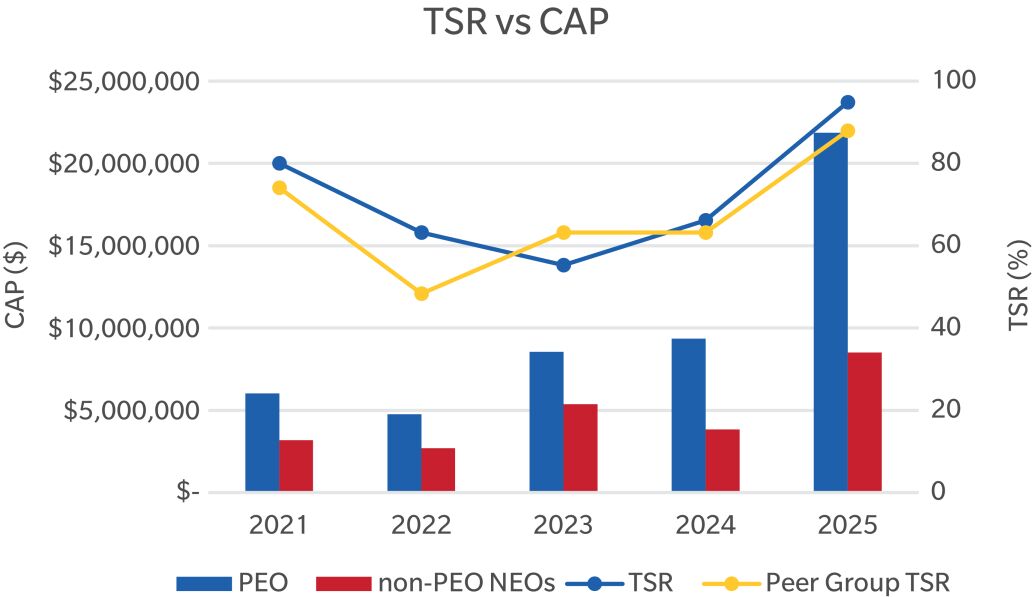 |
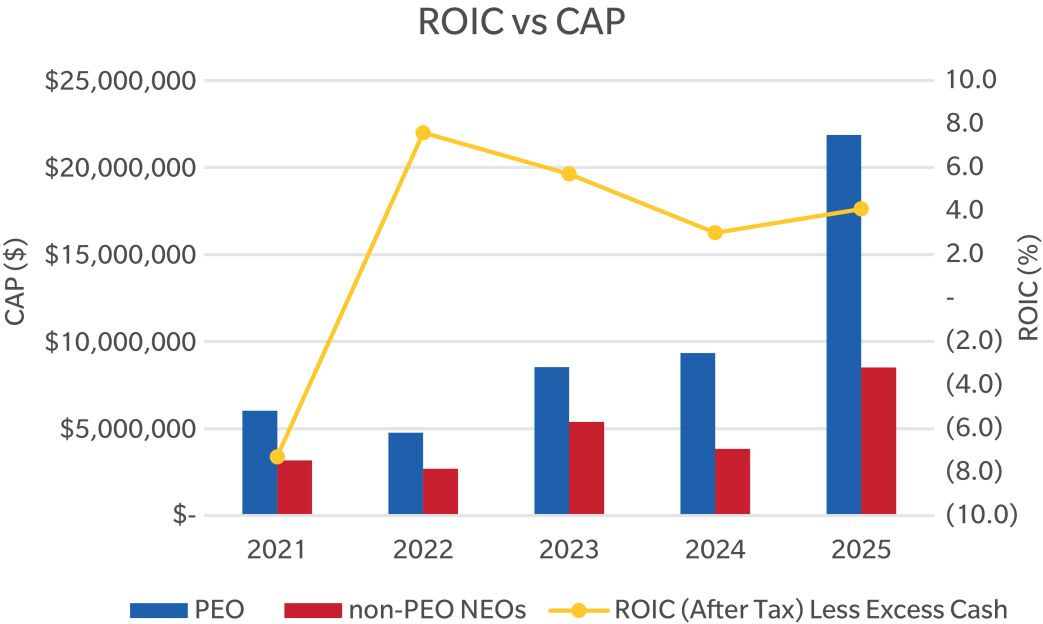 |
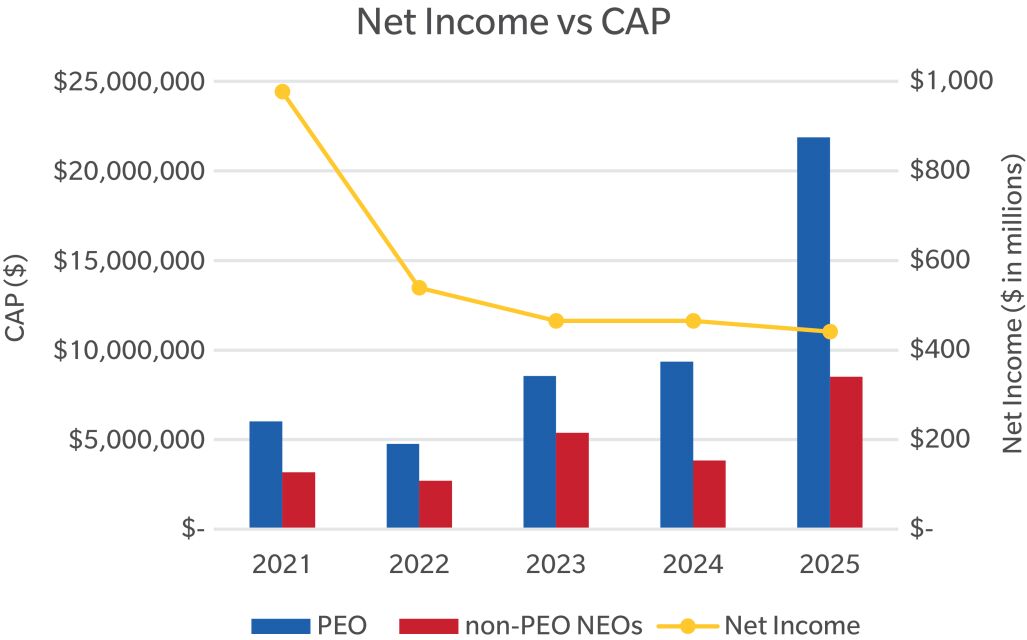
• |
(after-tax) less Excess Cash |
• |
• |
• |
• |
Wall Street Journal ranking of U.S. airlines, using seven equally weighted objective industry operational performance metrics; and |
• |
Company progress towards major initiatives. |
58 |
|
Southwest Airlines 2026 Proxy Statement |
Table of Contents
| Compensation of Executive Officers
|
Grants of Plan-Based Awards in Fiscal 2025
The following table provides information with respect to grants of plan-based awards to the named executive officers in 2025.
| Name |
Estimated Possible Payouts Under Non-Equity |
Estimated Future Payouts Under Equity Incentive Plan Awards |
All Other (#)(2) |
Grant Date ($)(3) | |||||||||||||||||||||||||||||||||||||||||
| Grant Date |
($) |
($) |
($) |
(#) |
(#) |
(#) | |||||||||||||||||||||||||||||||||||||||
| Robert E. Jordan |
— | (1) | N/A | 1,700,000 | 3,400,000 | — | — | — | — | — | |||||||||||||||||||||||||||||||||||
|
|
2/4/2025 | (4) | — | — | — | 13,113 | 131,131 | 262,262 | — | 4,037,523 | |||||||||||||||||||||||||||||||||||
|
|
2/4/2025 | — | — | — | — | — | — | 131,131 | 4,037,523 | ||||||||||||||||||||||||||||||||||||
|
|
10/16/2025 | (5) | — | — | — | N/A | 150,196 | 300,392 | — | 5,000,025 | |||||||||||||||||||||||||||||||||||
| Tom Doxey |
— | (1) | N/A | 776,250 | 1,552,500 | — | — | — | — | — | |||||||||||||||||||||||||||||||||||
|
|
3/14/2025 | (4) | — | — | — | 4,077 | 40,774 | 81,548 | — | 1,293,759 | |||||||||||||||||||||||||||||||||||
|
|
3/14/2025 | (6) | — | — | — | N/A | 100,000 | 200,000 | — | 3,173,000 | |||||||||||||||||||||||||||||||||||
|
|
3/14/2025 | — | — | — | — | — | — | 88,048 | 2,793,763 | ||||||||||||||||||||||||||||||||||||
| Andrew M. Watterson |
— | (1) | N/A | 1,020,000 | 2,040,000 | — | — | — | — | — | |||||||||||||||||||||||||||||||||||
|
|
2/4/2025 | (4) | — | — | — | 5,521 | 55,213 | 110,426 | — | 1,700,008 | |||||||||||||||||||||||||||||||||||
|
|
2/4/2025 | — | — | — | — | — | — | 55,213 | 1,700,008 | ||||||||||||||||||||||||||||||||||||
|
|
3/14/2025 | (6) | — | — | — | N/A | 100,000 | 200,000 | — | 3,173,000 | |||||||||||||||||||||||||||||||||||
| Justin Jones |
— | (1) | N/A | 735,750 | 1,471,500 | — | — | — | — | — | |||||||||||||||||||||||||||||||||||
|
|
2/4/2025 | (4) | — | — | — | 3,540 | 35,402 | 70,804 | — | 1,090,028 | |||||||||||||||||||||||||||||||||||
|
|
2/4/2025 | — | — | — | — | — | — | 35,402 | 1,090,028 | ||||||||||||||||||||||||||||||||||||
|
|
3/14/2025 | (6) | — | — | — | N/A | 60,000 | 120,000 | — | 1,903,800 | |||||||||||||||||||||||||||||||||||
| Anthony Roach |
— | (1) | N/A | 675,000 | 1,350,000 | — | — | — | — | — | |||||||||||||||||||||||||||||||||||
|
|
2/4/2025 | (4) | — | — | — | 1,130 | 11,303 | 22,606 | — | 348,019 | |||||||||||||||||||||||||||||||||||
|
|
2/4/2025 | — | — | — | — | — | — | 11,303 | 348,019 | ||||||||||||||||||||||||||||||||||||
|
|
3/14/2025 | (4) | — | — | — | 1,660 | 16,609 | 33,218 | — | 527,004 | |||||||||||||||||||||||||||||||||||
|
|
3/14/2025 | (6) | — | — | — | N/A | 60,000 | 120,000 | — | 1,903,800 | |||||||||||||||||||||||||||||||||||
|
|
3/14/2025 | — | — | — | — | — | — | 16,609 | 527,004 | ||||||||||||||||||||||||||||||||||||
| Tammy Romo |
— | (1) | N/A | 823,500 | 1,647,000 | — | — | — | — | — | |||||||||||||||||||||||||||||||||||
|
|
2/4/2025 | (4) | — | — | — | 4,457 | 44,577 | 89,154 | — | 1,372,526 | |||||||||||||||||||||||||||||||||||
|
|
2/4/2025 | — | — | — | — | — | — | 44,577 | 1,372,526 | ||||||||||||||||||||||||||||||||||||
| (1) | This row shows cash incentive awards granted under the Company’s STI Plan with respect to the performance period from January 1, 2025 through December 31, 2025. This row shows the potential amounts to be paid based on achievement at target and maximum performance levels. The potential payouts were performance-driven and therefore completely at risk. The amount of the Compensation Committee determined payout for 2025, beginning at zero percent of the target payout, was interpolated between performance targets. The business metrics and targets used to determine the amounts of the awards paid are described above under “Compensation Discussion and Analysis.” |
| (2) | The awards consist of time-based RSUs granted under the Company’s Amended and Restated 2007 Equity Incentive Plan (the “2007 Equity Plan”). The RSUs are settleable in shares of common stock and are scheduled to vest with respect to one-third of the shares covered thereby annually, which vesting began on February 21, 2026 for awards granted February 2025 and March 21, 2026 for awards granted March 2025. The Company does not pay dividends on unvested RSUs. |
| (3) | The values included in this column represent the grant date fair value of these awards computed in accordance with FASB ASC Topic 718 determined without regard to forfeitures. The assumptions used in calculating the values for fiscal 2025 are included in Note 9 to the Company’s financial statements included in its Annual Report on Form 10-K for the fiscal year ended December 31, 2025. |
| (4) | The awards consist of annual performance-based RSUs granted under the 2007 Equity Plan with respect to the performance period from January 1, 2025 to December 31, 2027. The performance-based RSUs are scheduled to vest, if at all, on February 21, 2028, and are settleable in shares of common stock. The columns show the potential number of shares of common stock to be paid out upon vesting of the performance-based RSUs for each named executive officer based on achievement at the threshold, target, and maximum performance levels. The potential payouts are performance-driven and therefore completely at risk. The number of performance-based RSUs that will vest and the number of shares of the Company’s common stock to be issued, if any, as of the vesting date will be determined based on the achievement of ROIC (after-tax) less Excess Cash targets. See “Compensation Discussion and Analysis” for further information. |
| Southwest Airlines 2026 Proxy Statement |
|
59 |
Table of Contents
| Compensation of Executive Officers
|
| (5) | The award consists of Southwest Even Better performance-based RSUs granted to Mr. Jordan under the 2007 Equity Plan with respect to the performance period from January 1, 2026 to December 31, 2026 and from January 1, 2027 to December 31, 2027. Mr. Jordan’s Southwest Even Better performance-based RSUs are scheduled to vest, if at all, on October 21, 2028, and are settleable in shares of common stock. The columns show the potential number of shares of common stock to be paid out upon vesting of the Southwest Even Better performance-based RSUs for Mr. Jordan based on achievement at the target and maximum performance levels. The maximum performance level reflects the Board’s discretion, if applicable financial targets are achieved, to increase the maximum payout up to 200 percent to reward extraordinary performance and acceleration of initiatives delivery. The potential payouts are performance-driven and therefore completely at risk. The number of Southwest Even Better performance-based RSUs that will vest and the number of shares of the Company’s common stock to be issued, if any, as of the vesting date will be determined based on the achievement of Adjusted EBIT targets. See “Compensation Discussion and Analysis” for further information. |
| (6) | The awards consist of Southwest Even Better performance-based RSUs granted under the 2007 Equity Plan with respect to the performance period from January 1, 2026 to December 31, 2026 and from January 1, 2027 to December 31, 2027. The Southwest Even Better performance-based RSUs are scheduled to vest, if at all, on March 21, 2028, and are settleable in shares of common stock. The columns show the potential number of shares of common stock to be paid out upon vesting of the Southwest Even Better performance-based RSUs for the named executive officer based on achievement at the target and maximum performance levels. The maximum performance level reflects the Board’s discretion, if applicable financial targets are achieved, to increase the maximum payout up to 200 percent to reward extraordinary performance and acceleration of initiatives delivery. The potential payouts are performance-driven and therefore completely at risk. The number of Southwest Even Better performance-based RSUs that will vest and the number of shares of the Company’s common stock to be issued, if any, as of the vesting date will be determined based on the achievement of Adjusted EBIT targets. See “Compensation Discussion and Analysis” for further information. |
Outstanding Equity Awards at Fiscal 2025 Year-End
The following table provides information with respect to RSUs (including performance-based RSUs) held by the named executive officers as of December 31, 2025. RSUs (including performance-based RSUs) were the only types of equity awards outstanding for the named executive officers at fiscal 2025 year-end.
|
Stock Awards | ||||||||||||||||||||
| Name | Number of Shares or Units of Have Not Vested (#)(1) |
Market Value of Vested ($)(2) |
Equity Incentive (#)(3) |
Equity Incentive ($)(2) | ||||||||||||||||
| Robert E. Jordan |
228,537 | (4) | 9,445,434 | 175,039 | (5) | 7,234,362 | ||||||||||||||
| Tom Doxey |
88,048 | (6) | 3,639,024 | 104,077 | (7) | 4,301,502 | ||||||||||||||
| Andrew M. Watterson |
102,455 | (8) | 4,234,465 | 111,041 | (9) | 4,589,325 | ||||||||||||||
| Justin Jones |
55,456 | (10) | 2,291,996 | 66,467 | (11) | 2,747,081 | ||||||||||||||
| Anthony Roach |
37,147 | (12) | 1,535,286 | 63,920 | (13) | 2,641,814 | ||||||||||||||
| Tammy Romo |
84,428 | (14) | 3,489,409 | 9,048 | (15) | 373,954 | ||||||||||||||
| (1) | The awards consist of RSUs that are settleable in shares of common stock. |
| (2) | Market value is computed by multiplying the number of time-based RSUs or performance-based RSUs by $41.33, which was the closing price per share of the Company’s common stock on December 31, 2025 on the NYSE. |
| (3) | The awards consist of performance-based RSUs that are settleable in shares of common stock include: |
| Award | Grant Date | Performance Period | Performance Metric | Vesting Date | ||||
| Performance-Based RSUs |
January 31, 2024 | January 1, 2024 to December 31, 2026 | ROIC (after-tax) less Excess Cash and Relative ROIC | February 21, 2027 | ||||
| Performance-Based RSUs |
February 4, 2025 March 14, 2025 |
January 1, 2025 to December 31, 2027 | ROIC (after-tax) less Excess Cash and Relative ROIC | February 21, 2028 | ||||
| Southwest Even Better performance-based RSUs |
March 14, 2025 October 16, 2025 |
January 1, 2026 to December 31, 2026 and January 1, 2027 to December 31, 2027 |
Adjusted EBIT, subject to Board discretion to increase the maximum payout | March 21, 2028 October 21, 2028 | ||||
| 60 |
|
Southwest Airlines 2026 Proxy Statement |
Table of Contents
| Compensation of Executive Officers
|
| In accordance with SEC rules, the number of performance-based RSUs from the 2024 grant represents the threshold number of performance-based RSUs that may vest on the February 21, 2027 vesting date, the number of performance-based RSUs from the 2025 grants scheduled to vest on February 21, 2028 represent the threshold number of performance-based RSUs that may vest on the 2028 vesting date, and the number of Southwest Even Better performance-based RSUs from the 2025 grants represent the target number of performance-based RSUs that may vest on the respective March 21, 2028 and October 21, 2028 vesting dates. The potential payouts are performance-driven and therefore completely at risk. |
| (4) | Of these RSUs, (i) 102,015 vested on February 21, 2026; (ii) 82,812 are scheduled to vest on February 21, 2027; and (iii) 43,710 are scheduled to vest on February 21, 2028. |
| (5) | Of these performance-based RSUs, (i) the threshold number that may vest on February 21, 2027 is 11,730; (ii) the threshold number that may vest on February 21, 2028 is 13,113; and (iii) the target number that may vest on October 21, 2028 is 150,196. |
| (6) | Of these RSUs, (i) 29,350 vested on March 21, 2026; (ii) 29,349 are scheduled to vest on March 21, 2027; and (iii) 29,349 are scheduled to vest on March 21, 2028. |
| (7) | Of these performance-based RSUs, the threshold number that may vest on February 21, 2028 is 4,077; and the target number that may vest on March 21, 2028 is 100,000. |
| (8) | Of these RSUs, (i) 47,246 vested on February 21, 2026; (ii) 36,805 are scheduled to vest on February 21, 2027; and (iii) 18,404 are scheduled to vest on February 21, 2028. |
| (9) | Of these performance-based RSUs, (i) the threshold number that may vest on February 21, 2027 is 5,520; (ii) the threshold number that may vest on February 21, 2028 is 5,521; and (iii) the target number that may vest on March 21, 2028 is 100,000. |
| (10) | Of these RSUs, (i) 22,097 vested on February 21, 2026; (ii) 21,559 are scheduled to vest on February 21, 2027; and (iii) 11,800 are scheduled to vest on February 21, 2028. |
| (11) | Of these performance-based RSUs, (i) the threshold number that may vest on February 21, 2027 is 2,927; (ii) the threshold number that may vest on February 21, 2028 is 3,540; and (iii) the target number that may vest on March 21, 2028 is 60,000. |
| (12) | Of these RSUs, (i) 9,239 vested on February 21, 2026; (ii) 5,537 vested on March 21, 2026; (iii) 7,532 are scheduled to vest on February 21, 2027; (iv) 5,536 are scheduled to vest on March 21, 2027; (v) 3,767 are scheduled to vest on February 21, 2028; and (vi) 5,536 are scheduled to vest on March 21, 2028. |
| (13) | Of these performance-based RSUs, (i) the threshold number that may vest on February 21, 2027 is 1,129; (ii) the threshold number that may vest on February 21, 2028 is 2,791; and (iii) the target number that may vest on March 21, 2028 is 60,000. |
| (14) | Of these RSUs, (i) 39,404 vested on February 21, 2026; (ii) 30,165 are scheduled to vest on February 21, 2027; and (iii) 14,859 are scheduled to vest on February 21, 2028. |
| (15) | Of these performance-based RSUs, the threshold number that may vest on February 21, 2027 is 4,591; and the threshold number that may vest on February 21, 2028 is 4,457. |
Option Exercises and Stock Vested During Fiscal 2025
The following table provides information with respect to stock awards vested for the named executive officers during 2025. None of the named executive officers had stock options outstanding during 2025.
|
Stock Awards | ||||||||||
| Name | Number of Shares Acquired on Vesting (#) |
Value Realized ($)(1) | ||||||||
| Robert E. Jordan |
91,752 | 2,735,127 | ||||||||
| Tom Doxey |
— | — | ||||||||
| Andrew M. Watterson |
42,215 | 1,258,429 | ||||||||
| Justin Jones |
10,684 | 318,490 | ||||||||
| Anthony Roach |
7,010 | 208,968 | ||||||||
| Tammy Romo |
40,142 | 1,196,633 | ||||||||
| (1) | Calculated by multiplying the number of shares acquired upon the February 21, 2025 vesting of time-based RSUs and/or performance-based RSUs by $29.81, the closing price of the Company’s common stock on February 21, 2025. |
Nonqualified Deferred Compensation in Fiscal 2025
As discussed above under “Compensation Discussion and Analysis – Retirement, Health, and Other Benefits,” the Company maintains a Retirement Savings Plan that resulted from the merger of the Company’s tax-qualified 401(k) plan and profit sharing plan for its eligible Employees. The Company also offers a non-qualified excess benefit plan. This plan enables eligible Employees to defer Company contributions (“excess amounts”) that cannot be contributed to the Retirement Savings Plan due to the
| Southwest Airlines 2026 Proxy Statement |
|
61 |
Table of Contents
| Compensation of Executive Officers
|
qualified plan contribution limits of Section 415(c) of the Internal Revenue Code. The plan only allows contributions above the Code Section 415(c) limits and prohibits other Employee contributions to the plan. Under the excess benefit plan, Employees, including the named executive officers, with excess amounts of at least $1,000 may defer payment of their excess amounts. Employees are immediately 100 percent vested in their benefits under the excess benefit plan; however, the benefits are unsecured obligations of the Company in the event of its bankruptcy or insolvency. Before the beginning of each plan year, participants may select a rate of return to apply to the amounts to be deferred to the excess benefit plan for the upcoming plan year. In 2025, the excess benefit plan allowed participants to select a rate of return equal to returns in one or more of the following investment options:
| Fund Name |
Ticker | 2025 Rate of Return |
|||||||||||||
| Vanguard Target Retirement Income Fund |
VTINX | 11.31 | |||||||||||||
| Vanguard Target Retirement 2020 Fund |
VTWNX | 12.15 | |||||||||||||
| Vanguard Target Retirement 2025 Fund |
VTTVX | 14.60 | |||||||||||||
| Vanguard Target Retirement 2030 Fund |
VTHRX | 16.24 | |||||||||||||
| Vanguard Target Retirement 2035 Fund |
VTTHX | 17.54 | |||||||||||||
| Vanguard Target Retirement 2040 Fund |
VFORX | 18.76 | |||||||||||||
| Vanguard Target Retirement 2045 Fund |
VTIVX | 19.99 | |||||||||||||
| Vanguard Target Retirement 2050 Fund |
VFIFX | 21.41 | |||||||||||||
| Vanguard Target Retirement 2055 Fund |
VFFVX | 21.43 | |||||||||||||
| Vanguard Target Retirement 2060 Fund |
VTTSX | 21.42 | |||||||||||||
| Vanguard Target Retirement 2065 Fund |
VLXVX | 21.43 | |||||||||||||
| Vanguard Target Retirement 2070 Fund |
VSVNX | 21.42 | |||||||||||||
| Vanguard Institutional Index Fund Institutional Plus Shares |
VIIIX | 17.86 | |||||||||||||
| Payden Absolute Return Bond Fund SI Class |
PYAIX | 6.07 | |||||||||||||
Amounts deferred to the excess benefit plan before 2018 received a rate of return equal to one or more of the following, in accordance with the participants’ elections:
| Fund Name |
Ticker | 2025 Rate of Return |
|||||||||||||
| Vanguard 500 Index Fund Admiral Shares |
VFIAX | 17.83 | |||||||||||||
| Fixed Income Fund Plus 2 Percent |
N/A | 4.40 | |||||||||||||
Once an excess amount is credited to a participant’s account, the participant may not change that investment election for that amount or transfer amounts between funds, but participants may change investment elections during annual enrollment for new excess amounts deferred. Participants may receive their accounts upon separation from service with the Company. They must elect the time and form of distribution of their accounts before their first year of participation in the excess benefit plan. Distribution may be in a lump sum payout or equal annual installments over a period of up to five years. It may be received or commenced (i) in the calendar year of separation from service or (ii) the calendar year following the year in which separation from service occurs.
The Company also offers a separate nonqualified deferred compensation plan, the SMC Deferred Compensation Plan, which is designed to provide benefits with respect to Employee contributions that cannot be contributed to the Company’s 401(k) plans due to qualified plan limits established by the IRS. Under the SMC Deferred Compensation Plan, officers of the Company who are not eligible to participate in the Company’s 2005 Deferred Compensation Plan for Pilots may, before the beginning of each plan year, irrevocably elect to defer up to 50 percent of their salary otherwise payable to them for such plan year and 100 percent of any bonus amounts they earn for such plan year. In 2025, the SMC Deferred Compensation Plan provided a rate of return equal to one or more of the investment options shown in the table above for the excess benefit plan. Participant benefits are unsecured obligations of the Company in the event of its bankruptcy or insolvency. Participants may receive their accounts upon separation
| 62 |
|
Southwest Airlines 2026 Proxy Statement |
Table of Contents
| Compensation of Executive Officers
|
from service with the Company. They must elect the time and form of distribution of their accounts before their first year of participation in the SMC Deferred Compensation Plan. Distribution may be in a lump sum payout or equal annual installments over a period of up to five years. It may be received or commenced (i) in the calendar year of separation from service or (ii) the calendar year following the year in which separation from service occurs.
The following table provides information with respect to nonqualified deferred compensation earned by the named executive officers for 2025.
|
Nonqualified Deferred Compensation for Fiscal 2025 |
|||||||||||||||||||||||||||||
| Name | Plan | Executive Contributions in Last Fiscal Year ($) |
Southwest Contributions in Last Fiscal Year ($) |
Aggregate Earnings ($) |
Aggregate Withdrawals/ Distributions in Last Fiscal Year ($) |
Aggregate Balance at December 31, ($) |
|||||||||||||||||||||||
| Robert E. Jordan |
Excess Benefit Plan | — | — | 97,830 | (1) | — | 646,241 | (2) | |||||||||||||||||||||
| Tom Doxey |
— | — | — | — | — | — | |||||||||||||||||||||||
| Andrew M. Watterson |
— | — | — | — | — | — | |||||||||||||||||||||||
| Justin Jones |
— | — | — | — | — | — | |||||||||||||||||||||||
| Anthony Roach |
— | — | — | — | — | — | |||||||||||||||||||||||
| Tammy Romo |
— | — | — | — | — | — | |||||||||||||||||||||||
| (1) | None of these earnings were above-market or preferential. Therefore, no portion of this amount has been reported as compensation to the named executive officer for the last completed fiscal year in the Summary Compensation Table. |
| (2) | Of this amount, $113,111 has been required to be reported as compensation to Mr. Jordan in the Summary Compensation Table for previous years. |
Potential Payments Upon Termination or Change-in-Control
Executive Service Recognition Plan Executive Employment Agreements
In 1987, the Board of the Company established Executive Service Recognition Plan Executive Employment Agreements (as amended, the “executive change-in-control agreements”). Each named executive officer is, and was during 2025, party to an executive change-in-control agreement with the Company. Although these agreements are titled “Employment Agreements,” their terms can only be invoked in the event of a change-in-control of the Company, and they do not provide for any incremental compensation to be paid to the named executive officers unless, subsequent to a change-in-control, an executive’s employment is terminated other than for cause or disability, or the executive resigns for good reason.
The executive change-in-control agreements provide that, in the event of a change-in-control of the Company, the Company agrees to continue to employ the executives, and the executives agree to remain in the employ of the Company, for one year after the occurrence of the change-in-control (the “Employment Year”). In such event, the executives would continue to be entitled to a base salary in an amount at least equal to the highest salary received by them during the preceding 12-month period. In addition, for any fiscal year that ends during the Employment Year, they would continue to be entitled to an annual bonus in an amount at least equal to the highest bonus (the “Change-in-Control Bonus Amount”) paid or payable to them in respect of either of the two fiscal years immediately prior to the fiscal year in which the change-in-control has occurred. If, during the Employment Year, an executive’s employment is terminated other than for cause or disability, or the executive resigns for good reason, then the executive is entitled to a lump sum payment equal to:
| (a) | a bonus, the maximum amount of which would be equal to the annual bonus paid to the executive for the last full fiscal year of the Company prior to the fiscal year of the date of termination, but which would be prorated to reflect the actual portion of the year during which the executive has been employed; |
| (b) | an amount equal to the executive’s annual base salary in effect at the time of notice of termination; and |
| (c) | the Change-in-Control Bonus Amount paid to the executive for the last full fiscal year of the Company (being the year in which the change-in-control has occurred, but not the date of termination of employment) or, if no such bonus has been paid, the Change-in-Control Bonus Amount that would have been payable to the executive for the then current fiscal year (being the year in which the date of termination of employment has occurred). |
| Southwest Airlines 2026 Proxy Statement |
|
63 |
Table of Contents
| Compensation of Executive Officers
|
For purposes of the executive change-in-control agreements:
| • | a “change-in-control” is generally deemed to occur in the event a third party acquires 20 percent or more of the Company’s voting securities or a majority of the Directors of the Company are replaced as a result of a tender offer or merger, sale of assets, or contested election; |
| • | “cause” means (i) an act or acts of dishonesty taken by an executive and intended to result in substantial personal enrichment of the executive at the expense of the Company or (ii) violations by an executive of the executive’s duties under the agreement that are (a) grossly negligent or (b) willful and deliberate on the executive’s part and that, in any case, result in material injury to the Company; and |
| • | “good reason” is generally defined as the assignment to the executive of duties inconsistent with the executive’s duties prior to the change-in-control, relocation, or a failure of the Company to abide by the provisions of the executive’s change-in-control agreement. |
2007 Equity Plan
Pursuant to the terms of the 2007 Equity Plan, in the event of the termination of a participant’s service as a result of death or disability, (a) any of the participant’s outstanding time-based RSUs or stock options that have not yet vested will fully vest as of the date of termination and (b) any of the participant’s performance-based RSUs will remain outstanding as if the participant’s service has not terminated and will otherwise be settleable in accordance with the terms of the grant. “Disability” means the inability of a participant to continue to perform services for the Company because of the sickness or injury of the participant, as determined by the Company’s Chief Executive Officer, Chief People Officer (or equivalent), Chief Financial Officer, and/or Chief Legal Officer (or equivalent). Such a determination will be made in good faith and in the sole discretion of one or more of these officers, who shall also have sole discretion to determine the effective date of a participant’s termination of service as a result of disability.
Beginning with equity incentive plan awards granted in 2021, provided the participant’s service has terminated no earlier than 12 months after the date of the grant, in the event of termination of a participant’s service as a result of a “qualified retirement,” (a) any of the participant’s outstanding time-based RSUs that have not yet vested will remain outstanding as if the participant’s service has not terminated and will continue to vest in accordance with the vesting schedule set forth in the notice of the grant and (b) any of the participant’s performance-based RSUs, with the exception of the Southwest Even Better performance-based RSUs, will remain outstanding as if the participant’s service has not yet terminated and will otherwise be settleable in accordance with the terms of the grant; however, the number of shares received upon settlement of the performance-based RSUs will be pro-rated based on the participant’s number of days of service between the date of the grant and the end of the performance period. A participant’s termination of service will be considered a “qualified retirement” if (a) the participant has completed at least 10 years of continuous service, (b) the participant’s age plus completed years of continuous service equal at least 65 at the time of the participant’s termination of service, and (c) the participant has not been terminated for cause.
The 2007 Equity Plan does not provide for acceleration of RSUs in the event of a change-in-control. In the event of the termination of a participant’s service for any reason other than as a result of (i) death or disability, or (ii) a “qualified retirement,” the participant’s outstanding unvested RSUs would be forfeited.
STI Plan
The Company granted restricted cash awards in 2023 under its STI Plan. In the event of the termination of a participant’s service as a result of death or disability, any of the participant’s outstanding restricted cash awards that have not yet vested will fully vest as of the date of termination. In addition, provided that the participant’s service has terminated no earlier than 12 months after the date of the award, in the event of termination of a participant’s service as a result of a “qualified retirement,” any of the participant’s outstanding cash awards that have not yet vested will remain outstanding as if the participant’s service has not yet terminated and will otherwise be settleable in accordance with the terms of the grant. In the event of the termination of a participant’s service for any reason other than as a result of (i) death or disability, or (ii) a “qualified retirement,” the participant’s outstanding unvested cash awards would be forfeited. The STI Plan does not provide for acceleration of restricted cash awards in the event of a change-in-control.
| 64 |
|
Southwest Airlines 2026 Proxy Statement |
Table of Contents
| Compensation of Executive Officers
|
The Company granted career investment cash awards in 2024 under its STI Plan. In the event of the termination of a participant’s service as a result of death or disability, any of the participant’s outstanding career investment cash awards that have not yet vested will fully vest as of the date of termination. In the event of the termination of a participant’s service for any reason other than as a result of death or disability, the participant’s outstanding unvested awards would be forfeited. The STI Plan does not provide for acceleration of career investment cash awards in the event of a change-in-control.
The Company also granted performance-based cash awards in 2023, for the performance period from January 1, 2023 to December 31, 2025. In the event of the termination of the participant’s service as a result of death or disability, any of these outstanding performance-based cash awards for a participant would have remained outstanding as if the participant’s service had not terminated and would otherwise have been settleable in accordance with the terms of the grant. In addition, provided the participant’s service had terminated no earlier than 12 months after the date of the award, in the event of termination of a participant’s service as a result of a “qualified retirement,” any of these performance-based cash awards for a participant would have remained outstanding as if the participant’s service had not yet terminated and would otherwise have been settleable in accordance with the terms of the grant; however, the amount of cash received upon settlement of the performance-based cash awards would have been pro-rated based on the participant’s number of days of service between the date of the grant and the end of the performance period. Reflecting the Company’s commitment to pay-for-performance, the 2023 performance-based cash awards paid out at zero percent of the target opportunity as the Company’s ROIC (after tax) Less Excess Cash for the performance period was below absolute and relative threshold performance levels.
Incremental amounts receivable by the named executive officers pursuant to the executive change-in-control agreements or the 2007 Equity Plan or STI Plan are set forth in the table below.
| Name |
Termination ($) |
Change-in- ($) |
Termination after a ($)(1) |
Estimated ($)(2) |
Estimated ($)(3) |
|||||||||||||||||||||||||
| Robert E. Jordan |
— | — | 4,080,700 | 9,694,600 | 4,274,956 | |||||||||||||||||||||||||
| Tom Doxey |
— | — | 575,000 | 3,639,024 | — | |||||||||||||||||||||||||
| Andrew M. Watterson |
— | — | 2,618,420 | 8,341,631 | 2,059,678 | |||||||||||||||||||||||||
| Justin Jones |
— | — | 1,866,650 | 4,336,162 | 872,998 | |||||||||||||||||||||||||
| Anthony Roach |
— | — | 1,160,825 | 3,535,286 | 381,683 | |||||||||||||||||||||||||
| Tammy Romo |
— | — | 2,222,413 | 3,562,743 | 1,720,376 | |||||||||||||||||||||||||
| (1) | Represents amounts payable pursuant to the executive change-in-control agreements and assumes the triggering event took place on December 31, 2025. |
| (2) | Represents amounts payable with respect to the acceleration of time-vesting RSUs under the 2007 Equity Plan and the acceleration of time-vesting restricted cash and career investment cash awards under the STI Plan, in each case in the event of death or disability only. Also assumes the triggering event took place on December 31, 2025, and reflects the unvested cash and the aggregate market value of unvested RSUs that would become vested under the circumstances. In the event of death or disability, performance-based RSUs and Southwest Even Better performance-based RSUs will remain outstanding and will vest if, and only if, the requisite performance criteria are eventually achieved. The aggregate market value is computed by multiplying the number of RSUs by $41.33, which was the closing price per share of the Company’s common stock on December 31, 2025, on the NYSE. |
| (3) | Represents amounts to become payable with respect to time-vesting RSUs under the 2007 Equity Plan in the event of a “qualified retirement” and amounts to become payable with respect to time-vesting restricted cash awards under the STI Plan in the event of a “qualified retirement.” Also assumes the triggering event took place on December 31, 2025, and reflects the unvested cash and the aggregate market value of unvested time-based RSUs that would continue to vest in accordance with the vesting schedule set forth in the notice of the grant. The aggregate market value is computed by multiplying the number of time-based RSUs by $41.33, which was the closing price per share of the Company’s common stock on December 31, 2025, on the NYSE. In the event of a “qualified retirement,” performance-based RSUs will vest if, and only if, the requisite performance criteria are achieved; however the number of shares received upon settlement of the performance-based RSUs will be pro-rated based on the participant’s number of days of service between the date of the grant and the end of the performance period. |
In addition to the amounts discussed above, in the event of termination of their employment for any reason other than for cause, each of the named executive officers would be eligible to participate in any non-contract retiree medical benefit plan or program that the Company may then make available to its retirees generally on the same terms as other retirees. In addition, these individuals would be entitled to the amounts credited to their accounts pursuant to the Company’s qualified retirement plans, as well as nonqualified deferred compensation amounts credited to their accounts pursuant to the Company’s excess benefit plan, and SMC Deferred Compensation Plan, each as disclosed in more detail above under the heading “Nonqualified Deferred Compensation in Fiscal 2025.”
| Southwest Airlines 2026 Proxy Statement |
|
65 |
Table of Contents
| Compensation of Directors
|
Fiscal 2025 Director Compensation
The following table provides information with respect to compensation earned by the non-Employee members of the Board for the year ended December 31, 2025.
| Name |
Fees Earned or Paid in Cash ($) |
Stock ($)(1) |
All Other Compensation ($) |
Total ($) |
|||||||||||||||||||||
| Lisa M. Atherton |
139,000 | 170,017 | — | 309,017 | |||||||||||||||||||||
| Pierre R. Breber |
130,075 | 170,017 | — | 300,092 | |||||||||||||||||||||
| Douglas H. Brooks |
220,260 | 170,017 | — | 390,277 | |||||||||||||||||||||
| Eduardo F. Conrado(2) |
58,527 | — | — | 58,527 | |||||||||||||||||||||
| C. David Cush(3) |
115,000 | 170,017 | — | 285,017 | |||||||||||||||||||||
| Sarah E. Feinberg |
112,500 | (4) | 170,017 | — | 282,517 | ||||||||||||||||||||
| Robert L. Fornaro(5) |
115,000 | 170,017 | — | 285,017 | |||||||||||||||||||||
| Rakesh Gangwal |
232,664 | 170,017 | — | 402,681 | |||||||||||||||||||||
| David J. Grissen |
122,459 | 170,017 | — | 292,476 | |||||||||||||||||||||
| David P. Hess |
135,000 | 170,017 | — | 305,017 | |||||||||||||||||||||
| Elaine Mendoza(2) |
63,027 | — | — | 63,027 | |||||||||||||||||||||
| Christopher P. Reynolds |
132,500 | 170,017 | — | 302,517 | |||||||||||||||||||||
| Gregg A. Saretsky(3) |
150,000 | 170,017 | — | 320,017 | |||||||||||||||||||||
| Patricia A. Watson |
110,000 | 170,017 | — | 280,017 | |||||||||||||||||||||
| (1) | Awards consist of shares of common stock for each of the Company’s non-Employee members of the Board. Each non-Employee member of the Board on May 14, 2025, received 5,418 shares of common stock. The values included in this column represent the grant date fair value of these awards computed in accordance with FASB ASC Topic 718. Each amount is equal to the number of shares of common stock multiplied by the closing price of the Company’s common stock on the applicable date of the grant, which was $31.38 on May 14, 2025. |
| (2) | Retired from the Board effective May 14, 2025. |
| (3) | Resigned from the Board effective February 23, 2026. |
| (4) | One hundred percent of this amount (representing cash retainer fees earned with respect to 2025) was deferred pursuant to the Company’s SMC Deferred Compensation Plan. |
| (5) | Mr. Fornaro participates, and will be entitled to continue to participate, in the Post-Termination Lifetime Medical and Dental Plan for Former AirTran Holdings, Inc. Officers in accordance with the terms of such plan, as provided in the agreements pursuant to which the Company acquired AirTran Holdings, Inc. on May 2, 2011. |
| 66 |
|
Southwest Airlines 2026 Proxy Statement |
Table of Contents
| Compensation of Directors
|
Non-Employee Directors’ cash retainer fees for Board membership and standing committees are generally paid on an annual basis. Board of Director and committee fees earned by the non-Employee Directors on an annualized basis with respect to 2025 are set forth in the table below:
| Board of Directors: | ||||
| Retainer Fee |
$ | 90,000 | ||
| Chair Retainer Fee |
$ | 200,000 | ||
| Non-Employee Vice Chair Retainer Fee |
$ | 35,000 | ||
| Audit Committee: | ||||
| Chair Retainer Fee |
$ | 30,000 | ||
| Member Retainer Fee |
$ | 15,000 | ||
| Compensation Committee: | ||||
| Chair Retainer Fee |
$ | 25,000 | ||
| Member Retainer Fee |
$ | 12,500 | ||
| Nominating and Corporate Governance Committee: | ||||
| Chair Retainer Fee |
$ | 20,000 | ||
| Member Retainer Fee |
$ | 10,000 | ||
| Safety and Operations Committee: | ||||
| Chair Retainer Fee |
$ | 20,000 | ||
| Member Retainer Fee |
$ | 10,000 | ||
| Finance Committee: | ||||
| Chair Retainer Fee |
$ | 30,000 | ||
| Retainer Fee for all Non-Employee Members |
$ | 15,000 | ||
| Meetings in excess of regularly scheduled Board and Committee Meetings* | ||||
| In-person or Telephonic Attendance Fee Per Meeting |
$ | 1,500 | ||
| * | Includes payments for ad hoc Fleet Oversight Committee meetings. |
At the Compensation Committee’s request, Meridian provided market data and assessments regarding the adequacy of the Company’s compensation program for non-Employee members of the Board in 2025. Based on the information provided, the Compensation Committee recommended a $10,000 increase in the annual cash retainer for 2026 non-Employee Director compensation.
During 2025, the Company provided free travel on Southwest Airlines on a reserved basis for Board members, their spouses, and children of Board members. In addition, the Company’s policy is to provide Board members up to 50 free oneway flight passes, which they could give to anyone on an unrestricted basis along with up to 50 free oneway flight passes, which they could request for use by qualified charitable and 501(c)(3) organizations.
The non-Employee Directors’ current compensation program provides for the following travel privileges following a non-Employee Director’s retirement from the Board: (a) if the Director has served on the Board for at least ten terms, the Director and his or her spouse are eligible for free travel on Southwest Airlines on a reserved basis for life, and the Director shall receive 50 free oneway flight passes per year for life (collectively, “Travel Privileges”); (b) if the Director has served on the Board for five terms or more but less than ten terms, the Director and his or her spouse are eligible for Travel Privileges for a period of ten years; or (c) if the Director has served on the Board for less than five terms, the Director and his or her spouse are eligible for Travel Privileges for a period of five years. In the case of a non-Employee Director’s appointment or retirement occurring between the Company’s annual meetings of shareholders, credit for the length of service for the full term shall be granted. In addition, non-Employee Directors may participate in professional development or continuing education programs, courses, seminars, and other similar events. The Company reimburses Directors for the costs associated with these programs, courses, and seminars, including reasonable travel expenses, membership fees, and registration fees.
Southwest Airlines Co. Severance Plan for Directors. The Board adopted the Severance Plan for Directors in 2009. Pursuant to the Severance Plan for Directors, upon retirement from the Board, a non-Employee Director who has served at least five years as of the date of retirement is entitled to a cash payment of $35,000, and a non-Employee Director who has served at least ten years as of the date of retirement is entitled to a cash payment of $75,000.
| Southwest Airlines 2026 Proxy Statement |
|
67 |
Table of Contents
| Audit Committee Report
|
The Audit Committee has reviewed and discussed with management the audited financial statements of the Company for the year ended December 31, 2025. In addition, the Audit Committee has discussed with Ernst & Young LLP, the Company’s independent auditors, the matters required to be discussed by the applicable requirements of the Public Company Accounting Oversight Board (“PCAOB”) and the SEC.
The Audit Committee has also received the written disclosures and the letter from Ernst & Young required by applicable requirements of the PCAOB regarding Ernst & Young’s communications with the Audit Committee concerning independence, and has discussed with Ernst & Young its independence.
Based on the foregoing review and discussions and relying thereon, the Audit Committee recommended to the Company’s Board of Directors that the audited financial statements be included in the Company’s Annual Report on Form 10-K for the fiscal year ended December 31, 2025.
AUDIT COMMITTEE
Pierre R. Breber, Chair
Douglas H. Brooks
David J. Grissen
David P. Hess
| 68 |
|
Southwest Airlines 2026 Proxy Statement |
Table of Contents
| PROPOSAL 2 Advisory Vote to Approve the Compensation of the Company’s Named Executive Officers
|
In accordance with the Dodd-Frank Act, as well as Section 14A of the Exchange Act, and the rules promulgated thereunder, the Company is providing its Shareholders with the opportunity to cast a non-binding advisory vote on a resolution to approve the compensation of the Company’s named executive officers as disclosed in this Proxy Statement (the “Say-on-Pay Resolution”). This vote is not intended to address any specific element of compensation, but instead is intended to address the overall compensation of the named executive officers as disclosed in this Proxy Statement.
As discussed in greater detail above under “Compensation of Executive Officers — Compensation Discussion and Analysis,” the Board and its Compensation Committee believe the compensation of the Company’s named executive officers for 2025 was reasonable and appropriate for the following reasons, among many others:
| • | The named executive officer compensation structure for 2025 reflects the Compensation Committee’s goal to balance the following objectives: (i) providing fair pay for performance, while maintaining a view from the perspective of the Company’s Shareholders; and (ii) retaining talent, while treating Employees consistently to the extent feasible. To link pay to performance and Shareholder interests, the Compensation Committee tied 100 percent of each named executive officer’s short-term incentive compensation opportunity to pre-established performance metrics. In establishing 2025 performance metrics and related targets, the Compensation Committee focused on financial and operational performance as well as achievement of the Company’s major initiatives. In the Compensation Committee’s view, the resulting short-term incentive payouts for 2025 were fairly and appropriately aligned with Shareholder interests, as discussed in more detail above in “Compensation Discussion and Analysis – Determination of 2025 Executive Compensation; Analysis of Compensation Elements.” The named executive officers’ long-term incentive awards reflected the Compensation Committee’s belief that long-term incentive awards, including equity, should constitute a strong component of overall compensation in order to (i) align a significant percentage of the named executive officers’ compensation opportunities with the interests of the Company’s Shareholders; (ii) serve as a performance-based method to provide appropriate total compensation opportunities relative to market, while also serving as a retention mechanism; and (iii) provide a sufficient percentage of total pay at risk when combined with short-term incentive compensation. Additional detail regarding the Compensation Committee’s rationale for its short-term incentive and long-term incentive determinations is provided above under “Compensation Discussion and Analysis – Determination of 2025 Executive Compensation; Analysis of Compensation Elements.” |
| • | During 2025, the Company provided minimal perquisites to the named executive officers. |
| • | During 2025, none of the named executive officers were party to an employment contract with the Company. |
| • | The Compensation Committee has adopted the Clawback Policy, pursuant to which, to the extent permitted by governing law, the Compensation Committee shall (unless determined to be impracticable) take reasonably prompt action to recoup executive officers’ erroneously awarded incentive-based compensation in the event the Company is required to restate its publicly reported financial statements due to material noncompliance with any financial reporting requirements. |
| • | None of the named executive officers has a severance arrangement related to termination of employment other than in connection with a change-in-control, and the change-in-control arrangements are “double trigger” in that they require both a change-in-control and termination of employment prior to any payout. Further, the Board has adopted a limitation on severance payments within the Company’s Corporate Governance Guidelines. |
| Southwest Airlines 2026 Proxy Statement |
|
69 |
Table of Contents
| PROPOSAL 2
|
|
Effect of the Proposal
Pursuant to the provisions of the Dodd-Frank Act and the rules of the SEC, the vote on the Say-on-Pay Resolution set forth below (i) is advisory and is therefore not binding on the Company, the Board, or the Compensation Committee; (ii) is not to be construed as overruling any decisions of the Company, the Board, or the Compensation Committee; and (iii) does not create or imply any additional fiduciary duties or changes to fiduciary duties of the Company, the Board, or the Compensation Committee. The Board believes that the Board and its Compensation Committee are in the best position to consider the extensive information that from time to time should be taken into consideration in determining named executive officer compensation. Nonetheless, the Company, the Board, and the Compensation Committee value the opinions of the Company’s Shareholders and will take into consideration the outcome of this vote as part of their future deliberations regarding named executive officer compensation.
Current Frequency of Shareholder Advisory Votes to Approve the Compensation of the Company’s Named Executive Officers
Based on the voting results at the Company’s 2023 Annual Meeting of Shareholders with respect to the frequency (the “Frequency Vote”) of Shareholder advisory votes to approve the compensation of the Company’s named executive officers, the Company decided to include an advisory vote to approve the compensation of its named executive officers in its proxy materials on an annual basis. The next required Frequency Vote is scheduled for the Company’s 2029 Annual Meeting of Shareholders.
Text of the Resolution to be Adopted
“RESOLVED, that the Shareholders approve, on an advisory basis, the compensation of the named executive officers, as disclosed in the Company’s Proxy Statement for the 2026 Annual Meeting of Shareholders pursuant to Item 402 of Regulation S-K, including the Compensation Discussion and Analysis, the compensation tables, and any related narrative disclosures.”
Vote Required
Provided a quorum is present at the meeting, the affirmative vote of the holders of a majority of the shares entitled to vote on, and voted for or against, this proposal is required to approve this proposal.
Recommendation of the Board of Directors
|
|
The Board of Directors unanimously recommends a vote FOR this proposal.
| |
Proxies solicited by the Board of Directors will be so voted unless Shareholders specify a different choice.
| 70 |
|
Southwest Airlines 2026 Proxy Statement |
Table of Contents
| PROPOSAL 3 Ratification of the Selection of Independent Auditors
|
The firm of Ernst & Young LLP, independent auditors, has been selected by the Audit Committee to serve as the Company’s independent auditors for the fiscal year ending December 31, 2026. Shareholder ratification of the selection of Ernst & Young LLP as the Company’s independent auditors is not required by the Company’s bylaws or otherwise. However, the Board is submitting the selection of Ernst & Young LLP to the Shareholders for ratification as a matter of good corporate practice. If the Shareholders fail to ratify the selection, the Audit Committee will reconsider whether or not to retain Ernst & Young LLP. Even if the selection is ratified, the Audit Committee, in its discretion, may direct the selection of a different independent registered public accounting firm at any time during the year if the Audit Committee believes this change would be in the best interests of the Company and its Shareholders.
Vote Required
Provided a quorum is present at the meeting, the affirmative vote of the holders of a majority of the shares entitled to vote on, and voted for or against, this proposal is required to approve, on an advisory basis, this proposal.
Recommendation of the Board of Directors
|
|
The Board of Directors unanimously recommends a vote FOR this proposal.
| |
Proxies solicited by the Board of Directors will be so voted unless Shareholders specify a different choice.
Relationship with Independent Auditors
Ernst & Young LLP has served as the Company’s independent auditors since the inception of the Company. A representative of Ernst & Young LLP is expected to be present at the Annual Meeting and will have the opportunity to make a statement if he or she so desires and to respond to appropriate questions.
The following table sets forth the various fees for services provided to the Company by Ernst & Young LLP in 2025 and 2024:
| Year | Audit Fees(1) | Audit-Related Fees | Tax Fees(2) | All Other Fees(3) | Total Fees | |||||
| 2025 |
$2,894,400 | $— | $ 78,193 | $7,675 | $2,980,268 | |||||
| 2024 |
$2,774,701 | $— | $ 133,005 | $7,675 | $ 2,915,381 | |||||
| (1) | Includes fees for the annual audit of the Company’s financial statements and internal controls over financial reporting, quarterly reviews, SEC registration statements, accounting and financial reporting consultations, research work regarding Generally Accepted Accounting Principles, the attestation of management’s Report on Internal Controls, and the annual passenger facility charge audit. |
| (2) | Includes services for tax compliance, tax advice, and tax planning. |
| (3) | Consists of fees for other permitted advisory services and products, including Ernst & Young LLP subscriptions. |
A copy of the Audit Committee’s Audit and Non-Audit Services Preapproval Policy is attached to this Proxy Statement as Appendix A. All of the services rendered by the independent auditors during 2025 were pre-approved by the Audit Committee or by its Chair pursuant to his delegated authority.
| Southwest Airlines 2026 Proxy Statement |
|
71 |
Table of Contents
| Other Matters
|
This Proxy Statement is being furnished in connection with the solicitation of proxies by and on behalf of the Board for use at the Annual Meeting to be held on May 7, 2026, at approximately 4:00 p.m. Central Daylight Time at www.virtualshareholdermeeting.com/LUV2026, or at any such other time and place to which the meeting may be adjourned or postponed. References in the proxy materials to the “Annual Meeting” also refer to any adjournments, postponement, or changes in location of the Annual Meeting, to the extent applicable.
About the Annual Meeting
Admission. To participate in the meeting, visit www.virtualshareholdermeeting.com/LUV2026 and enter your 16-digit control number included in your proxy materials. Online login will begin at 3:45 p.m., Central Daylight Time. Please allow time for online login procedures.
Questions. Once logged in to the virtual meeting website, Shareholders may submit questions related to an agenda item for the Annual Meeting through that site. Questions will be addressed as time permits and may be grouped, summarized, and answered together if related. If a question posed is not addressed during the Annual Meeting, or if a Shareholder has a question or remark not related to an agenda item, such matters may be raised after the Annual Meeting by contacting our Investor Relations Department at investor.relations@wnco.com. Additional rules and procedures relating to the submission of questions and how questions will be addressed can be found in the Rules of Conduct for the Annual Meeting, which will be posted and available for review upon login to the virtual meeting website.
Technical Support. If you encounter any difficulties accessing the virtual Annual Meeting during login or during the meeting, please contact the phone number found on the login page at www.virtualshareholdermeeting.com/LUV2026.
Internet Availability of Proxy Materials
The Company has chosen to take advantage of the “Notice and Access” rules adopted by the SEC, which allow public companies to deliver a Notice of Internet Availability of Proxy Materials (“Notice of Internet Availability”) and provide internet access to the proxy materials and annual report to their stockholders. In lieu of paper copies of the Proxy Statement and other materials, many Shareholders will receive a Notice of Internet Availability containing instructions on how to access the proxy materials and Annual Report and vote online. Please follow the instructions on the Notice of Internet Availability for requesting paper or e-mail copies of the proxy materials and Annual Report. If you requested to receive proxy materials by e-mail in 2025, you will receive an e-mail containing instructions with links to this year’s proxy materials, annual report, and to the proxy voting site. If you choose to receive future proxy materials by e-mail, you will receive an e-mail next year with instructions with links to the proxy materials, annual report, and to the proxy voting site. Your election to receive proxy materials by e-mail will remain in effect until you instruct otherwise. Choosing to receive your future proxy materials by e-mail will save the Company the cost of printing and mailing documents to you.
Please do not return the Notice of Internet Availability. The Notice of Internet Availability is not a valid proxy.
Voting Procedures
A representative of Broadridge Financial Solutions, Inc. will tabulate votes and serve as Inspector of Election for the meeting. Each Shareholder will be entitled to one vote for each share with respect to each matter to be voted on at the meeting. A “Shareholder of record” is a person or entity who holds shares on the record date that are registered in such Shareholder’s name on the records of Southwest’s transfer agent. A person or entity who holds shares through a broker, bank, or other nominee is
| 72 |
|
Southwest Airlines 2026 Proxy Statement |
Table of Contents
|
|
Other Matters
|
considered a “beneficial owner” of the shares. You may receive more than one set of proxy materials. This means your shares are held in more than one account. Please vote all of your shares.
Voting by Shareholders of Record. If you are a Shareholder of record, you may vote (i) through the Internet before the Annual Meeting at www.proxyvote.com or during the Annual Meeting at www.virtualshareholdermeeting.com/LUV2026; (ii) by telephone from the United States, using the number on the proxy card; or (iii) by completing and returning the proxy card. To help us keep our costs low, please vote through the Internet, if possible. Shares represented by proxy will be voted during the meeting and may be revoked at any time prior to the time at which voting closes during the meeting by (i) timely submitting a valid, later-dated proxy; (ii) delivering a written notice of revocation to the Corporate Secretary of the Company; or (iii) voting online at the virtual meeting. Please note that attending the meeting without casting a vote will not revoke any previously submitted proxy. If you properly complete and sign your proxy card, but do not indicate how your shares should be voted on a matter, the shares represented by your proxy will be voted in accordance with the recommendation of the Board.
Voting by Beneficial Owners. If you are a beneficial owner of shares, these proxy materials are being forwarded to you by your broker (or bank or other nominee) who is considered the Shareholder of record of your shares. As the beneficial owner of the shares, you are entitled to direct your broker as to how to vote your shares. You may so instruct your broker through the Internet or by telephone as described in the applicable instructions your broker has provided with these proxy materials. You may also vote by completing the voting instruction card the broker provides to you. To help us keep our costs low, please vote through the Internet, if possible. You may change your vote by submitting new voting instructions to your broker in accordance with such broker’s procedures. If you provide voting instructions to your broker, your shares will be voted as you direct. If you do not provide voting instructions, pursuant to the rules of the NYSE, your broker may vote your shares only with respect to proposals as to which it has discretion to vote under the NYSE’s rules. For any other proposals, the broker may not vote your shares at all, which is referred to as a “broker non-vote.” As the beneficial owner of shares, you are invited to attend the meeting at www.virtualshareholdermeeting.com/LUV2026 by entering the 16-digit control number provided by your broker (or bank or other nominee) and vote your shares online during the meeting.
In accordance with the Texas Business Organizations Code, a list of our Shareholders of record will be available and may be inspected for a period of at least 10 days prior to the Annual Meeting. If you want to inspect the Shareholder list, email our Investor Relations Department at investor.relations@wnco.com to schedule an appointment or request access.
Quorum; Effect of Abstentions and Broker Non-Votes
The presence at the meeting, online or by proxy, of the holders of a majority of the shares of the Company’s common stock entitled to vote at the meeting is necessary to constitute a quorum. Shareholders at the close of business on March 11, 2026, are entitled to vote at the meeting. As of that date, the Company had issued and outstanding 491,075,748 shares of common stock. Abstentions and broker non-votes are each included in the determination of the number of shares present and entitled to vote at the meeting for purposes of determining the presence or absence of a quorum for the transaction of business at the meeting; however, neither abstentions nor broker non-votes are counted as voted either for or against a proposal and, as such, will not affect the outcome of the vote on any proposal.
Please note that, if you are a beneficial owner of shares and do not provide specific voting instructions to your broker, your broker will only be entitled to vote your shares in its discretion with respect to Proposal 3 (Ratification of the Selection of Independent Auditors). Your broker will not be able to vote your shares in its discretion with respect to Proposals 1 or 2, which will be referred to as a “broker non-vote” on those proposals.
Submission of Shareholder Proposals and Director Nominations
To permit the Company and its Shareholders to deal with Shareholder proposals and Shareholder director nominations in an informed and orderly manner, SEC rules and the Company’s bylaws establish advance notice procedures. All notices must be submitted to the Corporate Secretary of the Company (the “Corporate Secretary”) at: Southwest Airlines Co., Attn: Corporate Secretary, Legal Department, HDK-4GC, P.O. Box 36611, Dallas, Texas 75235. Any written notice (containing the information specified in the Company’s bylaws) must be received by the Corporate Secretary by and between the deadlines listed below (subject to change if the 2027 Annual Meeting is more than 30 days before or more than 60 days after the first anniversary date of
| Southwest Airlines 2026 Proxy Statement |
|
73 |
Table of Contents
| Other Matters
|
|
this year’s annual meeting date). A copy of the applicable bylaw provisions may be obtained, without charge, upon written request to the Corporate Secretary at the same address.
| 2027 Proxy Statement and Annual Meeting Deadlines | ||
| Shareholder Proposals for Inclusion in Proxy |
November 28, 2026 | |
| Shareholder Director Nominations for Inclusion in Proxy |
October 29, 2026 – November 28, 2026 | |
| Shareholder Proposals and Director Nominations for Presentation at the Annual Meeting But Not for Inclusion in Proxy |
February 7, 2027 – March 9, 2027 | |
| Shareholder Proxy Solicitation for Shareholder Director Nominees | ||
Any Shareholder who wishes to submit a proposal for inclusion in the Company’s Proxy Statement and Proxy relating to the 2027 Annual Meeting of Shareholders must comply with and follow the procedures required by SEC Rule 14a-8. Additionally, any Shareholder who intends to solicit proxies in support of any director nominees must comply with the content requirements of SEC Rule 14a-19 (the SEC’s universal proxy rule) in addition to complying with the earlier deadlines and requirements in the Company’s bylaws. In accordance with the Company’s bylaws, a proposal or director nomination must be received by the Corporate Secretary between the deadlines listed above to be properly and timely submitted as business to come before the Company’s 2027 Annual Meeting of Shareholders. If the Company does not receive notice of a proposal by and between the stated deadlines, it will be considered “untimely,” and the proxy committee may properly use its discretionary authority to vote for or against the proposal.
Delinquent Section 16(a) Reports
Section 16(a) of the Exchange Act requires the Company’s executive officers, Directors, and persons who beneficially own more than 10% of the Company’s common stock to file reports of ownership and changes in ownership of Company common stock with the SEC and the NYSE. These persons are also required by SEC regulation to furnish the Company with copies of all such reports they file. To the Company’s knowledge, based solely on its review of its copies of such reports, or written representations from such persons, the Company believes that all filing requirements applicable to its Directors, executive officers, and beneficial owners of more than 10% of the Company’s common stock have been satisfied, except that, due to an inadvertent oversight, Ms. Atherton filed a late Form 4 on March 10, 2025, to report the purchase of 118 shares of the Company’s common stock by her spouse on January 30, 2025.
Conduct of Meeting and Discretionary Authority
The Chair of the Board has broad responsibility and authority to conduct the annual meeting in an orderly and timely manner. This authority includes establishing rules for the meeting. These rules will be available at www.virtualshareholdermeeting.com/LUV2026 on the day of the meeting. The Chair of the Board may exercise broad discretion in determining the extent of discussion on each item of business. Further, in the event a quorum is not present at the meeting, the Chair of the Board may adjourn the meeting in order to solicit the required quorum.
In the event a quorum is present at the meeting, but sufficient votes to approve any of the items proposed by the Board have not been received, the persons named as proxies may propose one or more adjournments of the meeting to permit further solicitation of proxies. A Shareholder vote may be taken on one or more of the proposals in this Proxy Statement prior to such adjournment if sufficient proxies have been received and it is otherwise appropriate. Any adjournment will require the affirmative vote of the holders of a majority of those shares of common stock represented at the meeting online or by proxy. If a quorum is present, the persons named as proxies will vote the proxies they have been authorized to vote on any other business properly before the meeting in favor of such an adjournment.
The Board does not know of any other matters that are to be presented for action at the meeting. However, if other matters properly come before the meeting, it is intended that the enclosed Proxy will be voted in accordance with the judgment of the persons voting the Proxy.
| 74 |
|
Southwest Airlines 2026 Proxy Statement |
Table of Contents
|
|
Other Matters
|
Householding
In some cases, only one copy of the Company’s Proxy Statement and Annual Report to Shareholders is being delivered to multiple Shareholders sharing an address unless the Company has received contrary instructions from one or more of the Shareholders. Upon written or oral request, the Company will promptly deliver a separate copy of these documents to a Shareholder at a shared address to which a single copy has been delivered. A Shareholder can notify the Company at Southwest Airlines Co., Attn: Corporate Secretary, Legal Department, HDK-4GC, P.O. Box 36611, Dallas, Texas 75235 or (214) 792-4000 if the Shareholder wishes to receive separate copies in the future. In addition, Shareholders sharing an address who are currently receiving multiple copies may also notify the Company at such address or phone number if they wish to receive only a single copy.
Costs of Solicitation
The Company will pay the costs of solicitation of proxies by the Board. In addition to solicitation through distribution of these proxy materials, solicitation of proxies may be made personally or by telephone by the Company’s regular Employees, and arrangements will be made with brokerage houses or other custodians’ nominees and fiduciaries to send proxies and proxy material to their principals. The Company’s regular Employees will not be additionally compensated.
A copy of the Company’s Annual Report on Form 10-K for the fiscal year ended December 31, 2025, including the financial statements and the financial statement schedules, if any, but not including exhibits, will be provided at no charge to each person to whom this Proxy Statement is delivered upon the written request of such person addressed to Southwest Airlines Co., Attn: Investor Relations, HDQ-6IR, P.O. Box 36611, Dallas, Texas 75235.
By Order of the Board of Directors,
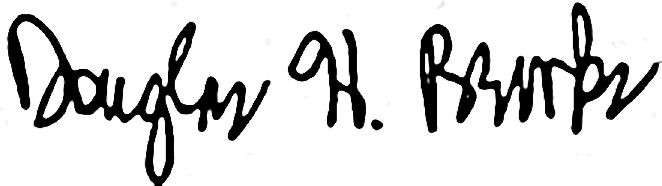
Douglas H. Brooks
Chair of the Board
March 27, 2026
| Southwest Airlines 2026 Proxy Statement |
|
75 |
Table of Contents
| Other Matters
|
|
TO: Participants in the Southwest Airlines Co. Retirement Savings Plan
The Accompanying Notice of Annual Meeting of Shareholders and Proxy Statement are related to shares of common stock of Southwest Airlines Co. held by the Trustee for your Retirement Savings Plan account, as well as any shares you may own in your own name.
Under the Retirement Savings Plan, each participant has the right to direct the Trustee to vote stock credited to his or her account. If you do not direct the Trustee to vote stock credited to your account, the Retirement Savings Plan provides that the Trustee will vote your shares in the same proportion as the shares for which the Trustee receives voting instruction from other participants.
The Trustee is required to vote the shares held for your account in accordance with your instructions or, if you do not provide instructions, in accordance with the Retirement Savings Plan. If you wish to instruct the Trustee on the vote of shares held for your account, you should vote via telephone or the Internet. Your vote must be received by May 5, 2026.
Cautionary Statement Regarding Forward-Looking Statements
This Proxy Statement contains forward-looking statements within the meaning of Section 27A of the Securities Act of 1933, as amended, and Section 21E of the Securities Exchange Act of 1934, as amended. Specific forward-looking statements include, without limitation, statements related to (i) the Company’s financial and operational outlook, momentum, expectations, goals, plans, targets, and projected results of operations, including with respect to improved year-over-year earnings, long-term success, earnings growth, and initiatives, and including factors and assumptions underlying the Company’s expectations and projections, including disciplined execution, relentless pursuit of opportunities, and superior financial performance; (ii) the Company’s transformation, including with respect to strengthening the Company’s competitive position and creating value from transformational initiatives; (iii) the Company’s plans and expectations with respect to stronger, sustained financial performance and the factors and assumptions underlying the Company’s expectations and projections, including diversified revenue opportunities, increased efficiency, and broadened network reach; (iv) the Company’s plans and goals with respect to continuing to evolve, meeting customers’ needs, and pursuing future opportunities that provide and drive value for shareholders and other stakeholders. These forward-looking statements are based on the Company’s current estimates, intentions, beliefs, expectations, goals, strategies, and projections for the future and are not guarantees of future performance. Forward-looking statements involve risks, uncertainties, assumptions, and other factors that are difficult to predict and that could cause actual results to vary materially from those expressed in or indicated by them. Factors include, among others, (i) the impact of fears or actual outbreaks of diseases, extreme or severe weather and natural disasters, actions of competitors (including, without limitation, pricing, scheduling, capacity, and network decisions, and consolidation and alliance activities), governmental actions, fears or actual acts of terrorism or war, consumer perception, consumer uncertainties with respect to trade policies or government shutdowns (including the imposition of tariffs), economic conditions, banking conditions, sociodemographic trends, and other factors beyond the Company’s control, on consumer behavior and the Company’s results of operations and business decisions, plans, strategies, and results; (ii) the Company’s ability to timely and effectively implement, transition, operate, and maintain the necessary information technology systems and infrastructure to support its operations and initiatives, including with respect to revenue management and assigned and extra legroom seating; (iii) consumer behavior and response with respect to the Company’s new commercial products and policies; (iv) the impact of fuel price changes, fuel price volatility, and fuel availability on the Company’s business plans and results of operations; (v) the impact of governmental regulations and other governmental actions, including with respect to government shutdowns, as well as the Company’s ability to obtain any required governmental approvals, on the Company’s business plans, results, and operations; (vi) the Company’s dependence on The Boeing Company (“Boeing”) and Boeing suppliers with respect to the Company’s aircraft deliveries, Boeing MAX 7 aircraft certifications, fleet and capacity plans, operations, maintenance, strategies, and goals; (vii) the Company’s dependence on the Federal Aviation Administration with respect to, among other things, the certification of the Boeing MAX 7 aircraft; (viii) the Company’s dependence on other third parties, in particular with respect to its technology plans, its plans and expectations related to revenue management, online travel agencies, operational reliability, fuel supply, maintenance, Global Distribution Systems, environmental sustainability, and the impact on the Company’s operations and results of operations of any third party delays or nonperformance; (ix) the Company’s ability to timely and effectively prioritize its initiatives and focus areas and related expenditures; (x) the impact of labor matters on the Company’s business decisions, plans, strategies, and results; (xi) the Company’s ability to obtain and maintain adequate infrastructure and equipment to support its operations and initiatives; (xii) the Company’s dependence on its workforce, including its ability to employ and retain sufficient numbers of qualified Employees with appropriate skills and expertise to effectively and efficiently maintain its operations and execute the Company’s plans, strategies, and initiatives; (xiii) the cost and effects of the actions of activist shareholders; and (xiv) other factors, as described in the Company’s filings with the Securities and Exchange Commission, including the detailed factors discussed under the heading “Risk Factors” in the Company’s Annual Report on Form 10-K for the fiscal year ended December 31, 2025.
| 76 |
|
Southwest Airlines 2026 Proxy Statement |
Table of Contents
| APPENDIX A
|
Southwest Airlines Co. Audit and Non-Audit Services Preapproval Policy
I. Purpose
Under the Sarbanes-Oxley Act of 2002 (the “Act”) and the rules of the Securities and Exchange Commission (the “SEC”), the Audit Committee of the Board of Directors is responsible for the appointment, compensation, and oversight of the work of the independent auditor. The Audit Committee is required to pre-approve the audit and non-audit services performed by the independent auditor in order to assure that they do not impair the auditor’s independence from the Company. Accordingly, the Audit Committee has adopted, and the Board of Directors of Southwest Airlines Co. (the “Company” or “Southwest”) has ratified, this Audit and Non-Audit Services Preapproval Policy (the “Policy”), which sets forth the procedures and the conditions pursuant to which services proposed to be performed by the independent auditor may be preapproved.
The SEC’s rules provide that proposed services may be preapproved without consideration of specific case-by-case services by the Audit Committee (“general preapproval”) or may require the specific preapproval of the Audit Committee (“specific preapproval”). The Audit Committee believes that the combination of these two approaches in this Policy will result in an effective and efficient procedure to pre-approve services performed by the independent auditor. Accordingly, unless a type of service has received general preapproval, it will require specific preapproval by the Audit Committee if it is to be provided by the independent auditor.
For each preapproval, the Audit Committee will consider whether the services are consistent with the SEC’s and the Public Company Accounting Oversight Board’s (the “PCAOB”) rules on auditor independence. The Audit Committee will also consider whether the independent auditor is best positioned to provide the most effective and efficient service, for reasons such as its familiarity with the Company’s business, people, culture, accounting systems, risk profile and other factors, and whether the service might enhance the Company’s ability to manage or control risk or improve audit quality. All such factors will be considered as a whole, and no one factor will necessarily be determinative.
The independent auditor has reviewed this Policy and believes that implementation of the policy will not adversely affect the auditor’s independence.
II. Delegation
The Act and the SEC’s rules permit the Audit Committee to delegate preapproval authority to one or more of its members. The member to whom such authority is delegated must report, for informational purposes only, any preapproval decisions to the Audit Committee at its next scheduled meeting.
III. Audit Services
The annual Audit services engagement terms and fees will be subject to the specific preapproval of the Audit Committee. The Audit Committee will monitor the Audit services engagement as necessary, but no less than on a quarterly basis, and will also approve, if necessary, any changes in terms, conditions, and fees.
| A-1 |
|
Southwest Airlines 2026 Proxy Statement |
Table of Contents
| Appendix A
|
In addition to the annual Audit services engagement approved by the Audit Committee, the Audit Committee may grant general preapproval to other Audit services, which are those services that only the independent auditor reasonably can provide. Other Audit services may include services associated with SEC registration statements or other documents issued in connection with securities offerings.
IV. Audit-related Services
Audit-related services are assurance and related services that are reasonably related to the performance of the audit or review of the Company’s financial statements or that are traditionally performed by the independent auditor. Because the Audit Committee believes that the provision of Audit-related services does not impair the independence of the auditor and is consistent with the SEC’s and the PCAOB’s rules on auditor independence, the Audit Committee may grant general preapproval to Audit-related services. Audit-related services include, among others, due diligence services pertaining to potential business acquisitions/dispositions; accounting consultations related to accounting, financial reporting or disclosure matters not classified as “Audit services”; assistance with understanding and implementing new accounting and financial reporting guidance from rulemaking authorities; financial audits of employee benefit plans; agreed-upon or expanded audit procedures related to accounting or billing records required to respond to or comply with financial, accounting or regulatory reporting matters; and assistance with internal control reporting requirements.
V. Tax Services
The Audit Committee believes that the independent auditor can provide Tax services to the Company, such as tax compliance, tax planning, and tax advice without impairing the auditor’s independence, and the SEC has stated that the independent auditor may provide such services. The Audit Committee believes it may grant general preapproval to those Tax services that have historically been provided by the auditor, that the Audit Committee has reviewed and believes would not impair the independence of the auditor, and that are consistent with the SEC’s and the PCAOB’s rules on auditor independence. The Audit Committee will not permit the retention of the independent auditor in connection with a transaction initially recommended by the independent auditor, the sole business purpose of which may be tax avoidance, and the tax treatment of which may not be supported in the Internal Revenue Code and related regulations. The Audit Committee will consult with the Chief Financial Officer or the Company’s Controller to determine that the tax planning and reporting positions are consistent with this policy.
The Audit Committee must preapprove Tax services to be provided by the independent auditor to any Executive Officer or Director of the Company, in his or her individual capacity, where such services are paid for by the Company.
VI. All Other Services
The Audit Committee may grant general preapproval to those permissible non-audit services classified as All Other Services that it believes would not impair the independence of the auditor, are routine and recurring services, and are consistent with the SEC’s rules and the PCAOB’s on auditor independence.
A list of the SEC’s prohibited non-audit services is attached to this policy as Exhibit 1. The SEC’s rules and relevant guidance should be consulted to determine the precise definitions of these services and the applicability of exceptions to certain of the prohibitions.
VII. Preapproval Fee Levels or Budgeted Amounts
Preapproval fee levels for all services to be provided by the independent auditor will be established by the Audit Committee. The Audit Committee is mindful of the overall relationship of fees for audit and non-audit services in determining whether to pre-approve any such services. The Audit Committee may consider the amount or range of estimated fees as a factor in determining whether a proposed service would impair the auditor’s independence. Where the Audit Committee has approved an
| Southwest Airlines 2026 Proxy Statement |
|
A-2 |
Table of Contents
| Appendix A
|
estimated fee for a service, the preapproval applies to all services described in the approval. However, in the event the invoice in respect of any such service is materially in excess of the estimated amount or range, the Audit Committee must approve such excess amount prior to payment of the invoice. The Audit Committee expects that any requests to pay invoices in excess of the estimated amounts will include an explanation as to the reason for the overage.
VIII. Procedures
All requests or applications for services to be provided by the independent auditor that do not require specific approval by the Audit Committee will be submitted to the Chief Financial Officer or the Company’s Controller and must include a detailed description of the services to be rendered. The Chief Financial Officer or the Company’s Controller will determine whether such services are included within the list of services that have received the general preapproval of the Audit Committee. The Audit Committee will be informed on a timely basis of any such services rendered by the independent auditor.
Requests or applications to provide services that require specific approval by the Audit Committee will be submitted to the Audit Committee by both the independent auditor and the Chief Financial Officer or the Company’s Controller and must include a joint statement as to whether, in their view, the request or application is consistent with the SEC’s and the PCAOB’s rules on auditor independence.
Exhibit 1
Prohibited Non-Audit Services
| • | Bookkeeping or other services related to the accounting records or financial statements of the Company |
| • | Financial information systems design and implementation |
| • | Appraisal or valuation services, fairness opinions or contribution-in-kind reports |
| • | Actuarial services |
| • | Internal audit outsourcing services |
| • | Management functions |
| • | Human resources |
| • | Broker-dealer, investment adviser or investment banking services |
| • | Legal services |
| • | Expert services unrelated to the audit |
| A-3 |
|
Southwest Airlines 2026 Proxy Statement |
Table of Contents

Table of Contents

SOUTHWEST AIRLINES CO.
2702 LOVE FIELD DRIVE
DALLAS, TEXAS 75235

|
SCAN TO VIEW MATERIALS & VOTE
|

|
VOTE BY INTERNET
Before The Meeting - Go to www.proxyvote.com or scan the QR Barcode above
Use the Internet to transmit your voting instructions until 11:59 P.M. Eastern Daylight Time on May 6, 2026 (May 5, 2026 for participants in the Southwest Airlines Co. Retirement Savings Plan). Have your proxy card in hand when you access the website and follow the instructions to obtain your records and to create an electronic voting instruction form.
During The Meeting - Go to www.virtualshareholdermeeting.com/LUV2026
You may attend the meeting via the Internet and vote during the meeting. Have the information that is printed in the box marked by the arrow available and follow the instructions.
VOTE BY PHONE - 1-800-690-6903
Use any touch-tone telephone to transmit your voting instructions up until 11:59 P.M. Eastern Daylight Time on May 6, 2026 (May 5, 2026 for participants in the Southwest Airlines Co. Retirement Savings Plan). Have your proxy card in hand when you call and then follow the instructions.
VOTE BY MAIL
Mark, sign and date your proxy card and return it in the postage-paid envelope we have provided or return it to Vote Processing, c/o Broadridge, 51 Mercedes Way, Edgewood, NY 11717.
TO VOTE, MARK BLOCKS BELOW IN BLUE OR BLACK INK AS FOLLOWS:
V87510-P48363 KEEP THIS PORTION FOR YOUR RECORDS
| — — — — — — — — — — — — — — — — — — — — — — — — — — — — — — — — — — — — — — — — — — — — — — — — — — — — — — — — — — — — — — — — |
DETACH AND RETURN THIS PORTION ONLY
THIS PROXY CARD IS VALID ONLY WHEN SIGNED AND DATED.
SOUTHWEST AIRLINES CO.
Company Proposals
| The Board of Directors recommends a vote “FOR” all of the nominees listed below: | ||||||||||
| 1. | Election of Directors. | For | Against | Abstain | ||||||
| 1a. | Lisa M. Atherton | ☐ | ☐ | ☐ | ||||||
| 1b. | Pierre R. Breber | ☐ | ☐ | ☐ | ||||||
| 1c. | Douglas H. Brooks | ☐ | ☐ | ☐ | ||||||
| 1d. | Sarah E. Feinberg | ☐ | ☐ | ☐ | ||||||
| 1e. | Robert L. Fornaro | ☐ | ☐ | ☐ | ||||||
| 1f. | Rakesh Gangwal | ☐ | ☐ | ☐ | ||||||
| 1g. | David J. Grissen | ☐ | ☐ | ☐ | ||||||
| 1h. | David P. Hess | ☐ | ☐ | ☐ | ||||||
| 1i. | Robert E. Jordan | ☐ | ☐ | ☐ | ||||||
| 1j. | Christopher P. Reynolds | ☐ | ☐ | ☐ | ||||||
| 1k. | Patricia A. Watson | ☐ | ☐ | ☐ | ||||||
|
|
| The Board of Directors recommends a vote “FOR” proposals 2 and 3: | For | Against | Abstain | |||||
| 2. | Advisory vote to approve the compensation of the Company’s named executive officers. | ☐ | ☐ | ☐ | ||||
| 3. | Ratification of the selection of Ernst & Young LLP as the Company’s independent auditors for the fiscal year ending December 31, 2026. | ☐ | ☐ | ☐ | ||||
| Please sign exactly as your name(s) appear(s) hereon. When signing as attorney, executor, administrator, or other fiduciary, please give full title as such. Joint owners should each sign personally. All holders must sign. If a corporation or partnership, please sign in full corporate or partnership name by authorized individual.
|
||||||||||
|
|
||||||||||
| Signature [PLEASE SIGN WITHIN BOX] | Date |
Signature (Joint Owners) |
Date |
|||||||
Table of Contents
SOUTHWEST AIRLINES CO.
ANNUAL MEETING OF SHAREHOLDERS
Thursday, May 7, 2026
4:00 p.m. Central Daylight Time
Our Annual Meeting will be broadcast live on the Internet. To listen to the broadcast, log on to
www.virtualshareholdermeeting.com/LUV2026.
Important Notice Regarding the Availability of Proxy Materials for the Annual Meeting:
The Notice and Proxy Statement and Annual Report are available at www.proxyvote.com
— — — — — — — — — — — — — — — — — — — — — — — — — — — — — — — — — — — — — — — — — — — — — — — — — — —
V87511-P48363
SOUTHWEST AIRLINES CO.
2702 LOVE FIELD DRIVE
DALLAS, TEXAS 75235
This proxy is solicited on behalf of the Board of Directors.
The undersigned hereby appoints Robert E. Jordan, Tom Doxey, and Jeff Novota, and each of them, as proxies, each with full power of substitution, and hereby authorizes each of them to represent and to vote, as designated on the reverse side of this form, all shares of Common Stock of Southwest Airlines Co. that the undersigned is entitled to vote at the Annual Meeting of Shareholders of Southwest Airlines Co. to be held virtually at www.virtualshareholdermeeting.com/LUV2026 on May 7, 2026, at 4:00 p.m., Central Daylight Time, or at any adjournment or postponement thereof.
THIS PROXY, WHEN PROPERLY EXECUTED, WILL BE VOTED IN THE MANNER DIRECTED BY THE UNDERSIGNED SHAREHOLDER. IF NO DIRECTION IS MADE, THIS PROXY WILL BE VOTED “FOR” EACH OF THE NOMINEES LISTED IN PROPOSAL 1; “FOR” PROPOSALS 2 AND 3; AND AT THE DISCRETION OF THE PROXY HOLDERS WITH REGARD TO ANY OTHER MATTER THAT MAY PROPERLY COME BEFORE THE MEETING OR ANY ADJOURNMENT OR POSTPONEMENT THEREOF.
YOUR VOTE IS IMPORTANT. PLEASE SIGN, DATE, AND RETURN THE ENCLOSED PROXY IN THE ENCLOSED ENVELOPE TO ENSURE THAT THE SHARES ARE REPRESENTED AT THE MEETING.
YOU MAY ALSO VOTE VIA THE TELEPHONE OR THE INTERNET.
Address changes and comments can be directed to the Southwest Airlines Co. Investor Relations Department at investor.relations@wnco.com
Continued and to be signed on reverse side